Designing and building a bench power supply.

Thread Starter

gregmartin

Joined Mar 17, 2021
7
I've been tinkering with various electronic projects for some years and have even got some of them to work. I thought it was time to go back to basics and get a bit more serious about my hobby and increase my understanding. I decided to build a bench power supply with separate outputs at 3v, 5v 9v and a variable output from 1v to 12v. I had a laptop psu delivering 12v DC (at a stated 4A) to provide the basic 12v. Reading around I found that my original idea for using a few LM317 chips would be a bit wasteful of power and also would generate unwanted heat as the chip is basically a variable resistor controlled by a transistor. I decided then to use several of the cheap LM2596 modules, one for each of the required voltages. I found a suitable enclosure at the building supply store, designed to build into a wall and accommodate electrical junctions and cables. I also found a low-cost combined Volt/Amp meter incorporating an LCD screen on Amazon. I hooked it all up and the project seems to work so far at a reasonable cost. The LM2596 module can be hacked to remove the onboard multi turn miniature potentiometer (controlling the output) and, for the variable output, connect a larger 10 turn potentiometer mounted on the front panel of the enclosure beside the LCD meter. Now I have a working benchtop power supply though it has been made without any calculations or sophisticated design. I want to know its limitations such as how much current I can draw from the LM2596 modules and whether there is any short circuit or other protection built into the modules. I'll be using it for experimenting with microcontrollers and basic building block circuits and maybe a solenoid. I'll appreciate any comments.
 

Jon Chandler

Joined Jun 12, 2008
1,573
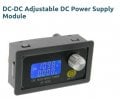
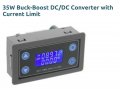
You would be hard-pressed to design anything with the features and performance of these type of modules. A variety of types are available with difference features. They are either a buck regulator or a buck/boost regulator. You supply DC power, then you can set the output voltage with the module, set a current limit, see output voltage and current on the display. Some modules will display power being drawn and energy used over time. Highly recommended!

Buck/Boost Module

Buck/Boost Module

SmartSelect_20230414_061134_Edge.jpgSmartSelect_20230414_061016_Edge.jpg
 

Thread Starter

gregmartin

Joined Mar 17, 2021
7
Indeed these are most likely better designed and cheaper than anything I could make and thanks for the rapid reply although I wanted to learn by the doing and a basic multi voltage power supply seemed a good place to start putting into practice all the theory. I have to work fast now before AI deprives us of all the experimentation (and learning) and satisfaction.
 

ElectricSpidey

Joined Dec 2, 2017
3,317
Personally, I prefer linear supplies on my bench and SMPS in the field to power my projects.

I don't worry about wasting power because I only use the supply when I'm at my bench, and I prefer the pure versatility of a linear supply.

My main bench supply is a home built dual variable 15/15-volt supply using 3 terminal regulators with pass transistors and a center tapped transformer.

I also have other supplies such as a brute force, and a SMPS to test my projects before going into the field.
 

Thread Starter

gregmartin

Joined Mar 17, 2021
7
Personally, I prefer linear supplies on my bench and SMPS in the field to power my projects.

I don't worry about wasting power because I only use the supply when I'm at my bench, and I prefer the pure versatility of a linear supply.

My main bench supply is a home built dual variable 15/15-volt supply using 3 terminal regulators with pass transistors and a center tapped transformer.

I also have other supplies such as a brute force, and a SMPS to test my projects before going into the field.
Thanks for the comment. I think I took the easy way probably involving a little less wiring. And as I'd like to spend some time on RF things the lower noise of 3 terminal regulators may be significant. Also used a laptop (SMPS I suppose) psu as a power source thinking that it would be electrically safe. I'm not sure I'd be able to verify the safety of a mains transformer. When the present item is finished and working I'll have a leftover bunch of 3 terminal regulators to use in future projects.
 

MrChips

Joined Oct 2, 2009
34,714
For lowest noise I would choose a 3-terminal linear regulator.
I would put my faith on a mains transformer being safer that a SMPS any day.
 
Top