Designing a Lights Controller

eetech00

Joined Jun 8, 2013
4,705
Thanks eT,

There's a possibility that the simple solution that I'm seeking doesn't exist. Therefore, I may HAVE to step up to something a little more complicated. :(
Hi

Could be done using all relays but the circuit will be much more expensive.

I've updated the circuit in post #12 to include the output relay circuits. The output contacts will be from small 12v relays.
I'm attaching a PDF of the updated schematic here (might be easier to read).

eT
 

Attachments

Last edited:

Thread Starter

Rabbit H

Joined Aug 5, 2016
153
Blue,

Now THAT'S more my speed! :confused:

Everyone,

Most, if not all, of you have submitted some good proposals of varying technology and complexity. And I appreciate the work that all of you have put into your designs! To say that I appreciate your help would be a mongo understatement!!!

Now comes the hard part; deciding which one to go with! Blue's system with electromechanical relays is more in-line with my original goals of simplicity, easy to troubleshoot and easy to repair. However, ALL of the circuits have opened my eyes to other avenues that, in my stubbornness, I initially passed on. It's going to be difficult to choose one!!!
 
Last edited:

eetech00

Joined Jun 8, 2013
4,705
Blue,

Not THAT'S more my speed! :confused:

Everyone,

Most, if not all, of you have submitted some good proposals of varying technology and complexity. And I appreciate the work that all of you have put into your designs! To say that I appreciate your help would be a mongo understatement!!!

Now comes the hard part; deciding which one to go with! Blue's system with electromechanical relays is more in-line with my original goals of simplicity, easy to troubleshoot and easy to repair. However, ALL of the circuits have opened my eyes to other avenues that, in my stubbornness, I initially passed on. It's going to be difficult to choose one!!!
HI

You haven't stated what your budget is for this project. However, here is another option.

Use a small low cost PLC (Programmable Logic Controller).
They're easy to program, wire and understand for someone who is familiar with relays and electrical control systems (like you :)). They also are designed for industrial environments and have onboard diagnostics for troubleshooting. The unit wouldn't require external interface relays and could be directly connected to the 24 VAC power, inputs and outputs (although you could add relays if desired). You would need to check that it supports the number of timers needed. They are very flexible devices.

A base unit costs about $70 USD, but additional modules might be needed depending on the I/O requirements. You would also need a PC to use for programming.

Here is an example of a PLC that might fit this application:

https://www.automationdirect.com/ad...Series_PLCs_(Stackable_Micro_Brick)/PLC_Units

Even an electrical guy who's VCR flashes for years could program one of these. :D

eT
 
Last edited:

Thread Starter

Rabbit H

Joined Aug 5, 2016
153
eT,

My budget? In Aviation Cost Units (ACUs), $70 is small potatoes. However, when I tried to view/download the base unit's user and programming manual, it's size exceeded the bandwidth capability of my AT&T's internet connection. (Measured in Bytes per Week!!!! Yes, I know, AT&T sucks but unfortunately that's the only service available to us country folks!)

Therefore, I'm already inclined to dismiss this idea before even getting to read about it.

Harvey
 
Last edited:

eetech00

Joined Jun 8, 2013
4,705
eT,

My budget? In Aviation Cost Units, $70 is small potatoes. However, when I tried to view/download the base unit's user and programming manual, it's size exceeded the bandwidth capability of my AT&T's internet connection. (Measured in Bytes per Week!!!! Yes, I know, AT&T sucks but unfortunately that's the only service available to us country folks!)

Therefore, I'm already inclined to dismiss this idea before even getting to read about it.

Harvey
hmmm....oh well...it seems like an excellent solution.

Good luck with your project...

eT
 

Thread Starter

Rabbit H

Joined Aug 5, 2016
153
Wellllllll…

Now that I've replaced our water heater, repaired the air conditioner, and attended to half a dozen other household calamities over the past two weeks, I'd like to get back to my lights controller. Let me tell you: Retirement and age do very little to make changing out a water heater located in a 118 degree attic the fun one would think it would be!!!

* * * * * * *
Blue,

I like the simplicity of your relay-based circuit (post 20). You mentioned that the bottom 4 relays are time delay relays but you didn't give their values.

Harvey
 

blue_coder

Joined May 7, 2016
37
Rabbit,

The first time delay relay would be 2-5 seconds, and just turn on the beacon light, the second time delay relay would be 10-15 minutes and turn the beacon and the windsock lights on, the third time delay relay would be 2-5 seconds and turn on just the beacon light, and a fourth time delay relay (not drawn) would be for 5 minutes and turn on just the obstacle light. After re-reading your original question, the external override I drew on the schematic was incorrect. Instead of there, it needs to cut the power to the second time delay relay to end the 10-15 minutes quicker.

I have only thought this through, not tested anything, so might be worth testing with a couple of stages to check that the principle works before buying a skid load of relays!
 

Thread Starter

Rabbit H

Joined Aug 5, 2016
153
Good Mornin' Blue, thanks for your response.

Your post last night has me a little confused. Maybe it's the way I read it. It sounds like the beacon will be activated after a 2-5 second delay and the beacon and windsock light will both be illuminated after 10-15 minutes?

Maybe things will be clearer if I make my morning coffee stronger coffee! :)

Harvey

PS
I accept your caveat that your design is untested and unproven. I'll duct tape together a trial circuit before permanently gluing everything in place.
 
Last edited:

Thread Starter

Rabbit H

Joined Aug 5, 2016
153
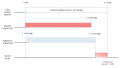
Here's a clearer way to show what I'm trying to accomplish. Note that I've eliminated the ability for a pilot to extend the beacon's "on" time by sending another set of mic clicks prior to system timeout. This feature is unnecessary at our airport and only adds unwanted complication.

Note: "L-854 R3" is a set of SPDT dry contacts within a commercially-produced receiver/decoder unit that initiates beacon activation via a pilot's request in the form of microphone clicks (a.k.a. squelch breaks). Upon receiving and decoding a valid request from a pilot, the 854's output relay (R3) will change state for 1, 15, 30, or 60 minutes (ground-selectable during system installation).

Harvey

upload_2018-8-29_10-15-20.png
 
Last edited:

Thread Starter

Rabbit H

Joined Aug 5, 2016
153
To All,

I feel that I may have unintentionally snubbed a few responders during this thread. Please know that without exception, I appreciate EVERYONE'S inputs and solutions, even the "complicated" :) ones.

Please understand that the majority of my 45+ years of electronics experience ranges from giant US Air Force Early Cold War radar systems (designed in the 1940s & '50's with hardwired vacuum tube technology) and perched on Alaskan mountaintops (see my avatar); to the remarkably smaller Viet Nam-era mobile radars (of the 1970's & later with CMOS technology). While I have NO doubt that today's microcontrollers and other "programmable" systems can do amazing things in a thimble, this is not the technology that I'm familiar or comfortable with, or the kind I want to have to troubleshoot some night in my jammies. :(
 
Last edited:

blue_coder

Joined May 7, 2016
37
It was morning for me being in the UK, so it's possibly my morning coffee which was too weak...

No, the confusion is arising because different time delay relays do different things (turn on after a set period or turn on for a set period). Could you give us some idea what time delay relay you are comfortable/familiar with so that we can base the circuit around that?
 

Thread Starter

Rabbit H

Joined Aug 5, 2016
153
Blue,

Yes, time delay relays are available in an amazing number of modes these days and Zoro has a useful function chart here:
https://d2pbmlo3fglvvr.cloudfront.net/img/zoro_tips/Relay_Function_Guide_eZtip.pdf

I haven't decided on a particular manufacturer and model of time delay relay yet so I'm open to suggestions. However, I'm pretty sure that I don't need the most expensive available with unnecessary features such as built-in LED countdown clocks, time accuracy to .01 seconds. etc. Nor do I want the cheapest (such as HVAC blower timers) that have poor time delay repeatability. I DO want a plug-in relay for ease in troubleshooting and replacement. Sometimes, the cost becomes the ultimate determining factor and I'd like to stay under $50 per relay if possible. Ideally, all of the relays would be the same style/part number so I would only have to keep one spare on hand.

Harvey

 
Last edited:
The :02 probably would be done separately with another one of the relays and the blue pink relationship done the same way.

Stage 1 is the trigger as i understand it and hopefully, you can stop it early with the top signal. It looks like In2 can control the first timer too.

MAYBE, if you set R3 to something smaller and use another device for the 15 min interval. you can process a re-trigger correctly.

Thoughts.
 
Last edited:

eetech00

Joined Jun 8, 2013
4,705
Here's a clearer way to show what I'm trying to accomplish. Note that I've eliminated the ability for a pilot to extend the beacon's "on" time by sending another set of mic clicks prior to system timeout. This feature is unnecessary at our airport and only adds unwanted complication.

Note: "L-854 R3" is a set of SPDT dry contacts within a commercially-produced receiver/decoder unit that initiates beacon activation via a pilot's request in the form of microphone clicks (a.k.a. squelch breaks). Upon receiving and decoding a valid request from a pilot, the 854's output relay (R3) will change state for 1, 15, 30, or 60 minutes (ground-selectable during system installation).

Harvey
Hello again :)

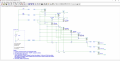
Here is a circuit based on my understanding of the timing diagram.
There is still a question, however, on the OL Timer. Is this a fixed duration? Or adjusted by the duration of the L854 Timer?

Anyway, I've shown 24VAC relays throughout the circuit and the timing cycle is initiated by the "L854-ST" start relay energized by the L854 contactor. I've also included a manual shutdown function since it wasn't clear if this was still wanted. A manual shutdown immediately shuts off the Beacon and Floodlight, and turns on the Obstacle light.
A "Reset" timer relay is included to allow adjustment of the duration required for all relays to return to the de-energized state.

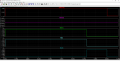
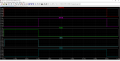
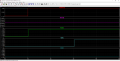
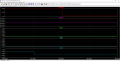
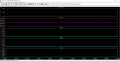
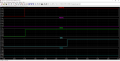
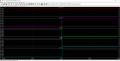
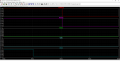
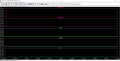
I've attached a schematic and two groups of timing graphs. One group shows auto-shutdown sequence and the other shows manual shutdown sequence. I tested the logic using the LTspice simulator so all time durations are shown is seconds.

See schematic attached.

AirportTimer-MSHDN-AC-2-Ckt.png

In each of the following graphs, L854 start begins at 1second. I've attached snapshots of each sequence at "state change" points of interest.

Auto-shutdown sequence.

000s-1000s-ASHDN.png

Manual-shutdown sequence.
In this sequence, manual shutdown is intiated at 5min (300s).

000s-1000s-MSHDN.png
 

Attachments

Last edited:

Thread Starter

Rabbit H

Joined Aug 5, 2016
153
E-Tech,

Would the parts count and system complexity be reduced if we used the 15 minute dropout of the receiver/decoder's R3 to terminate the obstacle lights?

Harvey
 

eetech00

Joined Jun 8, 2013
4,705
E-Tech,

Would the parts count and system complexity be reduced if we used the 15 minute dropout of the receiver/decoder's R3 to terminate the obstacle lights?

Harvey
Hi

I don't understand the problem being solved..What does the R3 decoder timeout replace?

eT
 

Thread Starter

Rabbit H

Joined Aug 5, 2016
153
It looked like your circuit turned the obstacle light off with its own time delay relay. I just thought that since the L-854 R3 contacts were already opening about the same time...

Or did I misinterpret your schematic?

Harvey
 

eetech00

Joined Jun 8, 2013
4,705
It looked like your circuit turned the obstacle light off with its own time delay relay. I just thought that since the L-854 R3 contacts were already opening about the same time...

Or did I misinterpret your schematic?

Harvey
Oh...I see...but then when should the OL turn on?

eT
 

Thread Starter

Rabbit H

Joined Aug 5, 2016
153
The Ob Light should turn on at the end of the windsock light period (T + 12:02) until the end of the shutdown sequence at T + 15, which is conveniently provided by the end of the end of the Receiver/Decoder's L-854-R3 enable gate.

Harvey
 
Top