Facebook
 Google
 GitHub
 Linkedin
Hi everyone!
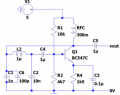
I am currently embarking on a project where I will design an ultrasound device that can Measure both the wall thickness and blood flow speed in the artery. The ultrasound transducers that I will be using resonate at 5Mhz. Therefore I have to produce a 5 MHz wave at a certain voltage to drive the transducer. After doing some reading i designed a Colpitts oscillator circuit at a 5 MHz corner frequency. Here is a model i produced on LT spice.
I understand that this circuit may not produce the most stable 5Mhz waveform, however I am quite committed at this point to make it work. The problem i am coming to is that this waveform needs to be pulsed for the ultrasound imaging to work. I have calculated that it needs to transmit for 0.6 microseconds (3 wave cycles) and then the ultrasound device has to flip to receive for 20 microseconds for all the necessary "echoes" to return.
My questions are:
How do i go about transmitting an receiving for this time? some sort of T/R switch?
What voltage Vpp should i want to amplify my drive signal too? And how would i go about amplifying the signal, an RF amplifier?
Any help would be much appreciated
I am currently embarking on a project where I will design an ultrasound device that can Measure both the wall thickness and blood flow speed in the artery. The ultrasound transducers that I will be using resonate at 5Mhz. Therefore I have to produce a 5 MHz wave at a certain voltage to drive the transducer. After doing some reading i designed a Colpitts oscillator circuit at a 5 MHz corner frequency. Here is a model i produced on LT spice.
I understand that this circuit may not produce the most stable 5Mhz waveform, however I am quite committed at this point to make it work. The problem i am coming to is that this waveform needs to be pulsed for the ultrasound imaging to work. I have calculated that it needs to transmit for 0.6 microseconds (3 wave cycles) and then the ultrasound device has to flip to receive for 20 microseconds for all the necessary "echoes" to return.
My questions are:
How do i go about transmitting an receiving for this time? some sort of T/R switch?
What voltage Vpp should i want to amplify my drive signal too? And how would i go about amplifying the signal, an RF amplifier?
Any help would be much appreciated