Designing a Circuit that when a force sensor is at a specific value and LED is turned on using a comparator

tonyStewart

Joined May 8, 2012
238
The minimum recommended supply voltage for the 741 is 20 V (±10 V) and, with a 2 kΩ load, is only spec'ed to be able to get within 5 V of either supply rail.

If this thing did manage to get to 5 V output, and assuming a 2 V LED forward voltage, it would be asking the 741 to deliver 30 mA when it's short-circuit output (of the LM741A) is spec'ed at a minimum of only 10 mA.

Asking it to deliver even 10 mA to a 2 V LED is requiring it to get within 2 V of the supply rail, when it typically can do that only when it is delivering about 6.5 mA.

Now, certainly most parts out of the bin outperform their spec'ed limits -- it has to be that way, otherwise the manufacturer's yield would be unacceptable. But if you happen to get a part that works when exceeding several of the specs this significantly, you are being lucky and there is certainly no guarantee that the next part you get will work.

It's a bad design for that choice of opamp (actually, it's just a bad choice of opamp, period). If the TS can't use a more suitable opamp, they would probably be better off using discrete transistors.
I agree Vcc=5V and 300 mV hysteresis will work fine but adds to the hysteresis of the force sensor to the lack of precision.

If you can make it work with a uA741, you can make it work with anything better.
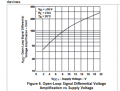
I have simulated it with the discrete version of the uA741 and it works fine from 4 V (+/-2) as shown in the plot below from TI specs, as long as your input Vcm is centred. The +/-Vcc is very gain sensitive as shown but just shy of 40k at +/-2.5V below.
The supply = +/-5V min is just "recommended" for ease of use.
1720916169673.png
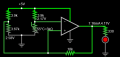
The high-side current limit is slightly more than the pull-down limiter.
The saturation limits of the Op Amp affect the hysteresis thresholds, so changing parts will affect that. Hysteresis is optional.
1720916762675.png
Proof with 741 sim https://tinyurl.com/26nzfpol
 

MisterBill2

Joined Jan 23, 2018
27,748
FIRST, the 741 opamp design is 50 years old, so it is a poor choice for any design.
SECOND, using an op-amp as a comparator is a poor choice in most instances and this is one such instance.
Third, using a device at far below the supply voltage for it's specifications means that none of the performance specifications may be applicable.
I realize that your school may have received a whole lot of 741 op-amps, and certainly they are less likely to be damaged by static electricity, but their specifications are so far obsolete that you are getting an obsolete education.
 

sghioto

Joined Dec 31, 2017
8,687
I think that some of you haven't realized that the circuit was constructed in simulation only.
As the TS said: "but this is not going to be made into a real circuit. So a lot of problems experienced with real components do not matter thankfully".
 

WBahn

Joined Mar 31, 2012
32,973
I think that some of you haven't realized that the circuit was constructed in simulation only.
As the TS said: "but this is not going to be made into a real circuit. So a lot of problems experienced with real components do not matter thankfully".
And I acknowledged that, saying that it was regrettable that he didn't care about whether it would work in the real world and added, for the record, that it likely wouldn't, to which you said it would.
 

sghioto

Joined Dec 31, 2017
8,687
OK, sure I accept that.
The reason I said it would is because I breadboarded the circuit and it did function as designed using a 741.
 

sghioto

Joined Dec 31, 2017
8,687
On a side note, for this simple circuit if built I would choose a LM358. It's 50 years old but still going strong as the venerable 555.
 

WBahn

Joined Mar 31, 2012
32,973
OK, sure I accept that.
The reason I said it would is because I breadboarded the circuit and it did function as designed using a 741.
And I noted that all manufacturers design their parts to do considerably better than the specs in order to get acceptable yields, so it's not surprising that it happened to work with one.

I breadboarded it and tried three different 741s (which is all I have left) and it worked for two of them, but not the third. Even with just a DMM as the load, the third one only pulled up to 3.2 V.
 
Top