design an RC snubber for ac solenoid lock ( inductive load)

Thread Starter

Marcodavid

Joined Aug 1, 2022
39
Dimmers are normally rated for resistive loads, not inductive.
Even so, that dimmer will still blow up since underrated... your load is 1500W


why not pick next common value such as 47 Ohm of suitable power?


not sure how you got that C value...
using those same numbers i get 77.5uF


your capacitor need to be rated for voltage higher than the circuit will experience.
yes capacitor will need to be non-polar. if you ever find ceramic capacitor with those specs, please share the photo of it, preferably next to some object for size reference.


snubber would work either way since mains side is low impedance. but if you place the snubber across switch, there will be current through load all the time even if switch is open.
Thanks for your useful reply

So even my i get 2000watt dimmer will blow up since the dimmer rated to resistive loads (can not never use dimer with inductive load)?
______________
I chose 44 ohm as i want the max voltage is 220v
V=ir = 5*44 =220v
___________
Yes it is 77 sorry for wrong calculation
___________
There is no ceramic capacitor with this spec

So how to calculate the capacitor value?
 

MisterBill2

Joined Jan 23, 2018
27,998
Guys

I took a decide to make this solenoid in the simplest, lowest cost way and using just AC current (so the how circuit will be in AC current only)

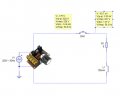
My problem is how to make snubber RC circuit
Not converting Ac to Dc

Dimmer will work even on Ac and Dc, i will add this to my AC current

The problem here is iam afraid of this dimmer getting damage so i want to design RC to protect it

So please let focus on how to add snubber RC and what is the calculations around it
If you us an adequately rated switch for powering this lock device, which I am guessing will only be a momentary pulse to operate it, you will have no need of a snubber. That is because an adequately rated switch for a ten amp inductive load will have enough mass in the contacts to withstand the spark when the button is released. And certainly you intend for the operation to only be momentary, similar to other electrically released latches.

Usually the simplest lowest cost and easiest way to make something one time, that will be used many times after that, is a very poor choice. So now I am wondering if this device is something different from a lock, possibly a trigger
 

DickCappels

Joined Aug 21, 2008
10,662
From the IP address, the thread starter is unlikely to have English as their first language, and that might be the root of what seems to be poor comprehension. A little patience will probably be very helpful right now.
 

MisterBill2

Joined Jan 23, 2018
27,998
From the IP address, the thread starter is unlikely to have English as their first language, and that might be the root of what seems to be poor comprehension. A little patience will probably be very helpful right now.
I am not privy to anybodies IP address. And the revised "information has removed the location data, unfortunately.
 

Thread Starter

Marcodavid

Joined Aug 1, 2022
39
If you us an adequately rated switch for powering this lock device, which I am guessing will only be a momentary pulse to operate it, you will have no need of a snubber. That is because an adequately rated switch for a ten amp inductive load will have enough mass in the contacts to withstand the spark when the button is released. And certainly you intend for the operation to only be momentary, similar to other electrically released latches.

Usually the simplest lowest cost and easiest way to make something one time, that will be used many times after that, is a very poor choice. So now I am wondering if this device is something different from a lock, possibly a trigger
Yes excatly it will work as trigger momentary pulse and i know the button will stand with the spike
But the will 2000w scr voltage regulator stand with this transient?
That is the problem
If 2000w scr voltage regulator will stand without need snubber or will need snubber?
 

MisterBill2

Joined Jan 23, 2018
27,998
Why do you want to use a voltage regulator, if the solenoid was designed to operate from the 220 volt mains? If the goal is to reduce the power you can simply add a power diode in series and cut the power by half. The diode will need to be rated for at least 400 reverse volts and at least ten amps forward current. With no filter capacitor the current will still be AC and so the reactance will still limit the current. A power diode will need a bit of heat sink, but even aat ten amps the diode will only dissipate 7 watts or so.
 

Thread Starter

Marcodavid

Joined Aug 1, 2022
39
Solved the problem

Actually i did not note that the regulator will be placed before the button so when the button is open the transient will stop at the button before to reach the regulator so the input and output to regulator will remain without getting very high voltage (kv).

One other thing the regulatory is marked to less 1000w while my design will give about
5*220= 1100 watt (bit more or less) so i want to exchange this for 1500 watt regulator

Misterbill2, yes i want to use regulator to control the power, i have not much experience with diode but i think using diode will not be a good controller like regulator.
 

Attachments

MisterBill2

Joined Jan 23, 2018
27,998
Using a diode is not adjustable, that is true. BUT you can easily look up tyhe complete specifications of the diode and know exactly what you are doing. With that lighting controller from amazon you will know the price and the shipping weight.
 

shortbus

Joined Sep 30, 2009
10,049
the purpose of using all this large and powerful solenoid is i am making something like a "kick" solenoid need it to move strongly and kick things
That quote from very early in the thread is a problem, to me any how. "Kick" solenoids aren't simple since most solenoids "pull" not kick.
 

MisterBill2

Joined Jan 23, 2018
27,998
OK, now a"kick" solenoid. I am guessing that means very fast action with a lot of force.
Now let me quote from post #1:
"I am designning ac solenoid lock, read the inductive load needs snubber circuit to protect from inductive turnoff transients"
Thus I am a bit confused.
 

shortbus

Joined Sep 30, 2009
10,049
Now let me quote from post #1:
My post came from his second post #5. You see the term "kick" different than me. When I kick something, I don't pull it to me, it gets pushed away not pulled.

I have to watch what II say in this thread or it will disappear again.
 
Top