Design a low power cut off

Thread Starter

seanlin96

Joined Feb 3, 2019
16
I am trying to design a circuit which cuts off all power when battery voltage drops below 11.8V and come back on when voltage is over 13V. I have done research but still unable to design a circuit. The input voltage is 12V. Any help will be great, thanks!
 

ericgibbs

Joined Jan 29, 2010
21,390
hi 96,
Welcome to AAC.
A dual LM393 Window comparator circuit, driving a Transistor/relay switch , would be one option.
Are you able to acquire LM393 comparators, etc .. at your location.?
E

Look at page #10, Limit Comparator, of this PDF
 

Attachments

crutschow

Joined Mar 14, 2008
38,316
Edit: Late edit, but I just realized from another thread, that the circuit below stresses the TLV431 well above its 7V max cathode voltage.
You would need to use a TL431 instead, with modified resistor values.


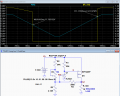
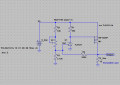
Below is the LTspice simulation of a low battery cutoff circuit.
It uses a TLV431 low-power voltage-reference IC as a comparator, driving a high-side power P-MOSFET to switch the load voltage.
The P-MOSFET is ON when the TLV431 Ref voltage is above 1.24V, and OFF when it is below 1.24V, as determined by the resistor divider network at that node.
Pot U2 adjusts the trip point and R4 adjusts the hysteresis (difference between high and low voltage trip points).
The simulation shows a lower trip point of 11.79V and and upper trip point of 13.1V for the 50% pot setting and resistor values shown.

The circuit maximum current drawn from the battery is about 1/2 mA.

The maximum load current is determined by the MOSFET used.
To avoid the use of a heatsink, select a P-MOSFET with an ON resistance low enough to keep the transistor dissipation below about a watt for the maximum load current (Rds(on) ≤ 1 / Ild²).

upload_2019-2-4_0-38-7.png
 
Last edited:

danadak

Joined Mar 10, 2018
4,057
Of course the problem with some circuit designs is their need for minimum Vbatt to
run the detection circuitry.

Some UPs have the ability, when min Vdd power not available, to keep their
logic outputs in a known state, usually tri-state. With an external pulldown that re-
sults in a known logic level, in this case "0", even when detection circuitry is not
powered properly.

Just another consideration to worry about :) It may or may not be a concern, you decide.
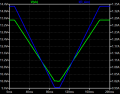
The point being you can use a small UP (if speced for it) to properly handle brownout
detection and control over the entire range of power being monitored.


Regards, Dana.
 
Last edited:

crutschow

Joined Mar 14, 2008
38,316
The circuit in post #3 will operate down to the Vgs minimum ON voltage of the P-MOSFET being used, plus 1V.
For the minimum operate voltage you could use a PNP BJT instead of the MOSFET which reduces the minimum battery voltage to about 2V.
 
Last edited:

Thread Starter

seanlin96

Joined Feb 3, 2019
16
Below is the LTspice simulation of a low battery cutoff circuit.
It uses a TLV431 low-power voltage-reference IC as a comparator, driving a high-side power P-MOSFET to switch the load voltage.
The P-MOSFET is ON when the TLV431 Ref voltage is above 1.24V, and OFF when it is below 1.24V, as determined by the resistor divider network at that node.
Pot U2 adjusts the trip point and R4 adjusts the hysteresis (difference between high and low voltage trip points.
The simulation shows a lower trip point of 11.79V and and upper trip point of 13.1V for the 50% pot setting and resistor values shown.

The circuit maximum current drawn from the battery is about 1/2 mA.

The maximum load current is determined by the MOSFET used.
To avoid the use of a heatsink, select a P-MOSFET with an ON resistance low enough to keep the transistor dissipation below about a watt for the maximum load current (Rds(on) ≤ 1 / Ild²).

View attachment 169387
Thank you very much crutschow! I will try this out today!
 

Thread Starter

seanlin96

Joined Feb 3, 2019
16
Below is the LTspice simulation of a low battery cutoff circuit.
It uses a TLV431 low-power voltage-reference IC as a comparator, driving a high-side power P-MOSFET to switch the load voltage.
The P-MOSFET is ON when the TLV431 Ref voltage is above 1.24V, and OFF when it is below 1.24V, as determined by the resistor divider network at that node.
Pot U2 adjusts the trip point and R4 adjusts the hysteresis (difference between high and low voltage trip points.
The simulation shows a lower trip point of 11.79V and and upper trip point of 13.1V for the 50% pot setting and resistor values shown.

The circuit maximum current drawn from the battery is about 1/2 mA.

The maximum load current is determined by the MOSFET used.
To avoid the use of a heatsink, select a P-MOSFET with an ON resistance low enough to keep the transistor dissipation below about a watt for the maximum load current (Rds(on) ≤ 1 / Ild²).

View attachment 169387
Hi, I am having trouble getting a potentiometer, U2. I tried using a 10k resistor but am getting "Time step too small; initial timepoint: trouble with node x". Is it possible for you to attach a spice model for me?
 

Thread Starter

seanlin96

Joined Feb 3, 2019
16
You can use a 5kΩ resistor since the pot was set to the 50% point.
Attached is the pot model and symbol.
Hi again, I now have the same circuit as you. I used the Ltspice inbuilt IRF7309P and found a TLV431.lib online. However, my I(R_Sim) is different to yours. I suspect the TLV431 model I'm using is the issue. I have attached the TLV431.lib file I used. upload_2019-2-5_11-4-35.png upload_2019-2-5_11-5-40.png
 

Attachments

Thread Starter

seanlin96

Joined Feb 3, 2019
16
Okay
When Ref voltage passes 1.24v the output should change state.
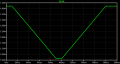
From the screenshot below, the J period for output voltage (green trace) from point 2 to point 1 should have been horizontal and constant, then after point 1 when Vref drops below 1.24 volts, Vout should have dropped as well, is that correct?
upload_2019-2-6_11-58-10.png
 

crutschow

Joined Mar 14, 2008
38,316
when Vref drops below 1.24 volts, Vout should have dropped as well, is that correct?
Correct.
Since it's not doing that, you LMV431 model appears to be operating incorrectly although it appears to be the same model I'm using.
What is the voltage at the MOSFET's gate doing?
 

Thread Starter

seanlin96

Joined Feb 3, 2019
16
Correct.
Since it's not doing that, you LMV431 model appears to be operating incorrectly although it appears to be the same model I'm using.
What is the voltage at the MOSFET's gate doing?
This is the gate voltage of the MOSFET. I used a TLV431 not LMV431. Can you please attach the model of the voltage regulator you used to generate? Thank you for the continuous help you are providing me, I really appreciate it.
upload_2019-2-6_15-15-19.png
 

Thread Starter

seanlin96

Joined Feb 3, 2019
16
You show a few μV of gate voltage which makes no sense. :confused:

The TLV431 model I used is the same as the one you posted.
See attached.
I completely re drew up a circuit using your tlv431 and the circuit you provided earlier, and now it works! Thank you very much Crutschow!
 
Top