Demodulator IC substitute

Thread Starter

cmartinez

Joined Jan 17, 2007
8,760
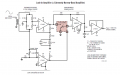
Does anyone know of a chip that could be used as an alternative to the AD630 being used in this circuit?
The sucker costs more than $20 bucks and my wallet's been hurting a little bit these past few weeks.
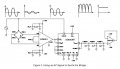
Capture.JPG
 

ian field

Joined Oct 27, 2012
6,536
Does anyone know of a chip that could be used as an alternative to the AD630 being used in this circuit?
The sucker costs more than $20 bucks and my wallet's been hurting a little bit these past few weeks.

View attachment 86673
On the datasheet, the simplified schematic looks like it could be a close relative of the Gilbert cell.

There were various chips around in the 80s & 90s, like the TBA120, and the SO41P, there was a similar DBM chip from Motorola - the MC1495, give or take a last digit.
 

Thread Starter

cmartinez

Joined Jan 17, 2007
8,760
Thanks crutschow for the tip, I'll certainly look into it.
Ian, the only chip I could find is the MC1496, which looks promising too. Thanks!
 

Tesla23

Joined May 10, 2009
560
Alright... first tough question...
How am I to connect the MC1496 so that it can substitute the AD630 in the previous circuit? I can't make heads from tails out of it....
It's probably easier to use an op-amp to invert the signal and then use a CMOS switch to toggle between the original and inverted signal at the modulating rate. Google 'synchronous detector' and look at the images for some ideas.

Here's an example from the LTC1043 datasheet, of course you now have to worry about balance and offsets (things that ADI did for you in the AD630). I've had success using cheap 4066 and 4053 switches and cheap op-amps to invert the signal and filter the result, but it all depends on your requirements.

syncDet.PNG
 

crutschow

Joined Mar 14, 2008
38,503
Alright... first tough question...
How am I to connect the MC1496 so that it can substitute the AD630 in the previous circuit? I can't make heads from tails out of it....
I think you would use the basic Product Detector circuit shown in Figure 28 in the data sheet.
The input and output coupling capacitor values may have to be increased, depending upon the frequency of the signal and the 51Ω resistor at pin 10 should be increased to 1kΩ

Note that the output has a DC bias level so it must be capacitively coupled. The signal out of this capacitor will thus need to be clamped to ground to give an average value other than zero when it goes through the low-pass filter (since the desired signal is the average signal magnitude, but any signal going through a capacitor has an average DC value of zero).
This can be done by connecting the capacitor output directly to the inverting input of a rail-rail op amp with a diode from the op amp output (anode) to the inverting input.
Connect the non-inverting input to ground.

That circuit will act as a near ideal diode clamp (also known as a DC restore circuit), clamping the negative peak of the signal to very near ground. The output from the LP filter will then be the positive average magnitude of the AC demodulated wave, the same as the AD630 circuit would give.
 
Last edited:

ian field

Joined Oct 27, 2012
6,536
Alright... first tough question...
How am I to connect the MC1496 so that it can substitute the AD630 in the previous circuit? I can't make heads from tails out of it....
The simplified schematic bears some resemblance to the Gilbert cell at its core, but I think AD have dressed it up to disguise it as much as possible.

They want you to buy their very expensive part - not the much cheaper 1496.
 

crutschow

Joined Mar 14, 2008
38,503
ahhh.... an evil conspiracy from Big Electronics... why am I not surprised?
Let's not get paranoid. :rolleyes:
The AD630 is more complex to allow it to operate down to DC with a low DC offset.
The MC1496 is an old chip, designed for AC in and out only, so has a much simpler circuit. That naturally makes it cheaper.
 
Last edited:

ian field

Joined Oct 27, 2012
6,536
Aha!... I just knew it!!! you're one of them!!! :p

Seriously now, thanks for the advice. I'll build the circuit in fig 28 and see how it behaves.
Thanks again!
AD know what the market place will stand.

There are always options - but designing your own IO circuitry means more components and PCB area.

Whether you can save much by choosing a cheaper and simpler device depends a lot on your ingenuity.
 

crutschow

Joined Mar 14, 2008
38,503
Well, it's half the price... which is a significant improvement. But which circuit should I use? The Linear Amplitude Modulator shown in pg 10 of its datasheet?
No, you want to use it as a product demodulator/detector.
You simply connect it as a Basic Multiplier as shown in Figure 12 on page 9 with the carrier to one input and the amplified bridge output to the other.
The output is the product of the two inputs, so you will get an output for the in-phase part of the two signals that looks like a full-wave rectified signal of the bridge output.
The filtered average of that is a DC signal proportional to the bridge imbalance.
 

Thread Starter

cmartinez

Joined Jan 17, 2007
8,760
No, you want to use it as a product demodulator/detector.
You simply connect it as a Basic Multiplier as shown in Figure 12 on page 9 with the carrier to one input and the amplified bridge output to the other.
The output is the product of the two inputs, so you will get an output for the in-phase part of the two signals that looks like a full-wave rectified signal of the bridge output.
The filtered average of that is a DC signal proportional to the bridge imbalance.
So the carrier (the AC excitation voltage) would be connected to +X (-X to ground), and the AD8221 output to +Y (-Y to ground) Is that it?
 

crutschow

Joined Mar 14, 2008
38,503
So the carrier (the AC excitation voltage) would be connected to +X (-X to ground), and the AD8221 output to +Y (-Y to ground) Is that it?
That's it, along with the Z input to ground and power.
The output (W) is then (X*Y)/10.

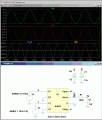
Below is an LTspice simulation:
The AD633.sub file goes in the LTC sub directory.
The AD633.asy file goes in the LTC sym/Misc directory

Demod.gif
 

Attachments

Last edited:

Thread Starter

cmartinez

Joined Jan 17, 2007
8,760
That's it, along with the Z input to ground and power.
The output (W) is then (X*Y)/10.
Verrrrrrrryyyy interrrrrresting.... That means that I can replicate any linear function that I want with this thing... like y = mx + c ... and some others, as I can tell from the datasheet. I can think of several other uses for this chip already.
Thanks!
 
Top