Demodulator IC substitute

Thread Starter

cmartinez

Joined Jan 17, 2007
8,759
No. A single resistor goes in series with the amplifier output and then to the diodes which connect directly to ground and V+ with no other resistors.
I see... I've already googled that and that's what I found... but then I tried to sim it, and it seems that the diode's voltage drop prevents it from clipping the voltage at exactly 5V. On the other hand, it is my understanding that a resistor in series to the ADC's input is a big no-no since the signal should to be as low impedance as possible.

Is there a more accurate way of accomplishing this? such as using a comparator with one input to the supply and the other to the InstAmp's output, and then switch a transistor (or mosfet) that will clip the voltage or something similar?
 

crutschow

Joined Mar 14, 2008
38,503
Inputs typically already have protective diodes so you likely don't need to add any, the external ones are just additional protection. The inputs will actually tolerate up to one diode junction drop above and below the rails and Schottky diodes conduct before junction diodes.

A small series input resistance will have little effect on the ADC response unless you have a very high speed ADC. The limit is the time it takes to charge the input capacitance and sampling charge through the resistor and for resistor values below 1kΩ, that's a very short time.
 

Tesla23

Joined May 10, 2009
560
On the other hand, it is my understanding that a resistor in series to the ADC's input is a big no-no since the signal should to be as low impedance as possible.
You can't do analog design simply by rules of thumb - or 'big no-no's'.

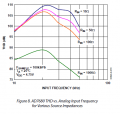
You need to read the datasheet - it will tell you what sort of source impedance you need for the ADC. It says that the source impedance affects the SNR and THD, they only give you details for the THD:
sourceR.PNG
which suggests that you can put a 100R resistor in series with little performance degradation.

Of more concern is possible damage to the device:

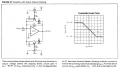
Figure 13 shows an equivalent circuit of the analog input structure of the AD7680. The two diodes, D1 and D2, provide ESD protection for the analog inputs. Care must be taken to ensure that the analog input signal never exceeds the supply rails by more than 300 mV. This causes these diodes to become forward-biased and to start conducting current into the substrate. The maximum current these diodes can conduct without causing irreversible damage to the part is 10 mA.

Schottky diodes are probably adequate to protect these, but the requirements are not exactly clear. Ensuring that the input is clipped at 300mV above the rail may be hard with a 100R source resistor, and you certainly can't limit the current to 10mA with a 100R. If you can get the performance you need with a 1k series resistor then you are probably OK, otherwise you may need to look at using a rail-rail amp as a buffer.

BTW you have never told us what sort of performance you need, what sort of resolution you are looking at?
 

Thread Starter

cmartinez

Joined Jan 17, 2007
8,759
You can't do analog design simply by rules of thumb - or 'big no-no's' .... BTW you have never told us what sort of performance you need, what sort of resolution you are looking at?
Thank you Tesla, I can tell that you're making an effort with me that goes beyond the call of patience, and I am very grateful for that.

Maybe it would be best if I told you about my background: I am a mechanical engineer with 25 years of experience in machine design, but I am self-taught in the field of electronics. I think I've pretty much got the hang of digital electronics (I'm an expert in the 8051 architecture, and I always do my programming in assembly), but analog is my big, humongous weakness, and I have little experience in that field compared with you and crutschow... but I'm still learning and trying to improve as much as I can, which is a lot easier when people like you go out of their way to help me.
I do read the datasheets, but my attention is normally focused on the working ranges and capabilities of what a part is supposed to do. So I pay attention to the text and tables, but I've seldom had to consult the graphs... I now know that ADCs are a universe in their own right, and attention to detail is crucial if one wants to extract the full capabilities of a component.

Now, regarding your question. I've used the AD7680 before with lots of success. Specifically with a project involving the reading a k-type thermocouple, in which I was able to extract the AD7680 full 16-bit resolution by doing multiple measurements and averaging the results before reporting them. This is a lot easier to do with this chip since it is capable of doing 100,000 conversions per second. One thing I found out the hard way about this chip is that it is extremely sensitive to the high temperatures involved during soldering, so care must be taken to set the work station at the correct temperature, and use the right solder for the job.

I want to extract the maximum resolution out of a 2Kg load cell that delivers 1.5mV/V (check the specifications tab in the page). This cell has an hysteresis of 0.02%. That is 2 parts out of 10,000, or 1 part out of 5,000... in theory then, a resolution of 13 bits should pretty much cover their capability, so maybe demanding full 16-bit resolution out of this thing is moot... but I'm going to try anyway and see what's the best I can do...

What do you think would be the best way to limit (clip) the voltage going into the AD7680? Could a circuit involving a comparator be used for this purpose?

Thanks again for your help.
 
Last edited:

Tesla23

Joined May 10, 2009
560
Thank you Tesla, I can tell that you're making an effort with me that goes beyond the call of patience, and I am very grateful for that.

Maybe it would be best if I told you about my background: I am a mechanical engineer with 25 years of experience in machine design, but I am self-taught in the field of electronics. I think I've pretty much got the hang of digital electronics (I'm an expert in the 8051 architecture, and I always do my programming in assembly), but analog is my big, humongous weakness, and I have little experience in that field compared with you and crutschow... but I'm still learning and trying to improve as much as I can, which is a lot easier when people like you go out of their way to help me.
I do read the datasheets, but my attention is normally focused on the working ranges and capabilities of what a part is supposed to do. So I pay attention to the text and tables, but I've seldom had to consult the graphs... I now know that ADCs are a universe in their own right, and attention to detail is crucial if one wants to extract the full capabilities of a component.
Sorry if I was a bit brusque, I wasn't trying to offend, simply to say what did and didn't work.

As far as driving your ADC, why not a simple solution like the AD8601 running from 5V, with a 1-2k series resistor at the input.

I think you would benefit from analysing the limitations on the performance of your design. I've had a quick look at it, please understand that I've never used a load cell so I may have missed some of the device's idiosyncrasies.

The maximum differential voltage appearing at the input of the AD8221 is a ±7.5mV square wave at 420Hz, superimposed on a common mode voltage which is a ±2.5V square wave. You want to measure the differential voltage to an accuracy of 0.02% of 7.5mV, or 1.5uV. To do this the AD8221 has to have a common mode rejection sufficient to make the 2.5V equivalent to less than 1.5uV RTI (referred to input). This is 124dB, clearly a tough spec. (In other words, if I connect both inputs of the AD8221 together and drive them with a ±2.5V square wave, I want an output from the AD8221 significantly less than what I get for a 1.5uV differential signal across the inputs). If I allow a margin of 10dB, then the common mode signal would limit your accuracy to 0.006%, so lets aim for a CMRR of 134dB (=124+10).

Looking at the AD8221 datasheet you see that for a gain of 100, typically the CMRR RTI is 140dB, looking promising, but the spec table tells you that for the A device it is only guaranteed to be 120dB and the B device 130dB. This suggests that you want the B device not the cheaper A one, and even then you may be marginal.

What is more concerning is the frequency response of the CMRR, it rolls off at 100Hz. You are using a 420Hz square wave, so you may only get 124dBish for the fundamental, and less for the harmonics.

How detrimental is the common mode signal? I'm not sure - it will provide an offset which will be removed by the tare operation, but trying to avoid the need to tare is probably the reason for using the chopping, but if you don't get it right you are only going to add another offset to be 'tare'd out'. I also have no idea how stable the offset introduced from the CMRR is.

So why you are chopping the signal to the bridge and how did you decide on the frequency?

Also note that doing the synchronous demodulation in software effectively wastes one bit of your ADC, but your averaging should be increasing your ENOB past what you need.
 

Thread Starter

cmartinez

Joined Jan 17, 2007
8,759
Thanks for your elaborate response, Tesla. I sincerely appreciate it.

This little project of mine is in a more advanced state than it seems, since this thread is but one of three that I opened to treat specific issues about the design I'm trying to implement. In the past, I've used a differential 24-bit ADC from Intersil that proved to be a nightmare to interface to and to use properly. I put a considerable amount of work in it, only to be bugged by constant glitches and strange behavior that I later found out was due mostly to my lack of experience. And the rest of the problems were caused by the chip's own characteristics and limitations. So what I did next was to use a less ambitious chip, that's the AD7680, as you already know. And I was quite pleased with it's performance.

To answer your questions:
I want to excite the load cell using AC because in my previous experience I was never quite able to cancel drift due to changes in temperature, connector and cabling thermocoupling, and also drift natural to the chips themselves. Then I read that the answer lied in AC excitation, since the constant change in polarity when taking those measurements naturally canceled those effects.
To accomplish that, I had to first develop a circuit for a positive-negative current-boosted voltage reference, that @OBW0549 very generously helped me design. I would've never been able to accomplish that without his help. I've worked with VR chips before, and I know that they're extremely stable over time and temperature. I am very much satisfied with the results.

The positive part of that voltage reference will not only be exciting the load cell, but will be powering the instrumentation amplifier I plan to use, and the ADC chip itself. That way, any drift manifested in the voltage reference will be spread to all the analog circuitry involved in an equal way and will therefore not affect the readings.

Now, I've been having a very interesting discussion in another thread with OBW0549 and @joeyd999 about the so-called advantages of AC excitation, and so far they both agree that it's probably better and simpler to use a chopper-stabilized, auto-zeroing instrumentation amplifier for this purpose instead..... aaaaandddd I have to admit that they're probably right... if anything, I trust not only their knowledge, but have the highest respect for their experience as well...

So what I'm going to do is perform a plan B in case this experiment of mine doesn't meet my expectations. And that plan is to do exactly what OB and Joey have suggested.... But let's hope it doesn't come to that... it would crush my ego and severely affect my self-esteem... :p

Now, why did I choose a 420 Hz AC excitation frequency? Because 420 is a multiple of 60, and I'm under the impression (read: I'm not sure) that that will help minimize noise induced from the presence of EMFs radiated by mains.
 
Top