Facebook
 Google
 GitHub
 Linkedin

Consider your first transformation below:
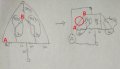
It is usually helpful to label nodes in both circuits and sanity check that the work makes sense. In the left diagram Nodes A and B are quite distinct, but in the circuit at the right you have them shorted together.
Also note that those horizontal 20 Ω resistors in the left diagram are connected directly to the very top node, but that you haven't preserved this relationship in your transformed circuit, but you have connected the 80/3 Ω resistors directly to the top node when that is not how they are connected in the original circuit.
The bottom line is that you've actually made quite a hash of this transformation. Sorry I didn't look more closely the first time around.
One trick that you can use on a circuit like this is to take the top resistor and split it into two resistors that are twice the size but are in parallel. The you can use one of them for the left half and one for the right half.
It is usually helpful to label nodes in both circuits and sanity check that the work makes sense. In the left diagram Nodes A and B are quite distinct, but in the circuit at the right you have them shorted together.
Also note that those horizontal 20 Ω resistors in the left diagram are connected directly to the very top node, but that you haven't preserved this relationship in your transformed circuit, but you have connected the 80/3 Ω resistors directly to the top node when that is not how they are connected in the original circuit.
The bottom line is that you've actually made quite a hash of this transformation. Sorry I didn't look more closely the first time around.
One trick that you can use on a circuit like this is to take the top resistor and split it into two resistors that are twice the size but are in parallel. The you can use one of them for the left half and one for the right half.