DC voltage level at the instant clipping occurs

Thread Starter

pumpkinpie

Joined Aug 7, 2024
37
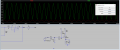
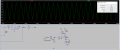
Hi all. I want to address a question about the small signal operation of a discrete MOS amplifier. In the following configuration, a triangular input is applied and increased until the voltage gain drops by %10. At this point, we observe clipping in the negative half cycle of the output waveform. What I wonder is whether the DC voltage at the drain increases, decreases, or stays the same. The gain drops due to the distortion of the output waveform, but since the gain is calculated as -gm.Rd, the gm is supposed to fall somehow (or isn't it?). Exploiting the formula for gm in saturation gm = sqrt(2*kn*Id) I deduced that the drain current decreases and thus the DC voltage at the drain must increase. But I am not pretty sure whether I can still use the above formula even when clipping occurs because it is the very last point at which we can continue assuming saturation. All the above discussion is somehow lacking in that we neglect the output resistance, to which the drain voltage and current are directly related.
 

Attachments

Last edited:

Thread Starter

pumpkinpie

Joined Aug 7, 2024
37
It stays the same or increases at a lesser rate.


No, the distortion occurs due to the drop in gain.
what do you mean by or? does this mean that the gain wouldn't stay the same over the whole sweep of the input voltage with the same frequency even when there was no clipping in the output waveform?
 

crutschow

Joined Mar 14, 2008
38,316
When the transistor cannot change the output voltage due to limiting, then it is no longer in the linear region, it is either in the cutoff or saturation region, so the gain equation no longer applies.
.
 

Thread Starter

pumpkinpie

Joined Aug 7, 2024
37
When the transistor cannot change the output voltage due to limiting, then it is no longer in the linear region, it is either in the cutoff or saturation region, so the gain equation no longer applies.
.
I assume that this reply is for the bipolar equivalent of the case. Here the MOSFET is normally operating in the saturation region for amplifier operation. When clipping occurs, is it still in the saturation region? or is it in the triode? it must be the latter since the gain equation (derived through saturation assumptions) does not apply. then Vds should be less than the overdrive voltage and this requires the DC voltage of the drain to be lower, right?
 

crutschow

Joined Mar 14, 2008
38,316
I assume that this reply is for the bipolar equivalent of the case.
Oops, I didn't look closely at the circuit.
Yes, for some odd reason, the operating regions for MOSFETs are defined differently than for BJT's.
So it would be either in the triode region or the cutoff region.
 

Thread Starter

pumpkinpie

Joined Aug 7, 2024
37
Oops, I didn't look closely at the circuit.
Yes, for some odd reason, the operating regions for MOSFETs are defined differently than for BJT's.
So it would be either in the triode region or the cutoff region.
Thank you for your reply. I want to clarify some points. Does the transistor switch to the triode region right at the moment the output waveform is clipped and goes back to the saturation mode where the output waveform is amplified as expected? How is that possible for the transistor to be in the cutofff region when the drain voltage is not measured as Vdd? If we operate at the triode region, we have to observe a lower voltage at the drain than the saturation case but the simulation results reflect nearly equal values..
 
Top