DC motor stall - bad motor or bad design

MisterBill2

Joined Jan 23, 2018
27,979
When a DC motor draws excessive current it is either overloaded or stalled. So the simple ways to sense that are to monitor either voltage or current, depending on the power source internal resistance. Voltage monitoring using a comparator is easier and simpler, but depends very much on the power source properties. The alternatives are monitoring the RPM or the power noise spectrum. Overloading increases the brush (commutation) noise while stall causes it to cease. So possibly monitoring brush noise would be the best detector of actual stalling. It may possibly even be the simplest method.
 

MaxHeadRoom

Joined Jul 18, 2013
30,772
Previously I have dealt with Helwig-Carbon for brushes and related products, they recommend using Garnet com paper for bedding and cleaning a com.
BTW they are a US Co that has been around for close to 100yrs in the motor brush business!

1728919632029.png

Also
 

MisterBill2

Joined Jan 23, 2018
27,979
I am guessing that for the motors in this discussion that the brushes are much smaller, possibly 2mm by 2mm square section. These are, after all, SMALL motors. What does happen with cheap small motors is that the brushes wear and so the shape of the contact zone changes, and the contact area becomes larger while the engaging force becomes less because of the brush wear.. So that is also a possible contributing condition. It may be that replacing the problem motors with better quality ones will be the solution, or just understanding that the really cheap motors do wear out, and that periodic replacement will be required.

AND, we still have no hint as to the actual function or the amount of torque load.
 
Last edited:

MisterBill2

Joined Jan 23, 2018
27,979
If the motor only has the slightly formed copper pieces then when those wear thru it is all over. The effort to remove the brush assembly and carefully solder in sections of solid copper wire to serve as contacts for the commutator will probably be a lot more effort than replacing the entire motor.
Once again I suggest considering at least one step up in motor quality.
 

KeithWalker

Joined Jul 10, 2017
3,614
See posting #12. ( The ones I am using now are rated "for use in medical equipment" ).
That means that they are NOT cheap hobby motors.
The way to diagnose the source of the problem is by measuring the voltage across the motor when it is in the fault condition. If it is the same or higher than when running normally, the fault is lack of continuity between the brushes and commutator. If it is less, the the motor is stalled, most likely from friction in the bearings.
The measured voltage difference may be small, but should be enough to make a diagnosis.
Do NOT squirt contact cleaner into the motors!
I originally mentioned that I suspected the bearings because the motors are operating on 50% duty cycle PWM. That may not be enough to overcome the friction in the sleeve bearings if the lubrication has dried out.
 
Last edited:

LowQCab

Joined Nov 6, 2012
5,101
"" for use in Medical-Equipment ""
Sounds like a 6000-Watt Audio-Amplifier from China.

I can't imagine the use of a generic "Motor" for an actual piece of Medical-Equipment in the first place,
further more, if it actually was for a "piece of Medical-Equipment",
it would have ~2 or more certifications listed, which are brutally expensive to obtain,
possibly putting the cost of the Motor into the ~$300.oo-plus-range, EACH.
Plus, it would have a rather extensive Specification-Sheet, or,
the Motor would have been custom designed for a specific Medical application.

I'm guessing this is just advertising-hype.
.
.
.
 

MisterBill2

Joined Jan 23, 2018
27,979
"" for use in Medical-Equipment ""
Sounds like a 6000-Watt Audio-Amplifier from China.

I can't imagine the use of a generic "Motor" for an actual piece of Medical-Equipment in the first place,
further more, if it actually was for a "piece of Medical-Equipment",
it would have ~2 or more certifications listed, which are brutally expensive to obtain,
possibly putting the cost of the Motor into the ~$300.oo-plus-range, EACH.
Plus, it would have a rather extensive Specification-Sheet, or,
the Motor would have been custom designed for a specific Medical application.

I'm guessing this is just advertising-hype.
.
.
.
Actually, it all depends on how one defines "medical equipment". That could include an electric back scratching device or even an electric toothbrush. And actually there are a whole lot of small DC motors used in a wide variety of small surgical devices.
There is the class of non-surgical, non-invasive things that the motors are not so horribly expensive. That is to say, less than $100 each.
Really, better motors can be removed from a discarded VCR. Usually there are at least two of them in the load/unload system. One to move the cartridge and one to thread the tape. Those both run open loop and so are just brushed motors.
 

MisterBill2

Joined Jan 23, 2018
27,979
An apparently random, quite intermittent failure such as this one, is often called "a dog" by those in the service business. Aide from pure luck or some fortunate discovery, the path to a fix usually involves gaining a deep understanding of all the details of how the system actually functions, which then tends to point toward the actual cause.
The one totally verified cause of the random failure to start of a commutator type motor was an open winding connection in the armature. That would have been simple to detect with an ohm meter resistance check across the brushes, with rotating the armature to verify the continuity. The motor performance did not seem to suffer in normal operation.
 

Thread Starter

Jassper

Joined Sep 24, 2008
103
Thanks for everyone's comments.

I understand that these will fail over time, however the ones In question are only 8 moths old. Generally they last 4 or 5 years before replacing and I have some out there going on 8 years now and no issues.

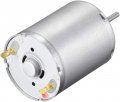
I purchase from the manufacture, 100 at a time and so far all the units in question fall within the last order so Very possible a bad batch of motors. I did purchase some from a different manufacture that claims better quality, but they look almost identical. About the only different I can see is the new ones have a dust cover over the vent holes in the bottom.


51vMFTFSRhL._AC_SL1100_.jpg

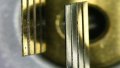
I cut one of them open Here are the brushes and top bearing,
PIC000.JPG


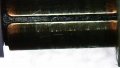
Commutator, It's got weird lighting on it, although it looks blackened, it is actually shinny chrome looking.
PIC004.JPG

Top bearing
PIC002.JPG

Everything looks good.

The motors have plenty of torque, I can't stall the motor with my fingers, I have to hold the shaft with a pair of pliers, then apply power. When I do this the motor will hum and get warm. the amp draw ramps up to about 1.2 amps. This is NOT the case when one randomly locks during use, there is no noise, and the voltage/current remains steady. It acts as if there is now power to the motor. The 3 motors on the board are all switch on by the same MOSFET, when one motor locks the others continue to operate. No excessive voltage/current draw and nothing gets hot.

When a motor locks, it behaves as if there is a "dead spot", I have voltage to the motor but no action. It is hard to get any measurements from the locked motor because all I have to do, and this is what baffles me, is touch the contacts with very little pressure and the motor starts working again.
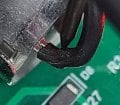
This is a picture of my meter prob barley pressing on the connection, maybe pressing with enough pressure to squish a flea.
And before everyone says bad solder joint, I have verified the solder is good, because that was my first thought as well. Additionally, I can also 'fix" the issue simply by lightly taping the motor with a small screwdriver.

20241004_062436.jpg

So I think I will chalk this up as a bad batch of motors and continue testing with the new ones and see if any of those randomly stop. If anyone knows a better motor of that size, please post a link.

Thanks

EDIT: forgot to mention that the motors will randomly lock up with - or without a load.
 
Last edited:

LowQCab

Joined Nov 6, 2012
5,101
Those Pictures show exactly what I was expecting to see by your previous descriptions.

Those Motors are basically the same junk "Toy" Motors that have been produced for over ~70-years.
They are worth less than ~$1.oo each in large quantities,
and are in no way suitable for "Medical-Equipment" as claimed.

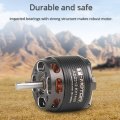
A 3-Phase-Hobby-Drone/Airplane-Motor with real precision Ball-Bearings, and no Brushes,
and designed to run at ~10,000 RPM for days on end, is what You need for reliability.
But they will require matching "ESCs", ( Electronic-Speed-Control ), Boards,
which must be driven with a very simple Micro-Controller.
There are a mind boggling number of different sizes and configurations available
with almost any Power-Range from ~2 to ~600-Watts.
.
Recommended Manufacturer = "T-Motor"
.
T-Motor example .jpg
.
.
.
 

MisterBill2

Joined Jan 23, 2018
27,979
What I think I see, based on the photo of the commutator, is copper plated steel for the commutator material. So as the copper will wear away the steel will not only have a greater electrical resistance, it will also develop a bit of rust occasionally. Rust (iron oxide) is a poor conductor. a poor connection under either brush will tend to not let a motor start, but any disturbance will complete the circuit and the motor will run as it should.
So that may possibly be the cause of the problem. The steel commutator will be simple to verify with a small magnet..And a small bit of contact cleaner would tend to reduce the instances of stalling. I very much doubt that it would hold dust that might be a problem.
 

Thread Starter

Jassper

Joined Sep 24, 2008
103
Those Pictures show exactly what I was expecting to see by your previous descriptions.
Yep, I've looked all over to find one in this size and they all look like this, even the more expensive ones.

and are in no way suitable for "Medical-Equipment" as claimed.
I believe they are used in Blood pressure machines and breast pumps - so they get to make that claim.

I'll look more in depth into the 3-phase motors, but space is a premium for the ESC's and such - may require a Compleat re-design. Thanks for the link.

What I think I see, based on the photo of the commutator, is copper plated steel for the commutator material. So as the copper will wear away the steel will not only have a greater electrical resistance, it will also develop a bit of rust occasionally. Rust (iron oxide) is a poor conductor. a poor connection under either brush will tend to not let a motor start, but any disturbance will complete the circuit and the motor will run as it should.
So that may possibly be the cause of the problem. The steel commutator will be simple to verify with a small magnet..And a small bit of contact cleaner would tend to reduce the instances of stalling. I very much doubt that it would hold dust that might be a problem.
I have a lot of the same thoughts but what really makes me wonder is how I have years old units still working today, and this issue is just now cropping up with fairly new motors and not seeing it on older ones. Just makes me scratch my head.
 

MisterBill2

Joined Jan 23, 2018
27,979
Copper plating is a batch process and so one batch could have a thinner copper plating, and even within a batch there can be some variations. Of course, knowing what the base material is will either back or refute this theory.
At one time those commutator segments were all copper, but then copper became so very expensive that the change was made.
It would be useful to see a scope trace of the voltage during the motors start-up, also a plot of the current, although THAT will take a lot more effort.
 

MaxHeadRoom

Joined Jul 18, 2013
30,772
I have a lot of the same thoughts but what really makes me wonder is how I have years old units still working today, and this issue is just now cropping up with fairly new motors and not seeing it on older ones. Just makes me scratch my head.
I have found that in General, the Johnson make of small motors are pretty decent, they originate out of China.
Also, the TM.s that use the larger 2HP 3HP seem to be well built.
 

MisterBill2

Joined Jan 23, 2018
27,979
Treadmill motors are an entirely different class of motors. even the brushed ones. A treadmill motor built like the cheap small ones would not last an hour in a treadmill.
 
Top