Dc Block Capacitor- Dc Voltage

Thread Starter

Guycohen

Joined Apr 2, 2025
4
Suppose I have chosen a capacitance value for a DC block capacitor.

How can I determine the required DC voltage of the capacitor? Should it be based on the average, RMS, or peak voltage?

For example, if I am transmitting at 400W, what DC voltage value should i choose?

Additionally, if the RF line also carries a DC voltage along with the RF signal, will the required DC voltage of the capacitor be different?
 

crutschow

Joined Mar 14, 2008
38,322
How can I determine the required DC voltage of the capacitor? Should it be based on the average, RMS, or peak voltage?
The capacitor voltage rating should be greater than any peak voltage across it.
if I am transmitting at 400W, what DC voltage value should i choose?
400W tells me nothing about the required voltage unless the impedance is specified.
If you are a HAM, you should know that.
Is this a 50 or 75Ω transmission line?
if the RF line also carries a DC voltage along with the RF signal, will the required DC voltage of the capacitor be different?
Yes.
It would be the peak RF AC voltage plus the DC voltage.
 

nsaspook

Joined Aug 27, 2009
16,251
Suppose I have chosen a capacitance value for a DC block capacitor.

How can I determine the required DC voltage of the capacitor? Should it be based on the average, RMS, or peak voltage?

For example, if I am transmitting at 400W, what DC voltage value should i choose?

Additionally, if the RF line also carries a DC voltage along with the RF signal, will the required DC voltage of the capacitor be different?
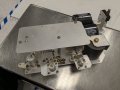
At 400W of RF power levels, you should use (as a rule of thumb) a proper RF rated capacitor with at least 2X (for mismatched transmission or antenna conditions) voltage rating of the expected matched and running peak RF voltage, plus the DC voltage operating voltage of the amplifier (really mainly a issue with a blocking capacitor connect a tube PA plate).

PXL_20250203_165640239.jpg
RF plasma tuning module.

https://www.kemet.com/en/us/technical-resources/what-is-an-rf-capacitor.html

For high power and high voltage and current.
https://www.ceramtec-industrial.com...itors/rf-ceramic-capacitors/rf-disc-capacitor
1743611382599.png
 

Irving

Joined Jan 30, 2016
4,996
What capacitance and what dielectric/construction?

Capacitor working voltage should be > (peak AC + DC bias) x safety factor (SF). Typical SF values range from √2 to 3 or more depending on environment (damp needs more) and industry requirements. Also be aware that actual capacitance will reduce with applied voltage. Depending on dielectric and construction this could be as much as 60 - 80% at 2/3 rated voltage (ie a 1uF 250v capacitor working at 160v could be effectively only 0.2 - 0.4uF). At high RF the parasitic inductance of the construction/leads can become problematic.

400W = 141v @ 50ohm and 173v @75ohm
 

Thread Starter

Guycohen

Joined Apr 2, 2025
4
The capacitor voltage rating should be greater than any peak voltage across it.
1.How do you calculate the peak voltage from the maximum power?
2.For example, suppose I am transmitting 400W in a 50-ohm circuit.
3.should a safety margin be added?
4.What is the voltage rating specified for the capacitor—RMS, peak, or average?

400W tells me nothing about the required voltage unless the impedance is specified.
Is this a 50 or 75Ω transmission line?

50.
 

nsaspook

Joined Aug 27, 2009
16,251
The capacitor voltage rating should be greater than any peak voltage across it.
1.How do you calculate the peak voltage from the maximum power?
2.For example, suppose I am transmitting 400W in a 50-ohm circuit.
3.should a safety margin be added?
4.What is the voltage rating specified for the capacitor—RMS, peak, or average?

400W tells me nothing about the required voltage unless the impedance is specified.
Is this a 50 or 75Ω transmission line?

50.
Sounds like school work.
 

Thread Starter

Guycohen

Joined Apr 2, 2025
4
Sounds like school work.
No, I am an senior engineer developing an RF board. This topic is not entirely clear to me, and I would like to understand it better.
 

nsaspook

Joined Aug 27, 2009
16,251
You don’t have to answer, but thank you very much anyway.
It's not that we don't have the answers, but we are not some AI bot, designed to give hallucinated answers. These things take time and effort to learn, understand and to be able to use the principles in practical applications.
As a senior engineer you should know that from simple AC/DC theory and transmission line theory that's taught at the technician level.

Where did you get your senior engineer education from?

I would find a copy of this and start studying the examples and circuits: ARRL's RF Amplifier Classics: Practical Designs and Construction

Read, study and understand this book for basic RF theory: https://archive.org/details/in.ernet.dli.2015.6364
Transmission Lines Antennas And Wave Guides (1945)
 
Last edited:

crutschow

Joined Mar 14, 2008
38,322
You don’t have to answer, but thank you very much anyway.
But I do.
P = V²/ R where V is the RMS voltage of a sinewave, so Vpk = √(P*R) * √2

Apparently your "senior engineer " title must mean you are not an engineer with any significant electrical knowledge, since any beginning electrical engineer would readily know the answer to your questions.
 

Irving

Joined Jan 30, 2016
4,996
This topic is not entirely clear to me, and I would like to understand it better.
That's fair, if you're referring to the specification of capacitor working voltage - most engineers rarely need to think about it (working at audio/logic levels).

I hope you're not designing a 400W RF power amp; that's certainly not a task for anyone without significant experience. I know, I've done it several times, and blown up my fair share of very expensive semiconductors (so much easier with valves!).
 

MisterBill2

Joined Jan 23, 2018
27,186
What has not been mentioned yet that I saw is the heating due to the power passing thru the capacitor. THAT is part of the reason why somc capacitors are bigger and heavier than othercapacitors of the same value and voltage rating.
 

nsaspook

Joined Aug 27, 2009
16,251
What has not been mentioned yet that I saw is the heating due to the power passing thru the capacitor. THAT is part of the reason why somc capacitors are bigger and heavier than othercapacitors of the same value and voltage rating.
It has been mentioned and links provided to the correct types of RF capacitors for RF power.
 

MisterBill2

Joined Jan 23, 2018
27,186
I just reviewed the thread and see no mention of heat. POWER is mentioned and even current, but not specifically HEATING, except once about "blowing up " devices. No, I did not chase any links this time.
 

nsaspook

Joined Aug 27, 2009
16,251
I just reviewed the thread and see no mention of heat. POWER is mentioned and even current, but not specifically HEATING, except once about "blowing up " devices. No, I did not chase any links this time.
Stop it. This is silly. Of course heating is obviously implied by the links I posted. Power, current, internal resistance == heat. That should be obvious to a senior engineer (or any capable technician) unless that senior engineer specializes in Sanitation (I'm not talking about you) .
 
Last edited:

Tonyr1084

Joined Sep 24, 2015
9,744
Apparently your "senior engineer " title must mean you are not an engineer with any significant electrical knowledge, since any beginning electrical engineer would readily know the answer to your questions.
First, welcome to AAC.

I'm not an engineer either. I have no degree whatsoever. I've quoted this post because I must agree. Still, I know the answer to your question. But if I give you a fish all you learn is to lean upon others for more fish. Rather than giving you the answer it's something even a non-engineer person (like me) would know if they've had any basic electronics courses. So why am I not giving you an answer? Because it's a first year electronics course answer. In fact, you've already been given the answer. Even without enough detail, you still have your answer.

In AAC's library there are basic courses on electronics, ohms law, etc. You'll find your answer there. And it'll likely be something you remember forever. Plus a whole lot more learning on the subject. Like others have said - if you ARE an EE you'd know the answer you seek.

Happy fishing.
 

nsaspook

Joined Aug 27, 2009
16,251
First, welcome to AAC.

I'm not an engineer either. I have no degree whatsoever. I've quoted this post because I must agree. Still, I know the answer to your question. But if I give you a fish all you learn is to lean upon others for more fish. Rather than giving you the answer it's something even a non-engineer person (like me) would know if they've had any basic electronics courses. So why am I not giving you an answer? Because it's a first year electronics course answer. In fact, you've already been given the answer. Even without enough detail, you still have your answer.

In AAC's library there are basic courses on electronics, ohms law, etc. You'll find your answer there. And it'll likely be something you remember forever. Plus a whole lot more learning on the subject. Like others have said - if you ARE an EE you'd know the answer you seek.

Happy fishing.
Fishing? This is another one with a slight twist about what people want.

Give a man a match and he will be warm for a minute, set him on fire and he will be warm for the rest of his life.
 
Last edited:

MisterBill2

Joined Jan 23, 2018
27,186
Stop it. This is silly. Of course heating is obviously implied by the links I posted. Power, current, internal resistance == heat. That should be obvious to a senior engineer (or any capable technician) unless that senior engineer specializes in Sanitation (I'm not talking about you) . There ARE a lot of folks who may NOT see that it is obvious.
While heat may appear to be obviously implied to many of us, there are quite a few folks who are beginners, and many who caution us that they are not familiar with a whole lot of electrical theory. So it is OK to mention things that may not be obvious to somebody with no experience.
IN ADDITION, consider that in the majority of simulators reference in these threads, components never burn up! THAT is why it is best to not assume that a beginner is aware of every aspect of a system! OKAY????
 
Top