dBV meter circuit - some analysis requested

Thread Starter

metermannd

Joined Oct 25, 2020
472
I came across a set of Gerber files and a partial BOM for this meter, and I could use some help in filling in some blanks.

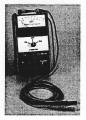
This was a signal strength meter used with a system where you could transmit a carrier wave over an electric distribution system to send instrument readings or remotely control loads.

The BOM I had appeared to be cut off, omitting four components; that's one of the questions I had (educated guesses as to the missing values of the components). C15 (on the first stage - feedback path on U10), R41 (in the second stage, after the filter), and R56 / D5 (LT1017 op-amp circuit).

The other questions I had have to do with the schematic -

What type of meter movement would have been attached to M1? Ammeter or voltmeter?

The 555 seems to be some kind of boost circuit to bump the 9V battery current to a higher voltage, correct? Would it be fair to assume it would be 12V?

What is the function of the LT1017 circuit?
 

Attachments

Irving

Joined Jan 30, 2016
5,001
The U10B opamp is configured as an integrator so its output will be the time-averaged level of the input voltage, ie the RMS voltage. The time constant over which the integrated value decays is based on the value of C15 and the parallel resistor RP56, and the carrier frequency. This device is very frequency specific, hence C15 is TBD. These values will also affect the output voltage from U10B, so R41 is selected to put the gain-setting resistor RP57 near mid-range.

The meter is in the feedback loop of the U12A opamp, so must be current driven. I think RP53 sets max level and RP54 is zero adjust. I would put each of these stages in LTSpice and experiment with it before building it.

The purpose of the 555 is, I think, to provide a single button on/off and auto power off. A quick play with LTSpice would validate that. Its not relevant to the measuring circuit so could be eliminated and replaced with just a on/off toggle switch.

I think the LT1017 is a battery level meter, so R56 and D5 (LED) are chosen as needed. I'm guessing the LED will flash when battery volts drops below 6v or so. Again, a quick play with LTSpice would validate that. Its not relevant to the measuring circuit so could be eliminated.

Hope this helps...

[edit] I was close re battery meter - LED flashes faster with good battery 4Hz @9v to 1.5Hz at 6.5v and off at 6v
 
Last edited:

Thread Starter

metermannd

Joined Oct 25, 2020
472
I've never played around with LTSpice... will see about learning how to set up the models to play around with it.

I don't know if I will be building this yet, but I wanted to make sure I had a general idea of what the various parts do. I take it that M1 would be a voltmeter then?

There are only two different carrier frequencies used with this setup - 12.5kHz and 9.615kHz.
In the meantime, I'll also update the notes on the schematic to show that C15 and R41 are frequency-specific.
Thanks for the input!
 

MisterBill2

Joined Jan 23, 2018
27,189
A good question is what does the TS want to measure?? A meter reading in dBV is rather unusual. Since dB is a log relationship and most measurements use constant size units, not dB.
 

Thread Starter

metermannd

Joined Oct 25, 2020
472
This was a tool used by companies using this powerline carrier signaling system to assess the signal strength at various points along the electric distribution circuits to determine if and where repeaters needed to be installed, and also for troubleshooting signal loss situations. I had access to one when I was repairing the various components of this system and used it to validate the transceiver units after repair to ensure they could send a good signal even when the attenuation switch was on its highest range (I want to say 20dB?).
 

MisterBill2

Joined Jan 23, 2018
27,189
OK, so now we know that it is a frequency selective/ frequency rejecting Ac dBvolt meter. That explains the tuned circuits in the circuit. The requirement is only to measure signal strength at specific frequencies.. Not at all like most audio frequency VU meters!
 

AnalogKid

Joined Aug 1, 2013
12,050
There is a dead short between VCC and GND through the PWR_FLAG net. Check the upper-left and center-right areas of the schematic.

ak
 

Irving

Joined Jan 30, 2016
5,001
There is a dead short between VCC and GND through the PWR_FLAG net. Check the upper-left and center-right areas of the schematic.

ak
That's not a short... PWR_FLAG isn't a connection, its a hint for the rules checker to identify power sources and applies to all power and ground lines.
 

Thread Starter

metermannd

Joined Oct 25, 2020
472
Correct. KiCAD has an 'electrical rules check' feature that allows you to proofread schematics, catching missed connections and the like. The flags really should be at or near the respective sources, so I ended up moving the ground flag down to the power switch circuitry (and I seem to remember now it was indeed push-button on / automatic off).

Incidentally, the transceiver amplifier cards were capable of putting out a hefty signal (think it was like 600Vp-p), to where it has a 100:1 voltage divider to sample the output voltage and a small CT loop to sample the output amperage as well. I do have a question about that card and could start a separate thread if there is interest.
 

Thread Starter

metermannd

Joined Oct 25, 2020
472
Coming back to this - found some notes that suggested the values of the mystery parts:

C15 = 10pF, R41 = 20K, R56 = 470, D5 is a green LED.

Found some literature that speaks of this unit.
Unit is calibrated to read from -60dB to +20dBV, +/- 2dB accuracy. Bandwidth 400Hz, attenuator for +0, +20, or +40dB.
 
Last edited:

Irving

Joined Jan 30, 2016
5,001
Isn't that likely the time-averaged level of the rectified average, (not RMS) voltage.?
Well yes, but the difference is just a scaling factor. The RMS of a sine wave is Vmax/√2 and that of the rectified 1/2 wave is Vmax/2, so has no material effect on the circuit operation given sufficient gain coverage.
 
Top