Darlington pair LTSpice

Thread Starter

kalemaxon89

Joined Oct 12, 2022
389
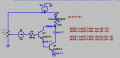
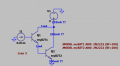
I tried to simulate the circuit explained in this video.
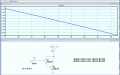
1714469740666.png

The currents should be as indicated in the comments in blue ... but by simulating they are "shifted" (157mA instead of 200mA etc.).
I don't understand if the problem lies in the bjt model, in my schematic, or elsewhere.

EDIT:
I realized now that the currents are as in the video if I use power supply (V1) = 26V.
I would like to ask you for some more explanation about this point.


In other words, how do I demonstrate with calculations what supply voltage I need to make the bjt amplify the current by its beta factor?
 

Attachments

Thread Starter

kalemaxon89

Joined Oct 12, 2022
389

Thread Starter

kalemaxon89

Joined Oct 12, 2022
389
hi k9,
This is a rough plot of Beta.

Update: @kalemaxon89
There is an AAC link of this parameter.
https://www.allaboutcircuits.com/te...anding-collector-current-bjt-beta-variations/

EView attachment 321251
There is one thing I still don't understand.
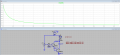
I followed the example in this video and I plotted beta. Is that correct?

If in this circuit (but applies in general) I want both bjts with beta = 10 because I want an amplified output current of 100 ... I note from the plotted beta graph that such beta = 100 will never be reached(?) ... because the green curve (i.e. beta) never reaches "100" on the y-axis.
Am I right? Or am I getting confused?


1714478051246.png
 

Thread Starter

kalemaxon89

Joined Oct 12, 2022
389
Hi k,
Are you aware of the Early Effect in BJT transistors?
Look over this link, and you will get an insight in why the Beta increases with Collector current.
E
https://eng.libretexts.org/Bookshelves/Electrical_Engineering/Electronics/Semiconductor_Devices_-_Theory_and_Application_(Fiore)/04:_Bipolar_Junction_Transistors_(BJTs)/4.3:_BJT_Collector_Curves
I still don't understand some things.
Let's simplify the example by taking a simple bjt.
Follow my reasoning:

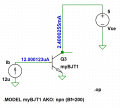
I took the 2N2222 model of npn and I want to amplify my input current Ib of 200 .. so I need beta = 200.

How do I get the bjt to work with such beta/amplification?
If I understand correctly, I have to make it "work" under certain conditions:
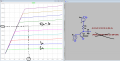
1) I find the Ic vs Vce characteristic curve of the bjt (on the datasheet or by simulating its model as I did)
2) suppose I have a supply Vce = 5V and my input is Ib = 12uA (that will be amplified by beta factor)
3) in the plot, the the intersection between Vce and Ib gives an output Ic = 2.4mA
4) so beta = Ic / Ib = 2.4mA / 12uA = 200
Therefore, if I supply the bjt with Vce = 5V and my input Ib = 12uA .. then beta = 200 --> Ic = 2.4mA

1714490445992.png

Plase read each step and tell me if and where I am going wrong
 

Attachments

crutschow

Joined Mar 14, 2008
38,392
You cannot adjust the Beta value, it is inerrant to each particular transistor you use and, as noted, can vary over a large range (often 3:1 or more).
And also, as also noted, you don't design a circuit that is highly sensitive to that value.

What exactly, are you trying to accomplish?
 

Thread Starter

kalemaxon89

Joined Oct 12, 2022
389
You cannot adjust the Beta value, it is inerrant to each particular transistor you use and, as noted, can vary over a large range (often 3:1 or more).
And also, as also noted, you don't design a circuit that is highly sensitive to that value.

What exactly, are you trying to accomplish?
Thank you for your response and patience.

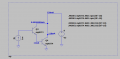
I am trying to understand why the calculated results here (that I wrote with the blue comments) are different from the simulation results:
1714498840590.png
 

Attachments

Jony130

Joined Feb 17, 2009
5,594
I am trying to understand why the calculated results here (that I wrote with the blue comments) are different from the simulation results:
Because your Darlington stage is saturated.
https://electronics.stackexchange.c...base-there-is-more-than-one-vce/355955#355955
You have a 9V supply voltage a silicon diode + 470Ω resistor and Darlington C-E in series.
So the maximum current can't be larger than 9V/470Ω = 19mA. If we ignore all the remaining components.
But we have a voltage drop across the diode and the Darlington stage. Thus,
I_max ≈ (Vsup - VD - Vce(sat))/R3 ≈ (9V - 0.7 - 0.7V)/470Ω ≈ 16mA

a2d.PNG
 

Attachments

Last edited:

Alec_t

Joined Sep 17, 2013
15,112
I am trying to understand why the calculated results here (that I wrote with the blue comments) are different from the simulation results:
You are specifying only the Bf parameter in your model.
Here's what the LTspice Help says about BJT modelling when certain parameters are unspecified:-
"The bipolar junction transistor model is an adaptation of the integral charge control model of Gummel and Poon. This modified Gummel-Poon model extends the original model to include several effects at high bias levels, quasi-saturation, and substrate conductivity. The model automatically simplifies to the Ebers-Moll model when certain parameters are not specified."
 

WBahn

Joined Mar 31, 2012
32,747
So, when I use the multimeter to measure beta I only have an estimate of it ... actually the beta parameter is not fixed/constant but varies (keeping Vce fixed) depending on Ic (and thus power supply) and depending on temperature.
Am I wrong?
It varies not only with those factors, but also just about everything else. Two transistors taken from the same die will have different betas. The same transistor under the same conditions will be different a week from now than it was a week ago. Your designs should only rely on the beta of any given transistor being somewhere within a pretty broad range and make absolutely no assumptions about how the beta of one transistor relates to the beta of another transistor unless you are designing and IC and have very carefully laid them out specifically to get them to match as much as possible.

As for your hand calculations not matching simulation results, that's because a good simulator (and there are plenty of bad ones out there) is intended to simulate how devices actually work in a real circuit as much as possible. There are simple models, which are pretty close to hand calculation models, but most models try to take a number of other factors into account. The more they take into account, the more likely the simulation results will match how the actual circuit will perform in the real world, but the more it will drive home how different the real world is from the textbook world. Good circuit design can go a long way toward keeping the two acceptably close, however.
 

Thread Starter

kalemaxon89

Joined Oct 12, 2022
389
It varies not only with those factors, but also just about everything else. Two transistors taken from the same die will have different betas. The same transistor under the same conditions will be different a week from now than it was a week ago. Your designs should only rely on the beta of any given transistor being somewhere within a pretty broad range and make absolutely no assumptions about how the beta of one transistor relates to the beta of another transistor unless you are designing and IC and have very carefully laid them out specifically to get them to match as much as possible.

As for your hand calculations not matching simulation results, that's because a good simulator (and there are plenty of bad ones out there) is intended to simulate how devices actually work in a real circuit as much as possible. There are simple models, which are pretty close to hand calculation models, but most models try to take a number of other factors into account. The more they take into account, the more likely the simulation results will match how the actual circuit will perform in the real world, but the more it will drive home how different the real world is from the textbook world. Good circuit design can go a long way toward keeping the two acceptably close, however.
Thanks for the very interesting clarification.

One thing is not clear to me: if I want to simulate on LTSpice an ideal bjt by choosing only one or more parameters (e.g. beta, or Vce(sat) etc.) is it ok to use the "npn" model of LTSpice with the command .MODEL myBJT4 AKO: npn (Bf=10) ?
Or do you recommend taking the model of an existing diode and doing all the calculations taking into account its non-idealities?
I am not familiar with simulations, so I don't know which is a "good" method.
 

Alec_t

Joined Sep 17, 2013
15,112
if I want to simulate on LTSpice an ideal bjt
A truly ideal bjt would have a fixed beta and no unwanted parameters. You could model it using standard components, e.g a controlled current source (f or g device) (and resistances etc, if you want it somewhat less than ideal).
If you model it by the method you propose in post #18, LTspice will use the Ebers-Moll model so it won't be ideal.
For many simulations the default bjt model is adequate. This has a fixed beta of 100. Bear in mind that simulations are often used just for proof of concept, where approximated performance is acceptable.
 

LvW

Joined Jun 13, 2013
2,013
In other words, how do I demonstrate with calculations what supply voltage I need to make the bjt amplify the current by its beta factor?
@kalemaxon89 - just a simple question.
I`ve got the impression that there is only one property of the Darlington pair you are interested in: The so called β-vaue.
May I ask you why?
 
Top