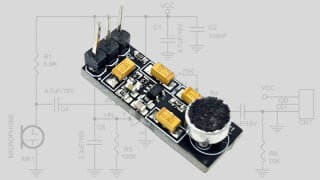
Yes, I had done that on one iteration of my board and it provided a stable 5.0 v. I don't recall why I decided to go back to the mini.... Maybe the others can chime in on that ?? I will remove R2.
Thx
John
Hi Eric. My code is actually working perfectly (lacking hysteresis), but here is what happens:
Dusk falls
Unit is energized by LDR circuit
PIR ready, but not triggered yet
RA red LEDs turn on at 125 PWM
3UP LED illuminates very dim (PWM)
Unit remains in this state until motion is detected by PIR.
When motion is detected, RA LEDs blink at 255 PWM several times over 5 seconds, then return to solid at 150 PWM. Then the 3UP LED slowly brightens over 90 seconds to 243 PWM brightness. The 3UP holds at 243 PWM for 2 minutes (30 seconds are added if motion is detected during that 2 minutes). The 3UP then slowly fades back down to very dim and the sketch loops.
This sequence will loop each time motion is detected throughout the night. All function is disabled by LDR at dawn.
When motion is detected, RA LEDs blink at 255 PWM several times over 5 seconds, then return to solid at 150 PWM. Then the 3UP LED slowly brightens over 90 seconds to 243 PWM brightness.
Not in my current code. The LDR energizes the unit and enables the PIR at dusk and disables it at dawn. The PIR going HIGH initiates the code sequence outlined earlier.
Yes I understand that.
I don't fully understand the code posted as I'm not an Arduino user but it appears to me in the code posted that it simply enables the PIR when the LDR input pin is a digital High and disables the PIR when a digital Low which provides the hysteresis.
hi
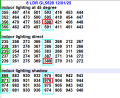
This is my test code, using a potentiometer in place of the LDR, to simulate light and dark, works OK.
E
C-like:
/*
  LDR Analog Input
  LDR GL5528 Jan 12 2025 ESP
  Bench testing the LDR >> ADC >> PIR enable limits
*/

int ldrPin = A0; // ADC input
int adcCount = 0;
int adcAvg = 0;
int enbPIR = 0; // PIR detection Enabled when = 1

void setup() {
  Serial.begin(9600); // used for IDE testing
  Serial.println("ADC Counts for LDR Resistance");
}

void loop() {
  // read the ADC count value created from the LDR voltage
  // take the Average of 10 readings, set readings delay to suit project


  for (int i = 0; i <= 9; i++) {
    adcCount = analogRead(ldrPin);
    adcAvg = adcAvg + adcCount;
   Serial.print(adcCount); // test only
  Serial.print("  "); // test only
    delay(200);
  }
  Serial.print("adcAvg= "); // test only
  adcAvg = adcAvg / 10;
  Serial.print(adcAvg); // test only

  // hysteresis
  if ( adcAvg > 600) { // dark
    enbPIR = 1;
    // Serial.print(adcAvg); // test only
  }
  if (adcAvg < 550) { // light
    enbPIR  = 0;
  //   Serial.print(adcAvg); // test only
  }

  adcAvg = 0; // clear AVG Count

  // Select if PIR is enabled or not
  if (enbPIR  == 1) {
    Serial.println(" Dark"); // test only
  } else {
    Serial.println(" Light"); // test only
  }

}
I know my light is unusual, but the dimming, brightening and blinking of the LEDs all have a specific purpose, which is irrelevant. I would love to eliminate several components as I am placing these parts by hand using a stencil, solder paste and a hot plate. If we can easily use the attiny for hysteresis using code, great, but if it creates new issues and headaches, I am fine with using the LM393 circuit established earlier as it worked just fine. I can't tell you how much I appreciate everyone's assistance in this effort.
John
Yes I understand that.
I don't fully understand the code posted as I'm not an Arduino user but it appears to me in the code posted that it simply enables the PIR when the LDR input pin is a digital High and disables the PIR when a digital Low which provides the hysteresis.

 Facebook
 Google
 GitHub
 Linkedin