Dark sensor circuit using LM393 question.... unstable OFF/ON... flickering

ericgibbs

Joined Jan 29, 2010
21,463
The power source is a standard 12v 7Ah feeder battery. The voltage will typically fluctuate between 13+v and 11.5+v. The unit works just fine down to 10v.
hi,
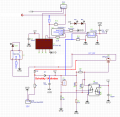
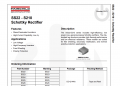
AS the circuit has no regulator for the 12V supply, consider using two Schottky diodes for reverse voltage protection.
E

Added: example type PDF

Caps1.png
 

Attachments

Last edited:

eetech00

Joined Jun 8, 2013
4,709
Yes, that could be done..... except for the LDD-700L which would get direct 12v as it is currently.
On second thought...No....Unless the LM393 was left at 12v because of headroom (VCC-2v)

But you can move the comparator function into the Atiny and remove the LM393.
 
Last edited:

Thread Starter

johnaustinkaty

Joined Jul 16, 2021
284
hi,
AS the circuit has no regulator for the 12V supply, consider using two Schottky diodes for reverse voltage protection.
E

Added: example type PDF

View attachment 361759
I have added the caps and diodes to my schematic and board. My question is about the fuse. Is it an SMD? What happens if it is blown? Also, eetech00 suggested a way to eliminate the LM393 altogether using a different approach to the dark sensor circuit. I'll look back through the posts and try to find that. I am confident that this circuit will be an extreme improvement from what I had just a week ago. Thx again guys for your help.... Still contemplating using 5v to power this circuit except for the LDD-700L led driver and mini-360. I will post my schematic when finished.
John
 

Thread Starter

johnaustinkaty

Joined Jul 16, 2021
284
On second thought...No....Unless the LM393 was left at 12v because of headroom (VCC-2v)

But you can move the comparator function into the Atiny and remove the LM393.
Agreed. This also allows me to get the RA red LEDs brighter. I'll have them in series with one 470 ohm resistor. I can dim them down with PWM.
 

Thread Starter

johnaustinkaty

Joined Jul 16, 2021
284
Agreed. This also allows me to get the RA red LEDs brighter. I'll have them in series with one 470 ohm resistor. I can dim them down with PWM.
I plan to stick with 12v to the LM393 and use it for the dark sensor circuit with hysteresis. Everything I have been able to test has worked great so far. However, I am still addressing all of your recent additional comments. Maybe additional questions tomorrow as I finish updating my schematic.
 

ericgibbs

Joined Jan 29, 2010
21,463
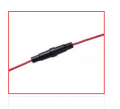
My question is about the fuse. Is it an SMD? What happens if it is blown?
hi john,
Ref the fuse, check the attached image
The fuse is located at the battery Positive terminal.

Ref your PM query,
If you powered all the circuit from the MINI-360 ie: 5V, what method would you use to switch the PMOS FET Gate driving the 12v input to the LDD 300, also have you checked the heat dissipation of the MINI with 12V input and 5V output??

E
 

Attachments

Thread Starter

johnaustinkaty

Joined Jul 16, 2021
284
hi john,
Ref the fuse, check the attached image
The fuse is located at the battery Positive terminal.

Ref your PM query,
If you powered all the circuit from the MINI-360 ie: 5V, what method would you use to switch the PMOS FET Gate driving the 12v input to the LDD 300, also have you checked the heat dissipation of the MINI with 12V input and 5V output??

E
1. Fuse image understood, but still not clear what it's purpose is ?????
2. I am keeping the voltage scheme as is.. no change
3. I have checked for hot spots on the MINI and there are no issues
 

ericgibbs

Joined Jan 29, 2010
21,463
Fuse image understood, but still not clear what it's purpose is ?????
Hi,
If a short circuit occurs on the PCB, the battery will be shorted out, the connecting wire may melt and start a fire etc......
A fuse protects the battery and power wiring.
E
 

Thread Starter

johnaustinkaty

Joined Jul 16, 2021
284
I wanted to clarify an earlier post:
My light will have a color option for illumination, RED or GREEN, using 3up super bright LEDs. It also has the two 5mm red RA LEDs that will be in series and will require around .028 A.
"The max current of the unit is approx .550 A (green high power LED) when PWM is at 250.
The max current to the super bright 3up LED specifically (green) is around .520 A. The red high power LED needs less at approx .420 A.
The LED driver is an LDD-700L from Meanwell.
.
 

ericgibbs

Joined Jan 29, 2010
21,463
hi john,
Diodes D1 and D2 are not suitable for the reverse voltage protection function or forward current required.

E

Update:

The switched 12v routing is also drawn incorrectly
 
Last edited:

eetech00

Joined Jun 8, 2013
4,709
Hi

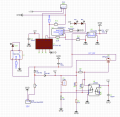
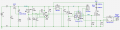
I've modified my schematic in line with the comments below.

1. I've added filter/bypass capacitors (as Eric suggested). These basically ensure voltages remain stable.

2. You've determined that the 1K pullup prevents the power-on flash you were seeing earlier.
It didn't make sense (to me) for the mosfet to control power to the LDD-300 anymore.
So I connected the LDD-300L supply pins directly to the supply rails, and configured a mosfet (2N7000) to
provide a signal to an Atiny GPIO pin as an "enable" control signal for the LDD-300. You can configure the
Atiny to set the DIM pin low/high, or "in-between", to control the LDD-300 OFF/ON/DIM, repectively.

3. I replaced the NPN LED drive transistor with a 2N7000 NMOS.
This reduces the number of different transistors and current requirements.

4. I recommend keeping the PMOS reverse voltage circuit. Its more efficient than diodes.
I've included suggested part numbers for the mosfet and Zener.

5. Lastly, I still think the LM393 comparator function can moved to the ATiny.

These are just some observations and suggestions.

1767989051278.png
 
Top