D9D or D9_D Question

Thread Starter

Mikarn

Joined Mar 12, 2025
8
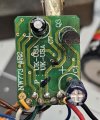
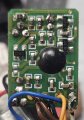
Hello everyone, first time here and very new to forums. Can anyone ID the attached component marked D9D or D9_D. It is a flat three legged component located in the middle left side of the photo.
This IC board is part of a 20 year old talking toy that I don't have a schematic for.

When I received the toy it was not working and missing off the board completely a 8059S (Q3) transistor and connecting to the Q3, a 100 ohm (101) resistor located in upper left corner of photo.
I replaced the missing transistor and resistor and the toy started working and talking, but with very reduced specker volume. I replaced the speaker with a known good speacker and still with very reduced volume.

When looking around the board, I can't see any additional physical damage, but I did feel a lot heat coming off of the D9D marked component. It's very hot to the touch.

I know its not much information to go on, but what do ya'll think about the heated D9D component, is it causing the reduced volume and just what is the D9D anyway?20250313_080343.jpg
Google says D9D is an obsolete Russian diode. Help if you can.
 

MrChips

Joined Oct 2, 2009
34,810
I presume that the board must be powered from a battery with red and black wires?
Using the black wire as a reference, measure the voltages at the three legs of device D9_D.
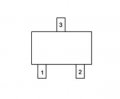
Use this pin numbering scheme.

SOT-23 pinout.jpg
It is possibly a double zener or a voltage regulator.
 

Thread Starter

Mikarn

Joined Mar 12, 2025
8
I presume that the board must be powered from a battery with red and black wires?
Using the black wire as a reference, measure the voltages at the three legs of device D9_D.
Use this pin numbering scheme.

View attachment 344461
It is possibly a double zener or a voltage regulator.
Yes... it is powered by 3 (AA) batteries entering the board at the bottom left of photo (Red and Black).

The two orange wires run to a blade contact switch that when it comes into contact with a piece of rail road tract that has different varing numbers of bumps on it, causes the toy train to activate in different manners. (Think along the lines of something like Morse Code in a way.)

The two brown wires go to the speacker to produce train noises.

Blue and white wires run to the main off and on switch.

Green and black wires run to a DC volt motor.

The messy soldier job in the bottom right corner was done by another person and needs to be cleaned up, but one of the orange wires and the white are combined together here on that one contact area. I posted a photo of the underside of board.

Does this help any?

20250313_131122.jpg
 

Thread Starter

Mikarn

Joined Mar 12, 2025
8
I presume that the board must be powered from a battery with red and black wires?
Using the black wire as a reference, measure the voltages at the three legs of device D9_D.
Use this pin numbering scheme.

View attachment 344461
It is possibly a double zener or a voltage regulator.
Yes... it is powered by 3 (AA) batteries entering the board at the bottom left of photo (Red and Black).

The two orange wires run to a blade contact switch that when it comes into contact with a piece of rail road tract that has different varing numbers of bumps on it, causes the toy train to activate in different manners. (Think along the lines of something like Morse Code in a way.)

The two brown wires go to the speacker to produce train noises.

Blue and white wires run to the main off and on switch.

Green and black wires run to a DC volt motor.

The messy soldier job in the bottom right corner was done by another person and needs to be cleaned up, but one of the orange wires and the white are combined together here in that one contact area. I posted a photo of the underside of board.

Does this help any?

View attachment 344473
I presume that the board must be powered from a battery with red and black wires?
Using the black wire as a reference, measure the voltages at the three legs of device D9_D.
Use this pin numbering scheme.

View attachment 344461
It is possibly a double zener or a voltage regulator.
Ok... terminal (3) has 3.5 vdc, terminal (1) has 0.61 vdc and terminal (2) has 0.0 vdc.

Thank you for your help!
 

MrChips

Joined Oct 2, 2009
34,810
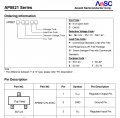
It is beginning to look like a 3.9 V voltage regulator similar to AP8821, possibly AP8821C-39PC.

The output is severely loaded down pulling pin-1 down to 0.61 V and dragging down Vin.
Look for a short on the board on the Vout side.

AP8821 voltage regulator.jpg
 
Top