CV Current Limited Boost Converter

Thread Starter

Christian_Mingle11434

Joined Sep 15, 2025
20
Hello all,

I'm tasked with building a boost converter with the following:


  1. 3-4V in
  2. 12V out
  3. 9A max input current

I realize that to do CV, I need to control the duty cycle as the input voltage and the load changes. I have only ever designed something similar to this in MATLAB, which is very abstracted from the nitty gritty of circuit design.

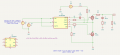
How would I go about designing this converter? I've got my basic converter attached here.

I've also attached a TI report on current mode boost converters, which is a bit daunting to me. Would I be better served with a programmable IC? If so, which would you recommend?
 

Attachments

Irving

Joined Jan 30, 2016
4,996
Welcome to AAC

It would be a lot easier with a dedicated IC which handles loop compensation etc internally, or at least, with easy to work out R & C values.

Assuming you're running off LiPo/LFP batteries down to 3v @ 9A = 27w in @ 85% efficiency = 12v @ 2A out. The difficulty you have is that few switching controllers handle as low as 3v input, yet most integrated switching regulators don't handle >500mA or so. One exception you might look at is TI's TPS61377 which might do the job.
 

Thread Starter

Christian_Mingle11434

Joined Sep 15, 2025
20
Thank you all for the helpful comments. As I understand it, part of this academic project dictates that I design the control loop myself, but as I look deeper into it, it seems daunting.

Designing it is one animal, but then I have to build out a PCB in KiCad (a new program for me), and test it. I believe this is a problem for me to ask myself and my professor, but would you find this difficult to design this from scratch, given my starting circuit? I get the academic purpose of it, but if the goal is to design a PCB, why not use off-the-shelf microcontrollers? Would my amateurish design even be feasible?

Basically, is the juice worth the squeeze?
 

MrAl

Joined Jun 17, 2014
13,667
Hello all,

I'm tasked with building a boost converter with the following:


  1. 3-4V in
  2. 12V out
  3. 9A max input current

I realize that to do CV, I need to control the duty cycle as the input voltage and the load changes. I have only ever designed something similar to this in MATLAB, which is very abstracted from the nitty gritty of circuit design.

How would I go about designing this converter? I've got my basic converter attached here.

I've also attached a TI report on current mode boost converters, which is a bit daunting to me. Would I be better served with a programmable IC? If so, which would you recommend?
Hello there,

Boost converters are a bit more finicky than say buck converters because they have a tendency to reverse control with the duty cycle if the internal losses are too high compared to the load. In a buck converter, if you increase the duty cycle by 1 percent the output goes up by roughly 1 percent, but in a boost that only works for a limited duty cycle as once it passes a critical point it works in the opposite way: a duty cycle increase of 1 percent can cause a 1 percent decrease in output voltage, which disrupts the entire scheme of things.

It's good that you are studying this type of converter using information from various websites that will help a lot. If you are comfortable with state space techniques then you can also read about solutions like that in a paper published on the web some time ago. It goes through various converter types and explains how to analyse them in detail. If you are interested I'll search for it again on the web.
 

Irving

Joined Jan 30, 2016
4,996
part of this academic project dictates that I design the control loop myself, but as I look deeper into it, it seems daunting.
Then I suggest you look at the internals of some of the chips mentioned and aim to replicate those in whole or part. The TI datasheets/app notes are often pretty detailed in their explanations.

One thing to be aware of, following on from @MrAl 's comments, is that boosting > 2 or 3x at higher currents is quite difficult stability wise which is why you see many devices for 3 -> 5v or 5 -> ±15v at 50 - 100mA but almost none outside those boundaries.

One option is the transformer coupled LLC Resonant converter where the feedback mechanism varies frequency rather than duty cycle (basically voltage control by sliding up/down the side of a resonance curve). The transformer coupling makes conversions of n>4 easier, though the overall solution may appear more complex. Here's a paper that gives the design methodology:

https://e2e.ti.com/cfs-file/__key/communityserver-discussions-components-files/1024/slup263.pdf
 

MrAl

Joined Jun 17, 2014
13,667
Quick update: I saw this video by Great Scott and it made me think "yeah, why not run the entire thing on a single programmable microchip?" It would be easy enough to put on a breadboard, and offer me plenty of test points. What do we think of this?
In the somewhat recent past microcontrollers have been used for buck and boost and everything in between. You can probably find code on the web.
 
Top