Cutoff frequency of LC filter

Papabravo

Joined Feb 24, 2006
22,084
According to this TI application note slaa701a.pdf, an LC section requires damping to achieve a maximally flat Butterworth response with no peaking due to resonance.
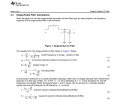
1703629610069.png
With this additional proviso, it seems the traditional formula is correct. This is what you need to do if working in the RF spectrum, but probably won't be used in audio work. You would use an active filter instead.

ETA: an LC section with an undamped resonance peak does not seem like it would be a useful device.
 
Last edited:

MrAl

Joined Jun 17, 2014
13,724
Hello! My first post. I came up with the exact same equation as omar-rodriguez for the -3 dB cutoff frequency for an LC circuit. And like Omar, I am amazed that so many people are assuming the equation 1/(2π sqrt(LC)) is the -3 dB cutoff frequency. That's wrong! That equation is for the resonant frequency, not the -3 dB cutoff frequency. Even DigiKey gets it wrong.

https://www.digikey.com/en/resource...sion-calculator-low-pass-and-high-pass-filter

View attachment 310944
View attachment 310945


View attachment 310946
Hi,

Strictly speaking, that is not an LC filter it is an oscillator. The reason for this is because both the L and the C are ideal components, and that means that they do not dissipate any energy. The energy keeps going from L to C then back C to L then back L to C, etc. That is what we call a sinusoidal.

In some mathematic terms, the Laplace transform is:
V(s)=A/(s^2+A)

and that is an oscillator, with time function:
V(t)=sin(t*sqrt(A))*sqrt(A)

and A=L*C.

This means it cannot perform as a filter as we usually think of as a filter, because it will oscillate forever.

If you want to do a real filter, place a small value resistor in series with L. Most real-life inductors have at least some ESR.
 
Top