Facebook
 Google
 GitHub
 Linkedin

Hi!
Forgive the banality of the question I am about to ask, but being one of the first times to try out instruments of this type, I still lack basic knowledge, which I hope to find here.
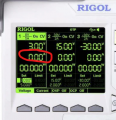
I was feeding two resistors in parallel with a bench power supply (Rigol DP831). The display (the photo is an example from the internet) showed the voltage set by me and the current (and the power V*I).
Unfortunately I don't remember the value of the resistors and the voltage I set (I did a lot of tests) so I can't give a numerical example, but it's no need anyway for my question.
The current value shown in the display (under the voltage value set by me) indicates the total current flowing in the circuit? In other words, the red arrow in the schematic:
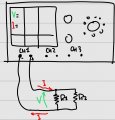
If I only wanted the current on one of the two resistors (without using ohm's law and calculations, but using only a multimeter) I would have to connect an additional multimeter in series with that resistor.
Am I wrong?
Forgive the banality of the question I am about to ask, but being one of the first times to try out instruments of this type, I still lack basic knowledge, which I hope to find here.
I was feeding two resistors in parallel with a bench power supply (Rigol DP831). The display (the photo is an example from the internet) showed the voltage set by me and the current (and the power V*I).
Unfortunately I don't remember the value of the resistors and the voltage I set (I did a lot of tests) so I can't give a numerical example, but it's no need anyway for my question.
The current value shown in the display (under the voltage value set by me) indicates the total current flowing in the circuit? In other words, the red arrow in the schematic:
If I only wanted the current on one of the two resistors (without using ohm's law and calculations, but using only a multimeter) I would have to connect an additional multimeter in series with that resistor.
Am I wrong?