Current draw questions

Thread Starter

Autobike

Joined Feb 23, 2018
109
hello. i've got 2 questions.

1) this is an 8 channel CCTV camera system. it has a separate 12V splitter type power adapter which powers all 8 cameras.
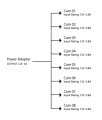
scr2.jpg


Power adapter rated output is 12V 3A. but each camera has a sticker which says "Input Rating 12V 0.8A". so when all the 8 cameras are working and drawing their max current, isn't it going to be 0.8A x 8 = 6.4A ? can someone elaborate. thank you.

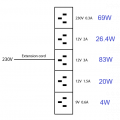
2) I have a 5 way extension cord with these 5 devices are plugged in.
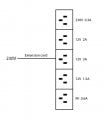
scr1.jpg

i'm trying to calculate the total current at the extension cord (assuming all 5 devices are drawing their max current). thank you.
 

Thread Starter

Autobike

Joined Feb 23, 2018
109
@ericgibbs hi. yea they all have IR LEDs which come into action at night. cameras are working fine.
but my question is when all the 8 cameras are working and drawing their max current, theoretically it should be 0.8A x 8 = 6.4A ? but the factory provided power adapter has a output of 12V 3A.

the mains extension is a separate question. sorry if i didn't make it clear.
it has one TV screen and 4 wifi / internet routers plugged into it. i'm trying to figure out the total current at the extension cord assuming all 5 devices are working and drawing their max current. since they are in different voltages i'm having a trouble to calculate the total current.

thank you.
 
I will give you a little hint on the extension cord.

Calculate the wattage of each device, add them all together and compare the result to the wattage capacity of the cord.

Power = Volts times Amps

For example, if the cord can handle 10 amps that would be 10 x 230 = 2300 watts.

Your 12 volt 2 amp device would be 24 watts.

etc...

This assumes the amp rating of each of the lower voltage devices is the output amperage.
 
Last edited:

B-JoJo-S

Joined Jan 3, 2026
469
when all the 8 cameras are working and drawing their max current, theoretically it should be 0.8A x 8 = 6.4A ? but the factory provided power adapter has a output of 12V 3A.
That is correct. As to why they sent a 3A power supply you'll have to ask them. Either you have the wrong supply or the information on the cameras is not correct. 3 amps divided by 8 devices (cameras at max amperage) would require the cameras not to exceed 0.375 amps (375mA) (3/8 of an amp). That power supply will not provide sufficient power for 8 cameras - assuming the data on the cameras is correct.

By all rights a proper power supply should produce MORE than 6.4 amps. It should produce at least 9.6A to have sufficient head room so the supply doesn't overheat. A good rule of thumb is to double the amps. 6.4 x 2 = 12.8 amps. This case a 12 amp supply would be more than sufficient. Even a 10 amp supply will be plenty of power. Keep in mind you don't want to provide too much amperage availability as it's a waste of power.
 

panic mode

Joined Oct 10, 2011
5,172
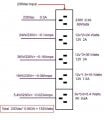
12V * 6.4A = 76.8W
add 10% for losses and you get 83W.

do the same for all other loads... (add 10% to everything that is not already 230VAC load).
so here your total wattage is only some 200W. any power cord should handle that with ease.

1786978293692.png
 

B-JoJo-S

Joined Jan 3, 2026
469
Say what?
If you have a requirement for 5 amps you want a power supply capable for at least 7.5 amps. But to get a 75 amp supply (didn't forget the decimal point) you have a supply that far exceeds the needs of the 5A load. You have a lot of wasted power and money. It won't hurt the 5A device but it's just plain wasteful.

Ohms law says the 5A load will only draw the needed amperage. It will only draw 5A. Meanwhile you'll keep 70 amps in reserve just doing nothing but slowly emitting heat as waste energy.
 
If you have a requirement for 5 amps you want a power supply capable for at least 7.5 amps. But to get a 75 amp supply (didn't forget the decimal point) you have a supply that far exceeds the needs of the 5A load. You have a lot of wasted power and money. It won't hurt the 5A device but it's just plain wasteful.

Ohms law says the 5A load will only draw the needed amperage. It will only draw 5A. Meanwhile you'll keep 70 amps in reserve just doing nothing but slowly emitting heat as waste energy.
Seriously?
 

panic mode

Joined Oct 10, 2011
5,172
switching power supplies have different performance curves for different loads. larger PSU in general may have higher losses. but doing this kind of hair splitting on a circuit powered by mains, where actual load is only some 70W is not going to melt the glaciers or make power bill look any different
 

ericgibbs

Joined Jan 29, 2010
21,531
Hi Auto,
This edited sketch should explain the total loading on the mains extension block.

The transformer you have is not suitable to drive all the Camera's requiring 6.4Amps.
You require a 12V rated at least 8Amps.

In my camera system I use 3 * 12V 1.0A transformers to drive 3 cameras.

E

BTW: Some of the earlier posts have misinformed advice, take care.:rolleyes:

Note: I see that panic mode beat me to it, while I was still prepping.

scr1.jpg
 
Last edited:

panic mode

Joined Oct 10, 2011
5,172
i do not know how discussion turned from 6.4A to 75A. that is making extreme examples with more than 1000% of reserve power. or going down to extremely low power device such as TV remote. choosing PSU that has 10-25% reserves is fine. using one that that has 300-500% reserve power is also ok but you are paying more for the PSU.

example RSP-2000-12 is 12V PSU1200W rate (100A).
https://www.meanwellusa.com/upload/pdf/RSP-2000/RSP-2000-spec.pdf

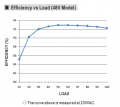
and when loads are extremely low, efficiency does drop. so instead of 92+ %, one gets as low as 80%. so 20% are losses. and since load is 12*6.4A=76.8W, and the losses are 15W. using PSU that has similar efficiency curve but rated for 150W would result in 8% loses or 6W. the difference is 15W-6W = 9W. so saving is real. but that is tiny saving that is spread over very long time and completely unnoticeable.

the big $$$ difference is in the price of PSU ad that is difference you pay up-front:
100A unit will cost some $800,
10A unit will cost $50.
1786980114459.png
 

Thread Starter

Autobike

Joined Feb 23, 2018
109
@ElectricSpidey thank you. got it.
@B-JoJo-S thx a lot for your clarification. i'll send them an email and ask.
@panic mode got it. thank you.
@ronsimpson thank you.

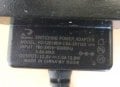
@ericgibbs thx a lot for your explanation. now i got it. i have a small question. for example this is a power adapter which i have at the moment.

pwradap.jpeg

in this case output wattage is 12V x 1A = 12W
input current = 12W / 230V = ~0.052A

adapter says ~0.6A max. is this normal in power adapters that the rated input current is considerably higher than the theoretical input current ( assuming it's drawing the max output current, 1A in this case ) ? thx again.
 

ericgibbs

Joined Jan 29, 2010
21,531
in this case output wattage is 12V x 1A = 12W
input current = 12W / 230V = ~0.052A
adapter says ~0.6A max. is this normal in power adapters that the rated input current is considerably higher than the theoretical input current ( assuming it's drawing the max output current, 1A in this case ) ?
hi Auto,
Reading the label on that PSU, it is a Switched Mode Power supply [SMPS]. the mains input voltage can range from 110Vac to 240Vac, which means the input current can be up to 0.6Amp maximum. The Vout DC is regulated to 12Vdc with a maximum load current of 1 Amp.

The PSU rating would make it suitable for driving only one of your cameras at 12Vdc at 0.8Amp, the camera would draw only 0.8A of the possible maximum 1Amp current from the power supply

Do you follow that OK?
E
 
it is normal...

every AC/DC power supply has rectifier and capacitor... before power is applied capacitor is discharged and essentially short circuit. then when powered on, massive inrush current is charging that capacitor. once the capacitor is charged, current value becomes normal. of course inrush current is significantly larger than normal supply current, specially on small power supplies where circuitry is kept minimal (low cost, small footprint) and absolute inrush current value is low (not a problem for mains).

lets see, 12V * 1A = 12W output. but this is only output power without losses.
input power is 12W + losses (heat dissipated by PSU). lets assume that is 10% (just a rule of thumb). so input power is 12W*1.10 = 13.1W.
if input voltage is 230V, input current is I=P/V=13.2W/230V=0.0574A
that is normal input current when PSU is supplying 1A at 12VDC output.

but the PSU marking says something like 0.6A which is more than 10x lager....but nobody cares since 0.6A is laughably small enough to not be a problem for typical AC outlet/extension cord rated for 10 or 15A.

now lets see what would be the input current for the 1200W PSU mentioned earlier.
output power is 1200W. input power is 1200W + loses (10%). = 1320W.
input current is 1320/230V=5.74A. if this power supply did not have some sort of inrush limiter, input current would be 60A. and that is way beyond 10-15A rating of typical outlet/extension cord. so skipping on inrush limiting is not an option here. that is one of reasons large PSU cost more.
 
The maximum input current of a SMPS is what you might expect operating at minimum input voltage and maximum output current.

The supply shown is not very efficient at its minimum input voltage. (and probably not very efficient at its nominal input voltage either)
 
but that is not the real reason. it simply cannot be that inefficient.
suppose one uses lower supply voltage such as 110VAC. then 0.6A*110VAC=66W. with that amount of power, tiny wall wart style PSU would burst into flames.
 
Top