Current Divison Problem

Thread Starter

kursat53

Joined Jun 7, 2021
1
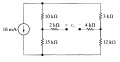
1742649687895.png
Find v0.
The solution of instructor is below:
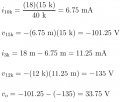
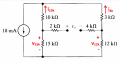
1742649735211.png

I cannot understand two parts
1. Why 2kΩ and 4kΩ are not included in the calculation?
2. Why do the 10kΩ resistor and 15kΩ resistors have the same current value?

I am stucked due to the two parts, please just explain these two and everything will be fine.
Thx for your answers.
 

MrAl

Joined Jun 17, 2014
13,680
View attachment 345154
Find v0.
The solution of instructor is below:
View attachment 345155

I cannot understand two parts
1. Why 2kΩ and 4kΩ are not included in the calculation?
2. Why do the 10kΩ resistor and 15kΩ resistors have the same current value?

I am stucked due to the two parts, please just explain these two and everything will be fine.
Thx for your answers.
Hi,

Welcome to the forum.

As Eric said, think about how much current flows through the 2k and 4k.
If you want to gain some more insight, place a resistor of 10k across Vo then calculate Vo and write down the answer. Next, increase the value of that extra resistor to 100k then calculate Vo again and write down that answer too. Next, increase it again to 1Meg, calculate Vo, then write that down again.
Now compare those three voltages and see what you can figure out. If it does not make sense yet, increase again to 10Meg, calculate Vo and write it down, then to 100Meg, calculate Vo and write it down, and by now you should see what is happening to the voltage Vo as you continue to increase the value of that added resistor.
Then finally think about what could happen if you were able to increase it to a very high value approaching infinity, which is just an open circuit as the original problem has.

This might sound like a little extra work, but it should give you more insight as to why those two resistors are not included. Well, they are included, but they just do not influence the voltages in the original circuit so we can leave them out of the calculations.

In some circuits when we do the analysis one or more resistors might cancel out in the math. That happens a lot really. If you get a result like:
Vout=5*Vin*R1/R1
then you no longer need R1 and just write:
Vout=5*Vin
and that means that the value of R1 does not matter in the circuit (in most cases).
 

WBahn

Joined Mar 31, 2012
32,746
View attachment 345154
Find v0.
The solution of instructor is below:
View attachment 345155

I cannot understand two parts
1. Why 2kΩ and 4kΩ are not included in the calculation?
2. Why do the 10kΩ resistor and 15kΩ resistors have the same current value?

I am stucked due to the two parts, please just explain these two and everything will be fine.
Thx for your answers.
What does Ohm's Law tell you about the relationship between the voltage drop across a resistor and the current flowing through that resistor?

Since one end of the 2 kΩ and the 4 kΩ resistors are unconnected, how much current can flow through them? What implication does this have for the voltage drops across them?

As for your second question, imagine that some current flows into the top of the 10 kΩ resistor. It then reaches the junction with the 2 kΩ resistor and the 15 kΩ resistor. In light of the previous consideration regarding how much current flows in the 2 kΩ resistor, where does ALL of the current in the 10 kΩ resistor have to go?

On another note, your instructor is doing you a disservice by being sloppy with their treatment of units. Sadly, this is very common. They are sloppy because their instructors were sloppy, and now they are teaching you to be sloppy because they don't know any better. But YOU have the opportunity to break the cycle, at least in your own world, by deciding to NOT be sloppy with your units.

Your instructor is ignoring units and then, at the end, tacking on whatever units they want the answer to have. Instead, if your track your units throughout your work, the end result will have the units it actually has. I can't even count the number of times that I have seen people make mistakes and get egregiously wrong answers because they made mistakes in their work that would have screwed up the units but, because they didn't track them, went completely uncaught. I even watched a guy standing next to me get killed because of it.

So, what should your instructor's work have looked like?

\(
i_{10\;k \Omega} \; = \; \frac{\left( 18\;mA \right) \left(15\;k\Omega\right)}{40\;k\Omega} \; = \; 6.75 \; mA
\)

Do you see how the kΩ cancels out, leaving units of mA in the numerator?

In the next line, you have

\(
v_{15\;k \Omega} \; = \; -\left( 6.75\;mA \right) \left(15\;k\Omega\right) \; = \; -101.25 \; V
\)

You should recognize that 1 mA multiplied by 1 kΩ is 1 V. If not, you can fall back on the definition of the ohm as being

\(
1 \; \Omega \; = \; \frac{1\;V}{1\;A}
\)

Dividing both sides by 1 Ω yields

\(
1 \; = \; \frac{\frac{1\;V}{1\;A}}{1 \; \Omega} \; = \; \frac{1\;V}{1\;A\Omega}
\)

We know that we can multiply anything by one and not change it, so we can go back to our earlier equation and augment it with

\(
v_{15\;k \Omega} \; = \; -\left( 6.75\;mA \right) \left(15\;k\Omega\right)\left(\frac{1\;V}{1\;A\Omega}\right) \; = \; -101.25 \; V
\)

And now the units more explicitly work out to V. If needed, we could handle the scaling prefixes similarly, by multiplying by (1 A / 1000 mA) and by (1000 Ω / 1 kΩ) to make things really explicit.

But your instructor's equation also brings up another very poor habit that they are training you to follow -- forcing the reader to pull out a crystal ball and read their mind because they are being too lazy to actually tell you how they are defining things.

They say that the current in the 10 kΩ resistor is 6.75 mA. Okay, but which way is it flowing? Current has both a magnitude and a direction and they need to define a reference direction so that you know unambiguously which direction the current is flowing if it is positive versus if it is negative. In this case, it's pretty easy to look at the diagram and, with just a quick gaze into the crystal ball, read their mind and realize that they are defining the current in that resistor as being the current flowing upward.

But the voltage across it requires a bit more crystal ball gazing. It turns out to be negative, but what does that mean? Where does that minus sign come from? There's no minus sign in Ohm's Law. It comes from an inconsistency on the instructor's part in how they defined the current through that resistor relative to the voltage across it -- basically, they violated the passive sign convention. That's actually fine -- there's nothing that requires the use of that convention. Where the sloppiness comes in is in not clearly defining their variables. Just as the final voltage, Vo, is clearly defined in the diagram both in terms of where it is, but also the reference polarity for it, so too should every other variable that the author uses. The diagram should be annotated with the definitions of each of those variables, instead of forcing the reader to guess what the instructor was thinking. Engineering is not about guessing or mind reading.

This is what their annotated diagram should have looked like:

1742672392426.png

But, even if they had done this, they are still leaving out significant steps, and it is those missing steps that lead directly to your confusion. They didn't establish that the their i_10k is the same as the current in the 15 kΩ resistor (or that their i_3k is the same as the current in the 12 kΩ resistor). It won't be long before you will see this by inspection, but you are still at the level where these things are not quite obvious yet, though, to be fair to the instructor, they may have emphasized these things enough that they expect you to be able to spot them on your own by this point. Similarly, their first equation has a "15 k" in the numerator, but this can lead to confusion because there is a 15 kΩ resistor in the circuit, so is that where the 15 k comes from?

They also don't do a good enough job of explicitly tying the voltages across the 15 kΩ and 12 kΩ resistors to the quantity that you are trying to find. This would have been trivially easy to do by setting up their work as follows, given the annotated diagram above:

Because the 2 kΩ and 4 kΩ resistors each have no current flowing in them, the voltage across each is identically zero. We can therefore find v_o by summing up the voltage drops as we go from the positive terminal to the negative terminal of v_0 round the bottom of the circuit.

\(
v_0 \; = \; v_{2k} \; + \; v_{15k} \; - \; v_{12k} \; + \; v_{4k} \
v_0 \; = \; v_{15k} \; - \; v_{12k}
\)

This makes it clear where the minus sign comes from, and greatly diminishes the chance of screwing up the sign as the work is performed.

I regret that you appear to have an instructor that is fostering these bad habits, and hope that you take the initiative to develop good ones despite that.
 
Top