Facebook
 Google
 GitHub
 Linkedin
Hello everybody!
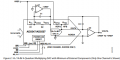
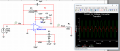
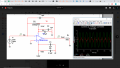
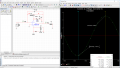
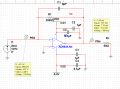
I am currently working on making my own Multichannel AWG. Since the DAC I picked ( AD5547) outputs current, I am designing a simple current to voltage converter at the output. I want my voltage output swing to be +- 5 V . I have included a picture of my multisim simulation below. The output current of my DAC is 2mA and I know that with the feedback used in my design : Vout = 2mA * Rf so Rf = 2500 Ohms . Other than that I just have a couple of decoupling capacitors and a compensating capacitor in parallel with Rf. Also, for simplicity, I am just using one of my DAC's output. The output voltage that I get is not what I'm expecting. I have included my design below. Any help is appreciated.
Thanks.
I am currently working on making my own Multichannel AWG. Since the DAC I picked ( AD5547) outputs current, I am designing a simple current to voltage converter at the output. I want my voltage output swing to be +- 5 V . I have included a picture of my multisim simulation below. The output current of my DAC is 2mA and I know that with the feedback used in my design : Vout = 2mA * Rf so Rf = 2500 Ohms . Other than that I just have a couple of decoupling capacitors and a compensating capacitor in parallel with Rf. Also, for simplicity, I am just using one of my DAC's output. The output voltage that I get is not what I'm expecting. I have included my design below. Any help is appreciated.
Thanks.