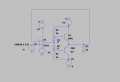
so if it was 9VDC the diode would be in reverse polarization and it wouldnt work, we are lucky we are applying an AC signal that stays at 9V for a brief period of time, right?
The signal, as you have it connected, will force its voltage at the junction of the two diodes. The bases will then be at Vin +0.65V and Vin - 0.65V. In a real circuit , there will be a series resistance in the signal path, so the voltages at the bases will not swing as far as the signal.
Hello all, can someone tell me if i understood this circuit properly?:
This circuit is basically identical to the last post i did, but with a difference, there is an op amp acting as voltage buffer, what he does here is this:
at pin "+" i connected the sine wave and the pin - is connected to the output.
Now what amplifier gonna do is a comparison beetwen the pin + voltage and pin -, and will try to match its output in order to make pin - voltage as close as possible to pin +, in this way with the op amp we compensate the drop of bjt internal diodes etc, cus we use our input as reference.
Secondly we got a low impedance as output.
Is this correct? for what other reason this circuit is used?
so if it was 9VDC the diode would be in reverse polarization and it wouldnt work, we are lucky we are applying an AC signal that stays at 9V for a brief period of time, right?

 Facebook
 Google
 GitHub
 Linkedin