CRO experts please help

BillB3857

Joined Feb 28, 2009
2,573
When I threw the unit together to make the waveforms shown in post #14, I used a 5v relay because that happens to be what I grabbed first. Is your relay a 12vDC or 12vAC relay. Just be sure to use 12VDC for your experiment. If you wire it up as shown in the post #8 diagram, it won't really matter but the waveform expected may be a little different because of the shading pole built into an AC relay.
 

Thread Starter

Pratik_S

Joined Apr 14, 2015
49
When I threw the unit together to make the waveforms shown in post #14, I used a 5v relay because that happens to be what I grabbed first. Is your relay a 12vDC or 12vAC relay. Just be sure to use 12VDC for your experiment. If you wire it up as shown in the post #8 diagram, it won't really matter but the waveform expected may be a little different because of the shading pole built into an AC relay.
I have a 5 v dc spdt relay and a 12 v dc spdt relay can use either of them.
 

Thread Starter

Pratik_S

Joined Apr 14, 2015
49
What kind of power supply do you have? Voltage source should match coil requirement if possible.
I have a 12V DC battery , how to check if the voltage source matches the coil requirement? Its better that I clarify all of my silly doubt's in order to learn electronics well. Thanks.
 

BillB3857

Joined Feb 28, 2009
2,573
Then the 12v battery and the circuit with the NC (Normally Closed) contacts in series with the coil and battery should do it. That makes a buzzer.
 

Thread Starter

Pratik_S

Joined Apr 14, 2015
49
Then the 12v battery and the circuit with the NC (Normally Closed) contacts in series with the coil and battery should do it. That makes a buzzer.
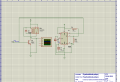
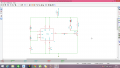
Made a circuit of an astable timer by connecting it with a relay circuit. Please let me know if it is correct. I cannot see an output waveform on the CRO after simulating this ckt. I am new on simulating designs so there might be some silly errors. Using Proteus.
 

BillB3857

Joined Feb 28, 2009
2,573
Simulation probably won't work for you. Simulations probably don't activate relays and act upon the results. Build the real thing with your 12V battery and 12v relay and look at the coil with a scope.
 

Thread Starter

Pratik_S

Joined Apr 14, 2015
49
Simulation probably won't work for you. Simulations probably don't activate relays and act upon the results. Build the real thing with your 12V battery and 12v relay and look at the coil with a scope.
I wonder how did you show me the waveforms with the diode and without it earlier ? BTW i will be doing it on the scope. does this circuit look correct for my purpose ?
 

Attachments

BillB3857

Joined Feb 28, 2009
2,573
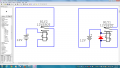
I built the circuit and connected it to my scope. The circuit you show is using a 555 timer to drive the relay through the driver transistor. The circuit I built is nothing more than power, relay and wire.
 

BillB3857

Joined Feb 28, 2009
2,573
Here is the circuit without and with the diode. Connect your scope ground to one relay coil connections and the probe to the other relay coil connection. Connect the battery and observe the wave form. Disconnect power, connect the diode across the coil (be sure to observe polarity, with the cathode being toward the positive connection of the coil), connect power and observe the wave form. Also, listen to the difference in the sound produced.
 

Attachments

MikeML

Joined Oct 2, 2009
5,444
Bill's buzzer is simple, but the operation is somewhat aperiodic. The relay coil current will also not reach steady-state before the contacts open and a new cycle begins.

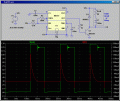
The 555 oscillator makes a more repeatable 'scope trace, and the dwell is sufficient for the relay coil current to settle down before the coil is switched off. Here is the diode current and the voltage at the collector of the transistor with the diode in place:

47r.gif

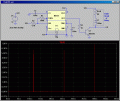
Now, ask yourself what the voltage at V(col) would be if the diode is not there. Can you find a transistor that will not suffer breakdown with no diode to protect it? Note that Spice transistor models do not account for breakdown...

47s.gif
 

Thread Starter

Pratik_S

Joined Apr 14, 2015
49
Bill's buzzer is simple, but the operation is somewhat aperiodic. The relay coil current will also not reach steady-state before the contacts open and a new cycle begins.

The 555 oscillator makes a more repeatable 'scope trace, and the dwell is sufficient for the relay coil current to settle down before the coil is switched off. Here is the diode current and the voltage at the collector of the transistor with the diode in place:

View attachment 84938

Now, ask yourself what the voltage at V(col) would be if the diode is not there. Can you find a transistor that will not suffer breakdown with no diode to protect it? Note that Spice transistor models do not account for breakdown...

View attachment 84939
Hi
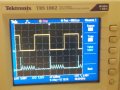
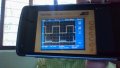
I tested the circuit on the DSO with 2 different transistors with diode and without diode. BC547 showed normal expected results whereas MPSA42 high voltage transistor did not turn off completely as expected, refer the attachment for the same. Why is this happening with MPSA42 ? Any idea? Thanks in advance. @BillB3857
 

Attachments

Last edited:

Thread Starter

Pratik_S

Joined Apr 14, 2015
49
Channel 1 is timer's On - Off trace and channel 2 is Transistor's trace.. When the timer turns off transistor turns off and again swings to On state and becomes unstable.
Not able to understand this behaviour of the transistor. Ideally it should turn off till the timer is off.
 
Top