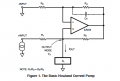
Thanks. I have built a circuit similar to this with impedance matching of 1k ohms for all the resistances. Is there a way to measure my rms current across my load? Because when I put a resistance before my load (About 100 ohms) and I take an oscilloscope to measure the Vrms across that resistance, I was not getting a fixed current of 1mA across the load.
Nevertheless I will still try this on a simulation software first. Thank you!
Umm...no. You can measure voltage across a load or current through it. If you don't know the difference, that calls into question whether you are measuring correctly.
ps, It puzzles me how to need a constant current from an inherently not constant voltage called, "AC".
You seem to have defined it pretty well when you named, "RMS". I think we can work with that.
You want to start with 1V peak and end up with 1 ma RMS. A current pump can do that but it has limitations caused by the resistance of the load. You inserted 100 ohms. Easy enough. 1 ma RMS is 1.414 ma peak, simple math and a couple of resistor values. 1.414 ma into 100 ohms is 0.1414 volts which the amplifier must be able to supply in both positive and negative voltages. Try doing that to 100,000 oms and it all falls apart because the voltage gets ridiculous (141 volts).
Umm...no. You can measure voltage across a load or current through it. If you don't know the difference, that calls into question whether you are measuring correctly.
ps, It puzzles me how to need a constant current from an inherently not constant voltage called, "AC".
You seem to have defined it pretty well when you named, "RMS". I think we can work with that.
You want to start with 1V peak and end up with 1 ma RMS. A current pump can do that but it has limitations caused by the resistance of the load. You inserted 100 ohms. Easy enough. 1 ma RMS is 1.414 ma peak, simple math and a couple of resistor values. 1.414 ma into 100 ohms is 0.1414 volts which the amplifier must be able to supply in both positive and negative voltages. Try doing that to 100,000 oms and it all falls apart because the voltage gets ridiculous (141 volts).
Thanks for your answer. I've been wanting to blow my brains out (figuratively speaking), because I was arguing on this point with the PHD student I am working with. He seems to be unable to accept that the voltage will fluctuate when Z(load) changes. He kept insisting that for current to stay the same, voltage must be the same (Which as you have mentioned according to ohms law, that doesn't work). For testing purposes, we are using Z(load) to be a tank of water.
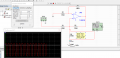
I have tested this circuit across a multisim simulation, and this is the result I got
Increasing the input voltage will give me a higher current at my probe end. So that is not an issue.
I'm using a hypothetical 10k ohms potentialmeter as my water tank here.
I'm guessing I might get a different waveform to this for my actual circuit. I will update again when I have built that circuit and probed it with an oscilloscope.

 Facebook
 Google
 GitHub
 Linkedin