Facebook
 Google
 GitHub
 Linkedin
Hi,
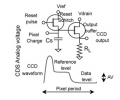
I have attached a file related to the output waveform of a CCD sensor. I am working with one right now and I have a similar waveform, the TCD1209DG to be exact. The signal floats on top of a 5v DC offset and it has a frequency of 12.5MHz, as it follows the phi 1 and phi 2 sampling clocks.
The time at which the output signal is visible, is approximately 30ns. The time at which the reference signal is visible is also approximately 30ns. I would like to introduce correlated double sampling, it however need a very fast switch with pretty fast rise times. In order to isolate the two signals in its respective capacitor. I have looked at MOSFETS with MOSFET drivers, analog switches, etc. But they're not fast enough or draw too much current from the CCD output when connect to the CCD output. I used LTSpice and Microcap-12 to simulate this.
I'd be happy to hear if anybody has suggestions on how to introduce fast switches with around 10ns rise time, or how to process this CCD output signal.
I have attached a file related to the output waveform of a CCD sensor. I am working with one right now and I have a similar waveform, the TCD1209DG to be exact. The signal floats on top of a 5v DC offset and it has a frequency of 12.5MHz, as it follows the phi 1 and phi 2 sampling clocks.
The time at which the output signal is visible, is approximately 30ns. The time at which the reference signal is visible is also approximately 30ns. I would like to introduce correlated double sampling, it however need a very fast switch with pretty fast rise times. In order to isolate the two signals in its respective capacitor. I have looked at MOSFETS with MOSFET drivers, analog switches, etc. But they're not fast enough or draw too much current from the CCD output when connect to the CCD output. I used LTSpice and Microcap-12 to simulate this.
I'd be happy to hear if anybody has suggestions on how to introduce fast switches with around 10ns rise time, or how to process this CCD output signal.
Attachments
-
 37.3 KB Views: 16