Facebook
 Google
 GitHub
 Linkedin

Today I have just repaired a "repaired" old valve (tube) guitar amplifier that belongs to a friend. Being that it is over 40 years old, my friend had taken it to his local repair shop to be overhauled, and to be fair, they had done a pretty good job apart from one thing! They had got the polarity of some coupling capacitors the wrong way round.
The originals had been the old wax and paper type that are notorious for becoming leaky, that is to say, they were more like high value resistors than capacitors due to the paper insulation deteriorating and passing D.C.
The repair shop had replaced them with modern polycarbonate types, and although the amplifier worked well, the hum level was excessive and although they had tried other replacement valves, checked all the grounding etc. and even fitted a hum bucking potentiometer across the heater supply, they were at a loss as to what was wrong.
Now, without trying to sound big headed, I was pretty sure I knew what the problem was.
I carefully noted the way the new capacitors had been fitted and removed them to perform a simple test. On completion of the test I re-fitted the capacitors, 4 of which I wired the opposite way round to which they had been fitted and on testing, Voila ! hum now at a very low and acceptable level.
What they had not taken into account was that in their construction, the capacitors are wound so that there is an outer and an inner layer. It is important to know which is the outer layer so that it can act as a screen to noise pickup. The original paper/wax capacitors had a black band at one end denoting the outer layer (although this can not always be trusted) but the new ones had no such marking. So, how did I determine the outer layer? Very simply with an oscilloscope and my fingers! (you could use the A.C millivolt range on a digital multimeter)
The process is this:- ....... Set the scope time base to sync to your mains line frequency and vertical range to 20mv. Use a probe set to 1.1 and connect the probe earth and tip ACROSS the capacitor under test. Now with you thumb and forfinger, hold the capacitor in its centre without touching either pin. Note the level of hum shown on the 'scope. Now reverse the probe connections and again note the hum level. Whichever way round gives the Lowest hum level, mark with a felt pen, the end of the capacitor that is connected to the probe GROUND connection. THAT is the outer layer.
If the capacitor is used for decoupling, that would be the end to connect to the grounded side. If it is used, as in this case, as a coupling capacitor, the outer layer should go to the lowest impedance side of the circuit. ie the anode (Plate) of the preceding stage, and the other end to the grid of the next tube.
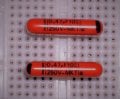
Now just to make life difficult, many capacitors do already come with a black bar at one end (see the photo's) that DO NOT accurately indicate the outer layer correctly.
To demonstrate this, I tested twenty or so of the capacitors shown in the photo's, and it was about a 50/50 split between those that were correct, and those that were not. I used a permanent marker to indicate the correct outer layer end.
Oh, the cause for the hum pickup was mainly due to the old twisted wire heater wiring being very close to the capacitors, so that when connected
the "wrong way round" they were picking up the hum.
The originals had been the old wax and paper type that are notorious for becoming leaky, that is to say, they were more like high value resistors than capacitors due to the paper insulation deteriorating and passing D.C.
The repair shop had replaced them with modern polycarbonate types, and although the amplifier worked well, the hum level was excessive and although they had tried other replacement valves, checked all the grounding etc. and even fitted a hum bucking potentiometer across the heater supply, they were at a loss as to what was wrong.
Now, without trying to sound big headed, I was pretty sure I knew what the problem was.
I carefully noted the way the new capacitors had been fitted and removed them to perform a simple test. On completion of the test I re-fitted the capacitors, 4 of which I wired the opposite way round to which they had been fitted and on testing, Voila ! hum now at a very low and acceptable level.
What they had not taken into account was that in their construction, the capacitors are wound so that there is an outer and an inner layer. It is important to know which is the outer layer so that it can act as a screen to noise pickup. The original paper/wax capacitors had a black band at one end denoting the outer layer (although this can not always be trusted) but the new ones had no such marking. So, how did I determine the outer layer? Very simply with an oscilloscope and my fingers! (you could use the A.C millivolt range on a digital multimeter)
The process is this:- ....... Set the scope time base to sync to your mains line frequency and vertical range to 20mv. Use a probe set to 1.1 and connect the probe earth and tip ACROSS the capacitor under test. Now with you thumb and forfinger, hold the capacitor in its centre without touching either pin. Note the level of hum shown on the 'scope. Now reverse the probe connections and again note the hum level. Whichever way round gives the Lowest hum level, mark with a felt pen, the end of the capacitor that is connected to the probe GROUND connection. THAT is the outer layer.
If the capacitor is used for decoupling, that would be the end to connect to the grounded side. If it is used, as in this case, as a coupling capacitor, the outer layer should go to the lowest impedance side of the circuit. ie the anode (Plate) of the preceding stage, and the other end to the grid of the next tube.
Now just to make life difficult, many capacitors do already come with a black bar at one end (see the photo's) that DO NOT accurately indicate the outer layer correctly.
To demonstrate this, I tested twenty or so of the capacitors shown in the photo's, and it was about a 50/50 split between those that were correct, and those that were not. I used a permanent marker to indicate the correct outer layer end.
Oh, the cause for the hum pickup was mainly due to the old twisted wire heater wiring being very close to the capacitors, so that when connected
the "wrong way round" they were picking up the hum.


 But the wax sticks to everything!