Cooling Resistors - how to

Thread Starter

Lumenosity

Joined Mar 1, 2017
614
I have a couple of large resistors. Maybe 5 Watt. They run about 150F under load.
I'd like to cool them. What's the best way? Are there resistor heat sinks?
Would these benefit from cooling?
Should I just replace them with higher capacity resistors of the same resistance value?
Looks to me like a 230 ohm resistor. Not sure the watts.

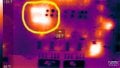
LargeResistors.jpg

LargeResistors2.jpg
 

Tonyr1084

Joined Sep 24, 2015
9,744
A higher wattage rated resistor isn't going to run any cooler. The fact is that so many amps at so many volts produces so many watts. Those watts are there regardless of what you put there to handle them. Needless to say, running 5 watts through a 1/2 watt resistor would burn it out. Running 5 watts through a 10 watt resistor still has to dissipate 5 watts of heat. Even if you put a 100 watt resistor there, there's still 5 watts of heat energy to be dissipated.

If you really want to run things cooler then you'll need heat sink mounted resistors and have a fan blowing on the fins of the sink. Actually the fan is optional, you could depend on natural convection. But if you're that concerned about the amount of heat then the heat sink is the way to go. A fan makes it that much better.

Now, if you REALLY want to go overboard with this, you could set up a water (or oil) cooled heat sink. But now I'm just being plain peanuts!
 

crutschow

Joined Mar 14, 2008
38,316
A higher wattage rated resistor isn't going to run any cooler.
Have to disagree with you on that. ;)

Higher wattage resistors are larger so they have more surface are for conduction and radiation of the heat.
If there were no difference in temperature between a lower and higher wattage resistor than how could a higher wattage resistor handle more power without exceedings its maximum temperature (assuming they both have the same maximum temperature rating)?
 

Tonyr1084

Joined Sep 24, 2015
9,744
Higher wattage resistors are larger so they have more surface are for conduction and radiation of the heat.
True. And I agree. However, even though there's a larger surface area to distribute the heat, the heat is still there. 5 watts is still 5 watts. 25˚ C is still 25˚ C, whether it's distributed over a small area or large. The physics remains the same.

The heat sink is just an extension of the surface area by which heat is distributed. A fan aids in stripping the heat away, but the heat, nevertheless, needs to go somewhere. Energy can neither be created nor destroyed. It can only be changed from one form to another. In this case electrical energy is being converted into heat energy. Conservation of energy just agrees with the fact that energy can neither be created nor destroyed. It still exists. Be it in the form of electrical energy, kinetic, potential, heat - or any other form of energy, it still remains constant. It is what it is regardless of its form.
 

be80be

Joined Jul 5, 2008
2,394
It's like this if you was in a room 10 feet by 10 feet you would not feel the heat
same thing here if it's bigger the heat will be lower and Yes you still have 5 watts burning off just over more space.
 

Tonyr1084

Joined Sep 24, 2015
9,744
Perhaps I should amend my comment in post #6:

Heat energy, though it remains constant, a smaller surface area will glow red hot when it reaches a certain temperature. A larger surface area won't glow red hot because, as Crutschow said, it IS a larger surface area. Forcing energy into a confined spot intensifies its affect in that local area. So Crutschow's comment is in fact valid. You probably can't hold a 5 watt resistor heated with 5 watts in the palm of your hand without feeling the urgency to drop it, whereas, 5 watts in a 100 watt resistor, you can probably hold that and feel its warmth but not get burned.

To answer your question about cooling them - you could simply add a fan to strip away the heat. Not likely necessary, but that's one solution. Another would be to remotely mount 10 watt resistors and run wires to their original locations to move the heat energy away from the board. I've seen boards cook over time from hot resistors. Those aluminum bodied resistors that mount to a heat sink would be an excellent way of moving the heat away from the board. (to give one possible answer the question) But also consider this: 5 watts moving through the resistor is also moving through the board. Through its traces too. Not that your board is running at 5 watts, going off your comment about 5 watt resistors. And those don't look like 5 watters to me. 2 watts is a pretty big resistor. Those look more like, if anything big, 1 watt.
 
Last edited:

RichardO

Joined May 4, 2013
2,270
Elevating the resistor off the surface of the board might reduce the temperature by getting better air flow around it. This is a trade off, however. The traces on the PCB conductor some heat away from the resistor and short leads have less thermal resistance from the resistor to the PCB trace.
 

Tonyr1084

Joined Sep 24, 2015
9,744

Tonyr1084

Joined Sep 24, 2015
9,744
OK. True. But the question isn't "Do I need to cool these resistors?" It's "How to cool resistors" (or "Cooling resistors, how to?") How? By blowing on them. Necessary? Probably not. But that's not the question. If someone asks how to turn a Dodge Ram Pickup into a Toyota Prius the answer shouldn't be "Why would you want to do that?" The point is that this is what is wanted.

I had a stereo that I played at loud volumes. Unfortunately it kept going into thermal overload. So I added a fan to the heatsink. WHY did I play it at overload levels? Because I was playing drums. Had to hear the music over my drums. But under normal conditions there was no need to put a fan on it. Still, it's what I wanted to do for my own reasons.
 

ebp

Joined Feb 8, 2018
2,332
I think they are probably rated at 2 watts, which is fairly common for that style. They will be film type, possibly metal oxide film. They typically are much less robust than wirewound, but also have much lower inductance, particularly for higher values.

I have resorted to adding cooling to components like that where the circuit board was phenolic-paper. Phenolic boards don't take heat very well and tend to become somewhat brittle after a few years. My method is to solder pieces of copper foil to the leads. Depending on the part it can easily increase the surface area for heat radiation by a factor of two or more. The type of copper foil sold in crafts stores for "tooling" is suitable, though I have no idea if anyone does copper tooling anymore. It is not a method I would recommend for anything subject to vibration.

I once saw a datasheet for a Philips power resistor with some parameter specified for room temperature of (can't remember - I think it was) 150°C, which is rather warm, as rooms go.
 

AnalogKid

Joined Aug 1, 2013
12,043
even though there's a larger surface area to distribute the heat, the heat is still there. 5 watts is still 5 watts. 25˚ C is still 25˚ C, whether it's distributed over a small area or large. The physics remains the same.
The physics *of radiation* is the same.

5 W is 5 W, but 5 W in one package will *not* have the same surface temperature as 5 W in a larger package. The larger part will run cooler because the 5 W is radiating away over a larger surface area. If this were not true, oversizing a component would not affect its long-term reliability, and it really truly does. In round numbers, and comparing components of identical materials and construction, a 10 W resistor dissipating 5 W will run approx 25% - 33% of the 5 W component surface temperature increase above ambient. There is a reason that all MIL contractors require that components not run above 50% of their power ratings, and this is it.

Construction is important, and it confuses things. At Digi-Key it is easy to find 3 W rated resistors that are smaller than 2 W parts. So your issue here is size, not ratings. A larger part will run cooler without resorting to thermal grease or heatsinks. If you gap the parts up even 1/8" above the surface of the board, that will make a large difference in the operating temperature.

ak
 
Last edited:

crutschow

Joined Mar 14, 2008
38,316
If someone asks how to turn a Dodge Ram Pickup into a Toyota Prius the answer shouldn't be "Why would you want to do that?" The point is that this is what is wanted.
Well, okay.
But I see no point to tell someone how to do something when he has an erroneous reason for wanting to do it. :rolleyes:
 

WBahn

Joined Mar 31, 2012
32,703
True. And I agree. However, even though there's a larger surface area to distribute the heat, the heat is still there. 5 watts is still 5 watts. 25˚ C is still 25˚ C, whether it's distributed over a small area or large. The physics remains the same.

The heat sink is just an extension of the surface area by which heat is distributed. A fan aids in stripping the heat away, but the heat, nevertheless, needs to go somewhere. Energy can neither be created nor destroyed. It can only be changed from one form to another. In this case electrical energy is being converted into heat energy. Conservation of energy just agrees with the fact that energy can neither be created nor destroyed. It still exists. Be it in the form of electrical energy, kinetic, potential, heat - or any other form of energy, it still remains constant. It is what it is regardless of its form.
But what matters is the temperature of the resistive material. If you have a 5 W resistor and a 10 W resistor and both are same resistor type rated to dissipate that much power at ambient with no cooling, then both are designed to have the resistive material be at the same temperature when dissipating the rated power. The physical construction of the 10 W resistor is simply intended to be able to conduct twice as much heat into the ambient air while maintaining the same internal temperature and relying on the ambient air's ability to move the heat away from the surface of the resistor through a variety of mechanisms.

But a direct consequence of this is that the resistive material in the 10 W resistor will then be much cooler when it is only dissipating 5 W than the 5 W resistor will be at that same power level.

Now, there are a number of factors that complicate things. Resistors mounted near a PCB with lots of other components around it cannot be considered to be "in free air" negate the basic differences between the two resistors.
 

WBahn

Joined Mar 31, 2012
32,703
OK. True. But the question isn't "Do I need to cool these resistors?" It's "How to cool resistors" (or "Cooling resistors, how to?") How? By blowing on them. Necessary? Probably not. But that's not the question. If someone asks how to turn a Dodge Ram Pickup into a Toyota Prius the answer shouldn't be "Why would you want to do that?" The point is that this is what is wanted.

I had a stereo that I played at loud volumes. Unfortunately it kept going into thermal overload. So I added a fan to the heatsink. WHY did I play it at overload levels? Because I was playing drums. Had to hear the music over my drums. But under normal conditions there was no need to put a fan on it. Still, it's what I wanted to do for my own reasons.
True up to a point. But consider often we see people that ask for specific help with a specific problem and, after the discussion progresses, it becomes apparent that the problem they are trying to solve is only their understanding of what it will take to solve some other problem and, once the other problem is brought into play, there is a much simpler and better way to solve it. I can't even count the number of times that this has been the case with paying customers -- indeed, the very fact that they are willing to pay someone to solve a problem for them is a potential indication that they may not really have an understanding of just what the real problem is that they are trying to solve and we have a responsibility to try to spot when that is the case and to help them establish whether the problem they asked us to solve really is the one that needs solving.

That may well be the case here. We should probably be asking, "Why do you think the resistors need to be cooled?" If the answer is that they are really hot to the touch, then reassurance that they are well within their operating specs may be enough to solve the problem (which was "my resistors are really hot to the touch" and not "my resistors need to run cooler"). But if the answer is that components near those resistors are running out of spec as a result of the heat from these resistors, then that is a different problem and just putting higher wattage resistors there probably won't solve that problem, even if the temperature comes down, since the same heat energy is being dumped into the same volume of air in either case.
 

MrAl

Joined Jun 17, 2014
13,667
Hello,

The question is about keeping the temperature lower, so i'll address that directly. The question of whether it needs to be lowered or not depends on a lot of different factors such as proximity to other components so i wont really asdress that at all.

Power heating causes temperature rise, and so the temperature rise depends on the amount of power heating and also the effective surface area that acts as the interface between the body and the ambient air. The temperature rise behavior can be modeled approximately as the amount of heat divided by the surface area, brought up to a constant power and then multiplied by another constant:
Trise=K1*(P/A)^K2

Note this is the temperature rise so the temperature of the body would actually be that plus the ambient temperature:
T=Trise+Tambient

Now since we are looking for a reduction in Trise we can turn it into a ratio of temperature rises and thus come up with something simpler. This means we can seek a temperature rise decrease of say 50 percent or say 66 percent.

Because of the exponent it turns out that for an increase in surface area of 4 times, the tempuerature rise reduces to about 33 percent of the original temperature rise. This is equivalent approximately to using 4 resistors of the same shape instead of just 1. That means if the target resistance is 100 Ohms, then we could put four 25 Ohm resistors in series or four 400 Ohm resistors in parallel, or two 100 Ohm resistors in series making two strings and then put those two stings in parallel, which is probably the best way to do it. OF course there has to be spacing between the devices or else we loose some of that increase in surface area.
For example if the temperature was 120 degrees C with a 30 degree C ambient then went we use four resistors instead of just one the temperature should drop to approximately 60 degrees C because the rise is 90 and 1/3 of that is 30, and 30+30=60 degrees C.
The resistors should be the same shape and made the same also in order to be sure to get the reduction expected.

Another way of course is to run wires off the PC board to a chassis mount resistor of a higher wattage. We just have to watch the ratings of those resistors because of the way they rate them as sometimes they assume a decent chassis size too. We then would also have to consider increased EMI and other possible side effects.

Just to note, the surface area ratio for about 1/2 the temperature RISE is around 2.3 which is somewhat close to 2, so very very roughly about twice the surface area leads to about one half the temperature RISE, but remember that 4 times the surface area leads to only about 1/3 the temperature RISE not 1/4. To get about 1/10 the temperature rise we'd need about 16 times the original surface area, quite a difference.
 
Last edited:

ArakelTheDragon

Joined Nov 18, 2016
1,366
First calculate the power over them. If possible use 2 in parallel, which will half the power and tell us the result.

Otherwise you need a heatsink and maybe a fan.
 
Top