Convolution

Thread Starter

mo2015mo

Joined May 9, 2013
157
Hi guys :) ,,,

I'm studying the Convolution from Signals & systems course, usually i have X(t): input signal and h(t): response to find y(t):eek:utput signal of a system
as y(t) = x(t)* h(t) = ∫x(τ) h(t-τ) dτ = ∫h(τ) x(t-τ) dτ

But How we can find h(t) if we have x(t) & y(t)??

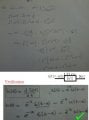
really i tried to find it but i have confused,, i attached photo with two examples A & B and assume that y(t) is an arbitrary function .

In example A ,, x(t) represents u(t):unit-step function so the Y(t) represents S(t)
==> H(t) = d/dt( S(t) ) = d/dt( exp(-t) ) = -exp(-t) Is it correct ??

In example B ,, x(t) represents the rect function u(t)-u(t-1) so the Y(t) represents S(t)-S(t-1)
==> H(t) = d/dt( S(t)-S(t-1) ) = ?? Is it correct ??

and Is there a General method to find H(t)??
 

Attachments

anhnha

Joined Apr 19, 2012
904
Hi,
Do you know Laplace transform?

\(\mathcal{L}\{f(t)*g(t)\} = F(s).G(s)\)

Where: *: convolution operator
And F(s), G(s) are the Laplace transform of f(t), g(t), respectively.

Therefore, in your case:

y(t) = x(t)* h(t)

Lapace transform:

\(\mathcal{L}\{y(t)\} = \mathcal{L}\{x(t)* h(t)\} = X(s).H(s)\)

From which:

\(H(s) = \frac{\mathcal{L}\{(y(t)\}}{X(s)} \)

\(h(t)= \mathcal{L}^{-1} \{H(s)\}\)
 

anhnha

Joined Apr 19, 2012
904
Here is an example for case A:

x(t) = u(t)
In your picture, y(t) is not e^(-t ). Let's assume that y(t) have this form:

y(t) = 0 for t< a
y(t) = e^(-t ) for t>= a

And therefore we can rewrite it as follows:

y(t) = e^(-t ).u(t-a)

\(\mathcal{L}\{x(t)\} = \mathcal{L}\{u(t)\} = \frac{1}{s} \)

\(\mathcal{L}\{y(t)\} = \mathcal{L}\{ e^{-t} u(t-a)\} = \frac{ e^{-as} }{s+1} \)

\(H(s) = \frac{\mathcal{L}\{(y(t)\}}{X(s)} = \frac{ s.e^{-as} }{s+1} = e^{-as}(1 - \frac{1}{s+1} )\)

\(h(t)= \mathcal{L}^{-1} \{H(s)\}= \mathcal{L}^{-1} \{e^{-as}(1 - \frac{1}{s+1} )\} = \mathcal{L}^{-1} \{ \ e^{-as} \} - \mathcal{L}^{-1} \{ \frac{e^{-as}}{s + 1} \} \)

\(h(t)= \delta (t-a) - e^{-t}.u(t-a) \)

PS. Hope I didn't make any mistake.
 

Thread Starter

mo2015mo

Joined May 9, 2013
157
Here is an example for case A:

x(t) = u(t)
In your picture, y(t) is not e^(-t ). Let's assume that y(t) have this form:

y(t) = 0 for t< a
y(t) = e^(-t ) for t>= a

And therefore we can rewrite it as follows:

y(t) = e^(-t ).u(t-a)

\(\mathcal{L}\{x(t)\} = \mathcal{L}\{u(t)\} = \frac{1}{s} \)

\(\mathcal{L}\{y(t)\} = \mathcal{L}\{ e^{-t} u(t-a)\} = \frac{ e^{-as} }{s+1} \)

If F(s)=L{f(t)} then L{u(t−a)⋅g(t−a)}=e^(−as). G(s)
so L{y(t)} = L{e^(-t)u(t−a)}= e^(-a)*e^(−as)/(1+s)


\(H(s) = \frac{\mathcal{L}\{(y(t)\}}{X(s)} = \frac{ s.e^{-as} }{s+1} = e^{-as}(1 - \frac{1}{s+1} )\)

\(h(t)= \mathcal{L}^{-1} \{H(s)\}= \mathcal{L}^{-1} \{e^{-as}(1 - \frac{1}{s+1} )\} = \mathcal{L}^{-1} \{ \ e^{-as} \} - \mathcal{L}^{-1} \{ \frac{e^{-as}}{s + 1} \} \)

\(h(t)= \delta (t-a) - e^{-t}.u(t-a) \)

PS. Hope I didn't make any mistake.
thanx v v very much Mr. anhnha
 
Last edited:

anhnha

Joined Apr 19, 2012
904
If F(s)=L{f(t)} then L{u(t−a)⋅g(t−a)}=e^(−as). G(s)
so L{y(t)} = L{e^(-t)u(t−a)}= e^(-a)*e^(−as)/(1+s)
Yes, you are correct.

\(\mathcal{L}\{u(t)\} = \frac{1}{s} \)


\(\mathcal{L}\{u(t -a)\} = \frac{ e^{-as} }{s}\)

\(\mathcal{L}\{(y(t)\}= \mathcal{L}\{\ e^{-t}u(t -a)\} = \frac{e^{-a(s+1)}}{s + 1} \)


And then you need to multiply the result above with e^-a.
 

Thread Starter

mo2015mo

Joined May 9, 2013
157
Yes, you are correct.

\(\mathcal{L}\{u(t)\} = \frac{1}{s} \)


\(\mathcal{L}\{u(t -a)\} = \frac{ e^{-as} }{s}\)

\(\mathcal{L}\{(y(t)\}= \mathcal{L}\{\ e^{-t}u(t -a)\} = \frac{e^{-a(s+1)}}{s + 1} \)


And then you need to multiply the result above with e^-a.
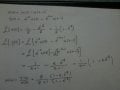
yes, i solved it as attached photo(A) and verified it.
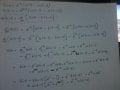
and i tried to solve example B as attached photo(B). :) Is it correct?? if correct how we can complete it
thanx 4 your help Mr. Anhnha :):)
 

Attachments

anhnha

Joined Apr 19, 2012
904
For part A.

Here is my opinion:

There are two ways to write your function:
1.

\(y(t) =\begin{cases}0 & t<a \\ e^{-t} & t \geq a\end{cases} \)

2.

\(y(t) = e^{-t}.u(t-a) \)

#1 and #2 are the same.

You wrote it like this:

\(y(t) =\begin{cases}0 & t<a \\ e^{-t}u(t-a) & t \geq a\end{cases} \)

I don't think it is incorrect but it is redundant.

\(e^{-t}.u(t-a) \) already says that y(t) = 0 for t<a.

And your solution for part A is correct. Now I recognize that I did make a few mistakes.:(

I will check part B now.
 

anhnha

Joined Apr 19, 2012
904
For part B, here is my view. You have to check that if it is correct or not.

x(t) = u(t) - u(t-1)
y(t) = s(t) - s(t-1)

\(X(s) = U(s)- e^{-s}U(s) = U(s)(1 - e^{-s})\)

\(Y(s) = S(s)- e^{-s}S(s) = S(s)(1 - e^{-s})\)

\(H(s) = \frac{Y(s)}{X(s)} = \frac{S(s)}{U(s)} \)

And therefore H(s) is same as in case A.
 

Thread Starter

mo2015mo

Joined May 9, 2013
157
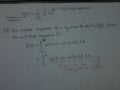
I have another question as attached photo ,, Given the impulse response as a rect(t-2/2) and required the unit-step response
i tried to get it by S(t)=∫h(t) dt but i faced the problem with integration of the unit-step function... :confused:
 

Attachments

anhnha

Joined Apr 19, 2012
904
I have another question as attached photo ,, Given the impulse response as a rect(t-2/2) and required the unit-step response
i tried to get it by S(t)=∫h(t) dt but i faced the problem with integration of the unit-step function... :confused:
Well, you know that u(t-1) - u(t-3) is equal to 1 for t= [1; 3] and zero otherwise, right?

\(\int_0^t (u(t-1) -u(t-3))dt = \int_1^3 1.dt = 2\)

BTW, I think you should research to know why your method h(t) = ds(t)/dt doesn't work. I don't remember it now. Hope someone can help.
 

Thread Starter

mo2015mo

Joined May 9, 2013
157
Well, you know that u(t-1) - u(t-3) is equal to 1 for t= [1; 3] and zero otherwise, right?

\(\int_0^t (u(t-1) -u(t-3))dt = \int_1^3 1.dt = 2\) <=== Incorrect i don't find any answer equals to 2 in multiple choices of this question .

BTW, I think you should research to know why your method h(t) = ds(t)/dt doesn't work. I don't remember it now. Hope someone can help.
Hope someone can help :)
 

Attachments

WBahn

Joined Mar 31, 2012
33,194
I'm not following some of your notation.

What is the difference between y(t) and Y(t)?

What is S(t)?

You don't need others to tell you if your proposed answer is correct or not. Once you have found what you believe is h(t), then convolve it with x(t) and see if you get the correct y(t).

You need to start developing the ability to check your own work. The people paying you will be paying you precisely because they need to solve problems that they don't know the answer to.
 
Top