Converting Transfer Function Into Circuits

MrAl

Joined Jun 17, 2014
13,709
Yes - that is one of the classical integrator filter topology (KHN structure).
The pole frequency is wp=SQRT(1/kr*T1*T2) with kr=R5/R6 and T1=R1C1 and T2=R2C2
Hello,

You are just making things more difficult for him by trying to introduce another method which also is not as general. It's up to you though if you want to help him alone then i'll take off and you can take over the help.
 

LvW

Joined Jun 13, 2013
2,030
So to fulfil my requirement, all my R value will be 1000 ohm and all my C value will be 2.2uF right? Then what does the R3 and R4 does? What will be the overall transfer function?
I did not check your component values...you have the formula for wp; that is sufficient.
There are many second-order functions with the same pole frequency (different pole-Q).
R3 and R4 are important for selecting/adjusting the desired pole-Q (Butterworth, Chebyshev,...)
 

Thread Starter

aarontan0219

Joined Nov 16, 2019
22
Hello,

You still have too many integrations so it cant be right base on just that fact alone.
Also, the signal R and C "integrators" are not true integrators. They are low pass filters which are not just integrators even though they contain an integrator.

You need to create a block diagram first. That't the general technique. If you take shortcuts you wont learn the general way to do these so when something more complicated comes up in the future you wont know what to do.
This is what i did according to your steps. If its wrong please tell me where its wrong as this is my only understanding base on my study and what my lecturer had taught. And he just want the circuit with combinations of inverting or non inverting integrators and amplifiers.1.jpg
 

Thread Starter

aarontan0219

Joined Nov 16, 2019
22
Hello,

You are just making things more difficult for him by trying to introduce another method which also is not as general. It's up to you though if you want to help him alone then i'll take off and you can take over the help.
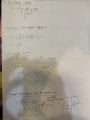
Sorry its ok if you continue to lead me as I more understand on your method and more detail.
 

MrAl

Joined Jun 17, 2014
13,709
This is what i did according to your steps. If its wrong please tell me where its wrong as this is my only understanding base on my study and what my lecturer had taught. And he just want the circuit with combinations of inverting or non inverting integrators and amplifiers.View attachment 192005
Hi,

Two main points here.

First, the RC front end is not an integrator. An integrator has function:
y/x=1/s

while the passive RC has function:
y/x=1/(s+1)

which is much different.

Breaking down the true integrator 1/s we have:
y/x=1/s
y=x/s

so that is an integration of x.

Now break down the passive RC network with RC=1:
y/x=1/(s+1)
y*s+y=x
y+y/s=x/s
y=x/s-y/s

so you see the passive RC has a feedback term while a true integrator does not have that. Sometimes you can work that into the system but you may not be able to do that with this system. Let's make RC non unity and do the breakdown again:
y/x=1/(s*RC+1)
y*s*RC+y=x
y*RC+y/s=x/s
y*RC=x/s-y/s
y=x/(s*RC)-y/(s*RC)
or written another way:
y=x*(1/RC)/s-y*(1/RC)/s

so we see we have the same gain 1/RC for both terms which is not very general because to stay general we have to have a method that allows us to use any gain we need for either term and they are very often not the same.
One of the goals is to stay as general as possible so this technique works with ANY system we come across.

The second point here is that if you have a second order system you must only use two integrators. If you had a third order system you would use three integrators, a fourth order system four integrators, etc.
You are using four integrators but only have a 2nd order system so you need to cut back to only two integrators.
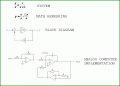
Note in my example system i gave a while back there are three integrators and that is because it is a 3rd order system, and also note the forward paths and feedback paths all utilize those same integrators. So we dont use separate integrators for the feedback we use the same ones that are used for the forward paths. So for a 2nd order system the two integrators are shared between the forward paths and feedback paths. It's not that hard to do because you just add the forward signals to the feedback signals using a summing block which turns into just an op amp that sums two or more signals as i am sure you know.
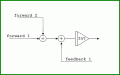
The attachment shows the basic idea of how to combine forward and feedback paths.
The two circles with the plus signs inside are just summing junctions. They add the two signals and provide the output on the right hand side of the circle.

System-002b.gif
 
Last edited:

Thread Starter

aarontan0219

Joined Nov 16, 2019
22
SA
Hi,

Two main points here.

First, the RC front end is not an integrator. An integrator has function:
y/x=1/s

while the passive RC has function:
y/x=1/(s+1)

which is much different.

Breaking down the true integrator 1/s we have:
y/x=1/s
y=x/s

so that is an integration of x.

Now break down the passive RC network with RC=1:
y/x=1/(s+1)
y*s+y=x
y+y/s=x/s
y=x/s-y/s

so you see the passive RC has a feedback term while a true integrator does not have that. Sometimes you can work that into the system but you may not be able to do that with this system. Let's make RC non unity and do the breakdown again:
y/x=1/(s*RC+1)
y*s*RC+y=x
y*RC+y/s=x/s
y*RC=x/s-y/s
y=x/(s*RC)-y/(s*RC)
or written another way:
y=x*(1/RC)/s-y*(1/RC)/s

so we see we have the same gain 1/RC for both terms which is not very general because to stay general we have to have a method that allows us to use any gain we need for either term and they are very often not the same.
One of the goals is to stay as general as possible so this technique works with ANY system we come across.

The second point here is that if you have a second order system you must only use two integrators. If you had a third order system you would use three integrators, a fourth order system four integrators, etc.
You are using four integrators but only have a 2nd order system so you need to cut back to only two integrators.
Note in my example system i gave a while back there are three integrators and that is because it is a 3rd order system, and also note the forward paths and feedback paths all utilize those same integrators. So we dont use separate integrators for the feedback we use the same ones that are used for the forward paths.
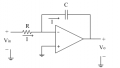
So u mean my circuit of inverting integrator are incorrect? As i search the internet for the circuit like below.
1574258609326.pngAnd the transfer function of it which is-1/sCRis derived by nodal analysis.
Vin/R+Vout sC = 0
Vin + Vout sCR=0
Vout sCR=-Vin
Vout/Vin=-1/sCR
 

LvW

Joined Jun 13, 2013
2,030
Aaron . ...I cannot understand ......in post'17 you have shown a circuit which can fulfill your requirements.
Why don`t you stick to this topology?
 

Thread Starter

aarontan0219

Joined Nov 16, 2019
22
Aaron . ...I cannot understand ......in post'17 you have shown a circuit which can fulfill your requirements.
Why don`t you stick to this topology?
As I need to fulfill the requirements of the Transfer Fuction given and I dont understand about the calculation of it as well as the uses of wp.
 

LvW

Joined Jun 13, 2013
2,030
Now, as you know the name of the filter structure - you should be able to start an Internet search by yourself for some more information and formulas and design strategies.
When you want to design a second-order lowpass with a certain specification it is absolutely necessary to know the corresponding terms (pole frequency, pole-Q). In an earlier post I have asked you if you know the general form for a 2nd-order lowpass function...this function shows explicitely the role of this two pole parameters . We cannot design the circuit for you.......at first, you must try to gain a basic understanding of the various filter functions and the corresponding terminology.
 
Last edited:

MrAl

Joined Jun 17, 2014
13,709
SA

So u mean my circuit of inverting integrator are incorrect? As i search the internet for the circuit like below.
View attachment 192018And the transfer function of it which is-1/sCRis derived by nodal analysis.
Vin/R+Vout sC = 0
Vin + Vout sCR=0
Vout sCR=-Vin
Vout/Vin=-1/sCR
No that part is fine. It is the PASSIVE RC sections that do not work as you suspect.
 

Thread Starter

aarontan0219

Joined Nov 16, 2019
22
No that part is fine. It is the PASSIVE RC sections that do not work as you suspect.
which part is the passive RC. So u mean the first diagram i drawn is correct already right? Just some of the part are wrong? If yes, which part? Inverting integrator, non inverting integrator or summing amplifier. As my lecturer accept the design and i dont want to waste my time simplify it as the deadline is this coming friday. Then whar should i change to the passive RC to make it works?
 

MrAl

Joined Jun 17, 2014
13,709
which part is the passive RC. So u mean the first diagram i drawn is correct already right? Just some of the part are wrong? If yes, which part? Inverting integrator, non inverting integrator or summing amplifier. As my lecturer accept the design and i dont want to waste my time simplify it as the deadline is this coming friday. Then whar should i change to the passive RC to make it works?
The passive RC section(s) is the R and C that are alone with no op amp.
The inverting integrators with op amps are correct, but you do have to deal with the inversion also.

Here is a true integrator although it also inverts so you have to deal with that.

System-002c.gif
 
Last edited:

LvW

Joined Jun 13, 2013
2,030
Aaron - a simple question:
Did you manage to find the 2nd. order lowpass transfer function expressed in pole parameters wp and Qp?
If yes - this will be the first step for solving your task because you have already this transfer function expressed with numbers!
It is really not a cumbersome task.
 

MrAl

Joined Jun 17, 2014
13,709
Hello again,

Here is a complete worked example for a very simple system.

Note all the R values can be all the same (rare) but we must enforce R*C=1 to get the integrator to work properly. Therefore C must be such that C=1/R.
Also note that we had to compensate for the inversion caused by the integrator by inverting the gains.
We also were able to create a 2 input summer by simply adding one resistor to the integrator.
 

Attachments

Thread Starter

aarontan0219

Joined Nov 16, 2019
22
Hello again,

Here is a complete worked example for a very simple system.

Note all the R values can be all the same (rare) but we must enforce R*C=1 to get the integrator to work properly. Therefore C must be such that C=1/R.
Also note that we had to compensate for the inversion caused by the integrator by inverting the gains.
We also were able to create a 2 input summer by simply adding one resistor to the integrator.
If the RC must be 1, how can i fulfill my requirements which the s^0 term which is 198025=RC?
 

MrAl

Joined Jun 17, 2014
13,709
If the RC must be 1, how can i fulfill my requirements which the s^0 term which is 198025=RC?
Hi,

That is typical but it always works.

I think you need to start with some basic implementation concepts like how to use summers and integrators and gain amplifiers.

As an exercise, see if you can figure out how to replace the gain stage on the very bottom of my drawing of the simple system with a single resistor. That is, change the resistor that goes from the output of that stage to the integrator input to allow removing that lower gain stage and replacing it with a short circuit. There is a certain resistor value that can go from the output of the circuit to the input of the integrator that will eliminate that lower gain stage completely.
It will help to write the equations for that circuit looking at the implementation itself. Then see if you can figure this out. It is important for you to understand how these stages work so that you can do any circuit in the future.
 
Last edited:

Thread Starter

aarontan0219

Joined Nov 16, 2019
22
Hi,

That is typical but it always works.

I think you need to start with some basic implementation concepts like how to use summers and integrators and gain amplifiers.
So you mean the value 198025 can be get by using gain amplifiers? As i came across some article and they said the the gain could also be done in the feedback path of summing amplifiers with one grounded. Then if so, does the output value affects the 198025 gain? or just let the gain be 198025 and dont care the output?
 

MrAl

Joined Jun 17, 2014
13,709
So you mean the value 198025 can be get by using gain amplifiers? As i came across some article and they said the the gain could also be done in the feedback path of summing amplifiers with one grounded. Then if so, does the output value affects the 198025 gain? or just let the gain be 198025 and dont care the output?
Draw out your most recent solution so we can see what you are talking about.
 

LvW

Joined Jun 13, 2013
2,030
Aaron - OK, I got the message. I will stop my attempt to help - unless you give me an answer to my question (post'33) .
 

LvW

Joined Jun 13, 2013
2,030
Hello,

You are just making things more difficult for him by trying to introduce another method which also is not as general. It's up to you though if you want to help him alone then i'll take off and you can take over the help.
Hello MrAl,
only now I have seen your comment to my post.
I like to mention that I did not "introduce another method" (and, hence, I did not make "things more difficult").
The questioner (Aarontan0219) has shown a working circuit in his post'17 (well-known structure with two integrators) and with my post'18 I gave him a formula for the pole frequency wp which involves the parts values for this circuit. That`s all!!
With this formula - together with the specified transfer function - he would be able to immediately calculate the corresponding parts values.....
 
Top