It would be helpful for us if you could tell us something about your knowledge of analog signal processing.Hello,
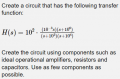
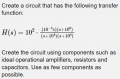
I have exam in Linear Circuit Theory soon, and I was wondering if I could get some guidance on how to solve this type problem:
No, I do not know which filter function the transfer function belongs to. The Transfer function is only thing that is given.It would be helpful for us if you could tell us something about your knowledge of analog signal processing.
Specifically: For example, do you know which filter function the given transfer function belongs to?
Perhaps it would be helpful when you try to describe the given function with words - using poles and zeros.No, I do not know which filter function the transfer function belongs to. The Transfer function is only thing that is given.
Hello there,Hello,
I have exam in Linear Circuit Theory soon, and I was wondering if I could get some guidance on how to solve this type problem:
View attachment 308277
This problem is from an older exam i was going through.
I don't understand the poles and zeros completely. Are they not related to the stability of the filter? The numerator are the poles and the denominator are the zeros of the transfer function? No I don't think i know about the effects on the filter function.Perhaps it would be helpful when you try to describe the given function with words - using poles and zeros.
Do you know something about the effects of poles/zeros on the filter function?
How would you describe the characteristics of a function like H(s)=1/[1+sT+(s/wp)²] ?
If you do a partial fraction expansion you'll see the solution right away.I don't understand the poles and zeros completely. Are they not related to the stability of the filter? The numerator are the poles and the denominator are the zeros of the transfer function? No I don't think i know about the effects on the filter function.
"The numerator are the poles..."The numerator are the poles and the denominator are the zeros of the transfer function? No I don't think i know about the effects on the filter function.
After reading that the TO does not know the meaning of poles or zeros of the transfer function, I am afraid that it will not help him much to transform the given function by partial fraction decomposition.If you do a partial fraction expansion you'll see the solution right away.
Hi there,After reading that the TO does not know the meaning of poles or zeros of the transfer function, I am afraid that it will not help him much to transform the given function by partial fraction decomposition.
By learning and applying this mathematical manipulation, he will only lose a lot of time without it helping him to solve the problem.
I am afraid that he will not "see the solution right away".
(Remember his post#8: "I don't understand the poles and zeros completely. Are they not related to the stability of the filter? The numerator are the poles and the denominator are the zeros of the transfer function? No I don't think i know about the effects on the filter function.")