Converting PC to 12-5-3.3V

Thread Starter

camerart

Joined Feb 25, 2013
3,868
I realize that the common power supply for the "big box" PCs is quite large, and certainly there are smaller supplies available presently. But switch-mode DC supplys are one of the rather more difficult to get right. THAT is the unfortunate reality. It is also why power supply transformers are still available from most of the larger electronics parts suppliers.
The good news is that an inverter adequate to power a typical desktop computer is not that difficult.

A totally different aproach would be a used "notebook" computer that uses an external DC supply, mostly in the 17 to 23 volt range. Creating an external single voltage supply will be much less demanding.
Hi Mr B,
I'll fall back on a laptop, if this idea fails.
C
 

Thread Starter

camerart

Joined Feb 25, 2013
3,868
Hi E,
If possible, measure the actual power drawn by the desktop PC, when running on mains power Usually it should be approx 100 to 200 Watts.

The current ratings shown on that posted label are typical Chinese 'enthusiastic' values.

Let's know what you measure.
E
Footnote:
Using my home Smart meter I get a value of ~100W when using a 32 Inch Monitor with a GigaByte Model Desktop PC.
That's ~0.43A, so using a 12Vdc to 240Vac Mains step up inverter 8.6A, say at 85% conversion efficiency, approx 10 Amps. A good condition 12V 60Ahr car battery would be suitable for Caravan use.
Hi E,
I ran the motherboard with only the disc drives for 1/2 hr, here are the results from a power meter.
KWh 0.020
A 0.281
WL 38.1
WH 40.2
V 237
The motorhome, will have a lifepo4 battery 12V 460Ah
and for the 3.3V I can charge a separate single lithium cell.

C.
 

ericgibbs

Joined Jan 29, 2010
21,649
hi E,
If that is 0.281 Amps at 237Vac, that's only ~66 Watts.
That would be only ~ 6 Amps from a 12V battery at 100% or 7 Amps at 85% conversion efficiency.

I would consider using a standard off the shelf, 12Vdc to 230Vac converter as an input to the PC.

E
 
this thing is that PC power draw is not fixed, it varies a lot based on application type and load. sitting idle (powered up but not doing anything) is one thing, running some application after everything is already loaded into memory is another, etc. different parts of the system are active at different teems - defragmenting HDD is a good stress test for HDD but video card load is negligible. current draw should be measured under maximum load, when everything is stressed at the same time, then add some margin to that measurement. that way you can be sure that obtained value is not exaggeration and the system will not succumb to brownouts.
 

Thread Starter

camerart

Joined Feb 25, 2013
3,868
hi E,
If that is 0.281 Amps at 237Vac, that's only ~66 Watts.
That would be only ~ 6 Amps from a 12V battery at 100% or 7 Amps at 85% conversion efficiency.

I would consider using a standard off the shelf, 12Vdc to 230Vac converter as an input to the PC.

E
Hi E,
Thinking about it, it's probably the screen, that takes most of the power use. I may use the Tv screen.

I will have a converter, probably 1000W, instead of the Maplins 300W that I already have.

This is just an experiment, as I will be getting rid of the PC, as it's too bulky, but I'll keep it if I can get it going with batteries.
C.
 

Thread Starter

camerart

Joined Feb 25, 2013
3,868
this thing is that PC power draw is not fixed, it varies a lot based on application type and load. sitting idle (powered up but not doing anything) is one thing, running some application after everything is already loaded into memory is another, etc. different parts of the system are active at different teems - defragmenting HDD is a good stress test for HDD but video card load is negligible. current draw should be measured under maximum load, when everything is stressed at the same time, then add some margin to that measurement. that way you can be sure that obtained value is not exaggeration and the system will not succumb to brownouts.
Hi PM,
Yes, I'm aware of that, the figures I gave will be well under the fully working system, especially including the screen.
I doubt there will be brown outs, as the battery will cope with starting the engine.
C.
 

ericgibbs

Joined Jan 29, 2010
21,649
hi E,
I would say the 330W converter will be sufficient.
Ensure you have adequate fusing between the 12V battery and the Converter, and onto the Converter Output to PC input.
Why don't you set it up and try a pretest on the bench.??

E
 

Thread Starter

camerart

Joined Feb 25, 2013
3,868
Hi,
If this is all possible, and I don't mind a quite test/fail chuck the lot away, there are a few technical other questions.

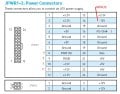
Here is an image of the power socket on the board. There are a couple of connections that are different colours, e,g, one of them is -12V, etc, which may be a puzzle.
C
 

Attachments

Thread Starter

camerart

Joined Feb 25, 2013
3,868
hi E,
I would say the 330W converter will be sufficient.
Ensure you have adequate fusing between the 12V battery and the Converter, and onto the Converter Output to PC input.
Why don't you set it up and try a pretest on the bench.??

E
Hi E,
I've got workmen here, and I'm playing in my hobby room out of the way, and this is a little project I can try without getting in their way.

If I can figure out the pins in #38, I'll probably just cut and rejoin all of the common wires like 12V 3.3v etc, and see what happens with test batteries.
C.
 
Last edited:

ericgibbs

Joined Jan 29, 2010
21,649
hi E,
I am sure that you realise that a 12V Lithium 460Ahr is potentially hazardous if mistreated in any way.?
Mount the inline Fuse as close as possible to the battery +12V terminal, the fuse rating should be not higher than 20A.

How do you plan to recharge the Lithium battery?
E
 

Thread Starter

camerart

Joined Feb 25, 2013
3,868
hi E,
I am sure that you realise that a 12V Lithium 460Ahr is potentially hazardous if mistreated in any way.?
Mount the inline Fuse as close as possible to the battery +12V terminal, the fuse rating should be not higher than 20A.

How do you plan to recharge the Lithium battery?
E
Hi E,
Yes, these batteries are like mini bombs if treated badly!
These modern batteries have a fair bit of protection, also bluetooth and heaters inside them, and the price reflects this.
I've just put solar panels on the van, then a switch, then a fuse, then an MPPT charger, and a DC to DC charger from the alternator, with fuses. It's quite a 'to do'.
C.
 
Hi,
If this is all possible, and I don't mind a quite test/fail chuck the lot away, there are a few technical other questions.

Here is an image of the power socket on the board. There are a couple of connections that are different colours, e,g, one of them is -12V, etc, which may be a puzzle.
C
what are the questions?

basically if you open PSU would will see that all wires of same color go to same node on the PCB. using multiple wires is simply a way to share current so that you don't have very thick single wires.

BLACK = COM/GND (0VDC)
RED = +5VDC
YELLOW = +12VDC
ORANGE = +3.3VDC
BLUE = -12VDC

then there is a standby power (low power, unlike +3.3V, +5V, +12V -12V that only turn on when PSU is on this is ALWAYS on)
PURPLE = +5VSB always on as long plugged into AC outlet. low power,

then you have signals:
GREEN = PSU_ON. this is input. when this is connected to COM (any black wire), PSU turns on and +3.3V, +5V, +12V -12V all turn on.
GRAY = PWR_OK, output tells you if power is ok.
 
Your measured numbers already settle most of the sizing, so work from those rather than the label on the supply.

1. Load current from the 12 V battery: you measured about 38-40 W with only the drives running. Allow roughly 80-120 W for the complete system under normal use. At 100 W, the battery current through a converter is about 100 / 12 / 0.85 = about 9.8 A, so size that branch for roughly 12-15 A continuous, not for the few amps the drives alone drew.

2. Do not connect the 12 V battery straight to the yellow +12 V wires. A charging 12 V lithium battery can sit at about 13.8-14.6 V, while the ATX +12 V tolerance is plus/minus 5 percent, or 11.4-12.6 V. Use a regulated 12 V DC-DC converter for the +12 V rail, and separate buck converters for +5 V and +3.3 V, all sharing one common ground point. Keep the red, yellow and orange wires grouped by rail, and do not mix the purple +5 VSB wire with the red +5 V rail.

3. Sequencing: the supply only turns the main rails on when the green PS_ON wire is pulled to a black ground wire, and the grey PWR_OK wire is the output that tells the board the rails are stable. Check those two signals with a meter before you connect the board: PS_ON to ground should be near 0 V when on, and PWR_OK should rise to about +5 V after the rails settle.

4. Fuse by branch, close to the battery. The 1000 W inverter is a separate branch: at full load it could draw about 1000 / 12 / 0.85 = about 98 A, so its cable and fuse must be sized for the inverter, not for the PC. The PC branch fuse should be just above its own calculated current, so a fault in the PC wiring opens its own fuse instead of relying on the much larger inverter fuse.

5. Before a long run, measure voltage at the board connector under load, not only at the converter output. Aim for less than about 0.3 V drop on the +12 V run and less than about 0.15 V on the +5 V and +3.3 V runs. If the drop is larger, shorten the run or use heavier wire for that rail first, rather than raising the converter output voltage.
 

Reloadron

Joined Jan 15, 2015
7,978
Pictured in post #3 is a standard ATX Power Supply, CORSAIR VS550 550 WATT PC POWER SUPPLY P/N CP-9020171 / 75-003436. My best guess is you want to power a PC using 12 VDC. They do make ATX form factor power supplies but I would do as suggested, use and inverter to get your mains voltage and then power your PSU. You will only need between 200 - 240 VAC @ 5.0 amps, I would go with 200 - 240 VAC @ 6 - 8 amps. Since your image reflects that input voltage I assume you need a 12 VDC to 200 to 240 VAC inverter.
I would consider using a standard off the shelf, 12Vdc to 230Vac converter as an input to the PC.
That's how I would go about it and I would choose an inverter with a TSW (True Sine Wave) output.

Ron
 

Thread Starter

camerart

Joined Feb 25, 2013
3,868
Hi all,
When designing a motorhome, volume and weight is a large factor, and everything ties into each other.
e,g, the suggestion of using a 12V-240V converter, adds the size of the converter, then in this case a PC with lots of tin and empty space plus power supply. This is what I'm considering, so if I keep the PC as it is, I would throw it away, and use a laptop. (the PC has lots of sockets for adding stuff)

Another example is gas or 12V fridge? Gas need larger bottles, 12V needs larger battery, and charging.

Thanks for all the input, once I've looked more carefully at previous answers, I'll work out all of plusses and negs.

So quick question, keeping it as minimum as possible, is it throw away PC and buy a laptop or keep the PC skeleton and buck converters? (remembering the costs)
C.
 
Last edited:
Top