Converting 12V pulse signal into 5V pulse signal

Thread Starter

dhinesh.ganesan

Joined Oct 19, 2017
48
upload_2017-12-22_10-54-44.png

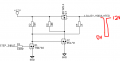
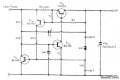
This is the circuit I've designed for the motor. The design works like when there is no step input then the Q3 will be turned on and always generates 12v steady signal. But when there is a step input then the 12V signal should convert to 5V but it is getting converted to 0V (like red drawing shows). So could anyone help me what changes I've to make on the circuit to get it to 5V pulse? For your note space is limited so it would be better if you suggest minimum changes.

Thanks for your help in advance.
 

Thread Starter

dhinesh.ganesan

Joined Oct 19, 2017
48
voltage divider at the output?
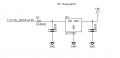
I can use but the doubt is I have a voltage regulator (12V to 5V) for 5V supply to motor and inverter. if I use the voltage divider at the top so the voltage regulator will see 5V pulse when there is step input. will that be good for the 5V Vcc to the motor and inverter?

upload_2017-12-22_11-21-21.png
 

Danko

Joined Nov 22, 2017
2,153
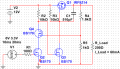
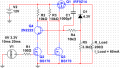
The design works like when there is no step input then the Q3 will be turned on and always generates 12v steady signal. But when there is a step input then the 12V signal should convert to 5V but it is getting converted to 0V (like red drawing shows). So could anyone help me what changes I've to make on the circuit to get it to 5V pulse? For your note space is limited so it would be better if you suggest minimum changes.
2-12-5V.png
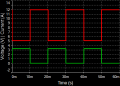
2-12-5V-2.png
 
Last edited:

AnalogKid

Joined Aug 1, 2013
12,085
The circuit in post #10 has no voltage reference. It depends on the trans-conductance curves of Q1, Q3 and Q4 to have just the right amount of gain. The output voltage will vary with room temperature, device aging, and from part to part. This circuit topology usually has a bipolar transistor at Q4 because a base-emitter junction forward voltage, Vf, while not super stable, is way more stable than the threshold voltage of a MOSFET.

This is not a drop-in replacement circuit, but it shows the basic regulator function. TR1 is both a part of the voltage reference and the first stage of the error amplifier. TR2 and TR3 complete the voltage regulator part. TR4 (and its 4 resistors) adds current limiting and can be removed if not needed.

ak
s200971920817950.jpeg
 
Last edited:

philba

Joined Aug 17, 2017
959
I think the TS needs to be clear what he needs. I've reread it several times and the explanation is pretty unclear. Does he want the output to be 12V when there is 0V on the input and 5V when there is some non-zero voltage (guessing 12V) on the input? What is the shape of step input? positive pulse? level?

What I think he is asking for is a simple voltage converter - 12V pulse in, 5V pulse out. That's a very simple 1 mosfet solution or even just a voltage divider. At least, that's what the TSs voltage regulator circuit sort of does (but with hideous latency).
 

Danko

Joined Nov 22, 2017
2,153
The circuit in post #10 has no voltage reference. It depends on the trans-conductance curves of Q1, Q3 and Q4 to have just the right amount of gain. The output voltage will vary with room temperature, device aging, and from part to part. This circuit topology usually has a bipolar transistor at Q4 because a base-emitter junction forward voltage, Vf, while not super stable, is way more stable than the threshold voltage of a MOSFET.
Another variant:
(Exactly as suggested in post #11)
3-12-5V.png
Edit: "Client is always right"
 
Last edited:

ScottWang

Joined Aug 23, 2012
7,499
You should say that what is the load needs a 12V and 5V pulse, in this application then it should be have a timer to setup the time that the input 3.3V signal needs, otherwise when the 3.3V input signal coming to high and change to low and then the output will be raising to 12V, your 3.3V can't hold the output voltage on 0V and 5V.
 

Thread Starter

dhinesh.ganesan

Joined Oct 19, 2017
48
If you describe why you think this circuit should make a 5 V output, we can tell you where the mistakes are. How is this circuit supposed to work (in detail)?

ak
Thanks for your help. The circuit receives 12V from the main power supply. The challenge is I got only 12V line and ground. I have to convert this 12V line to 5V pulse when there is a step pulse from the microcontroller, because the motor only sees a 5V pulse. At the same time, I have to supply 5V to the motor. So I have used a 5V voltage regulator for the motor supply. The problem/doubt is when there is a step pulse my 12V steady signal coming to 0V (not 5V) where the voltage regulator is also seeing 0V and the rest of the circuit doesn't work because the regulator is not getting enough power. That's the reason if the voltage regulator sees 5V then there is less chance that the voltage regulator getting shuts down.
 

Thread Starter

dhinesh.ganesan

Joined Oct 19, 2017
48
If you describe why you think this circuit should make a 5 V output, we can tell you where the mistakes are. How is this circuit supposed to work (in detail)?

ak
I have used MOSFET because the current consumption of the whole circuit should be less than 10mA when there is no pulse. is the explanation sufficient for you? Could you please ask me if it is not clear to you.

Thanks for your help
 

shortbus

Joined Sep 30, 2009
10,050
I'm just learning about all of this so may be wrong. If you have 12VDC run it parallel from the rest of the circuit that is needing 12V through the regulator to make 5V. Then use that 5V as the pull up on a CD40107 out put, and put your 12V signal on that chips input. The 40107 has an open drain output so any voltage that will be compatible with 4000 series CMOS will work, 5 - 15 volts. A 12V trigger into the 40107 will give the 5V output that's needed.

http://www.ti.com/product/CD40107B
 
Top