Convert Square wave to DC continous wave

MrAl

Joined Jun 17, 2014
13,707

Thread Starter

NTC

Joined Mar 23, 2023
9
Hi,

Without knowing more about your requirements here are some ideas.
Note you dont really need to rectify, you just need to smooth.
You may not even need the diode.

If you only need 5v then increase the series resistor values. You may only need one resistor also. You only need a filter, but for a smoother output keep at least two resistors and two capacitors as shown. You probably also want a 5v regulator on the output, unless the output is to feed your buck and that is what will bring it down to 5v.

Hi
MrAl

Thanks for your reply.

Your circuit still has current peaks drawn from the source... that creates noise in our communication protocol..
 

Attachments

Alec_t

Joined Sep 17, 2013
15,119
that creates noise in our communication protocol.
What is the maximum current your comms part of the system draws?
What are the switching currents/voltages in just that part?
Will the comms part get its power from the 10V on the PCB?

It is still unclear exactly what you are trying to do. Can you post at least a block diagram showing the whole system (DC-DC converters/PCB/etc) to clarify things?

If the only part of the system which is upset by the 'ripple' on the 24V supply is the comms part, then perhaps diode isolation between the comms part and the remainder of the system would overcome the problem. Like this:-
1679677839131.png
 
Last edited:

crutschow

Joined Mar 14, 2008
38,520
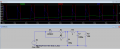
Here's the sim of a circuit that may do what you need.
It uses a MOSFET-Zener regulator to buffer the signal and reduce the voltage to about 10V while minimizing the current increase during the signal pulses.
There are some short, 12mA current spikes (red traces) from the input source due to parasitic capacitive coupling, but they are only just a little over 1µs long, so are not likely to interfere with the signal pulses.

1679678457995.png
 

MrAl

Joined Jun 17, 2014
13,707
Hi
MrAl

Thanks for your reply.

Your circuit still has current peaks drawn from the source... that creates noise in our communication protocol..

Hello again,

Ok then you can try a linear constant current regulator but that might not work either.

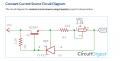
The following circuit is a current balancer which really just creates a constant current draw from the source.
As the voltage changes, the total load impedance changes to match which keeps the current draw the same for both 24v and 33v.
Note there are no filter elements, and the timing of the 24v and 33v levels is not critical.

The 'switch' drawn within the rectangle is a comparator and a switch such as a transistor like a mosfet. When the comparator senses a voltage slightly over 24v, it turns the switch OFF. That leaves just one resistor in series with the load, which keeps the current the same as when the switch was closed with 24v.
Since the balancing act depends on the load resistance and the two resistors, we have to use a little equation to calculate R2 knowing R3, and we can choose R1 based on what output voltage we want, although there will be a minimum R1 value in this case of 75 Ohms, which makes R2 equal to zero Ohms, but i included a little resistance for R2 in the example so that would account for any resistance in the switch. You can of course adjust that as needed.

There may be tiny spikes but they should be very short depending on how fast the comparator and 'switch' is. Because the load has to change with voltage level changes, i dont think you can get it any better.
There is still one small problem though, you probably have to use a constant current circuit before your actual load to keep the current the same in the output too (shown as R3 for now). If the load R3 changes, there will still be some current changes on the input. The only way to compensate for a change in R3 is to change R2 also, which means another control element would have to be introduced. The control law would include the formula shown in the drawing and R1 would be chosen to work for the entire range of R3 values.

SWR_20230324_154656.png
 
Last edited:

crutschow

Joined Mar 14, 2008
38,520
But the power dissipation is too high. About 2Watt...
Then you need to go to a switching regulator for higher efficiency since any type of linear regulator will dissipate the same amount of power.

LTspice simulation below of a representative buck regulator circuit set for 10Vdc out, that can tolerate a 40V input.
Q1 was added to give a high-impedance input, low-impedance output filter to minimize the peak current from the supply.
It's limited to about 87mA pk after the initial startup transient (red traces).
(Note it will start up okay, even if the initial current is limited to 100mA by the source resistance).
The circuit dissipation is about 0.35W giving an efficiency of 74%.
That's a little lower than might be expected, due to the loss from Q1.

1679699261734.png
 
Last edited:

MrAl

Joined Jun 17, 2014
13,707
Yeah you know what is funny is that switching regulators are notorious for drawing input currents that change.
 

DickCappels

Joined Aug 21, 2008
10,661
An easy solution was given in post #3. Use a large capacitor acros those small ones and use a 1N4001 as the diode, unless the pulses are fast in which case use a Schottky diode like a 1N5819.
 

MrAl

Joined Jun 17, 2014
13,707
An easy solution was given in post #3. Use a large capacitor acros those small ones and use a 1N4001 as the diode, unless the pulses are fast in which case use a Schottky diode like a 1N5819.
Pardon me, but didn't you read the replies after that?
He said he cant have current spikes coming from the source.
Check that out and the newer attempts at a solution.
 

LowQCab

Joined Nov 6, 2012
5,101
OK,
Here's my shot at "No-Current-Spikes" ...........
1mA Current-Ripple from the "Source" ( whatever it may be ).
.
.
.
Special Power Supply 1 .png
.
 

crutschow

Joined Mar 14, 2008
38,520
you know what is funny is that switching regulators are notorious for drawing input currents that change.
And how is that pertinent besides being funny?
And what is notorious about drawing changing input currents (I presume with a change in load)?
 

BobTPH

Joined Jun 5, 2013
11,521
A buck or boost converter draws a varying current when the load is constant. Which is exactly what the TS is trying to avoid.
 

crutschow

Joined Mar 14, 2008
38,520
A buck or boost converter draws a varying current when the load is constant. Which is exactly what the TS is trying to avoid.
What "varying current" are you referring to?
If you looked at my circuit in post #28 you would see that the filter input to the converter removes most of the high frequency current variation from the source, to meet the TS's requirements.
 

LowQCab

Joined Nov 6, 2012
5,101
The TS wants "Unobtainium" .
He does not know what the Supply is capable of.
He's guessing 100%,
( I should say "fantasizing" a "what-if" with no actual information ).
.
.
.
 

MrAl

Joined Jun 17, 2014
13,707
And how is that pertinent besides being funny?
And what is notorious about drawing changing input currents (I presume with a change in load)?
Hello Cruts,

Bucks and boosts draw pulsed currents so they need input capacitors. The input capacitors provide a smoother input for the buck or boost, but if the input voltage to the input cap changes the current to the input capacitor changes, and that means the input will pulse. That's with a raw buck or boost.

The input circuit in post #28 is called a capacitance multiplier. It 'multiplies' the capacitance of the 100uf cap, making it seem like the load gets a smoother voltage level.
Im not sure how that would work in the app though because it seems like a fast change in input voltage would cause a fast change in input current due to the fact that the transistor can not respond immediately due to the 100uf cap on the base. I'd be happy to take a look though if you post your LT Spice schematic file.

The last suggestion i made also uses a transistor that acts immediately when the input voltage changes. The delay would only be with whatever comparator is used, so not sure if i could recommend a common comparator like the LM339 or similar, but rather a faster device. I dont really have any spec on what his source can tolerate though so it's hard to judge what will work and what will not work. That's probably subject to a breadboard test. Because this circuit would still cause spikes, there would have to be some capacitance added. It could be very small though because the spikes would be very very fast not lasting very long. Given some real world parts though, there may not be any spikes.

But please post your schematic file i'd like to take a look at yours. I hope i have all the parts in the library i have for that simulator.
 

MrAl

Joined Jun 17, 2014
13,707
OK,
Here's my shot at "No-Current-Spikes" ...........
1mA Current-Ripple from the "Source" ( whatever it may be ).
.
.
.
View attachment 290667
.

Hi,

That looks kind of complicated but it does look like it works good though.
The output load does not need to be that low in value. He says 200 Ohms is the load, for at least these tests. Maybe with that load you can get it less complicated.

I have to wonder why the inductor and capacitor filter did not work, or did anybody try that yet? Maybe the right values would do it after all that's why they use inductor input filters in high power stuff, to lessen the peak currents.
 

LowQCab

Joined Nov 6, 2012
5,101
The Circuit performs well, as shown in simulation,
but I have to confess that it was created purely out of sarcasm and frustration,
because a ~10mH Choke, and over ~20,000uF of Capacitance is just not at all practical.

The existing Control-Loop was never intended to Power 3 Buck-Converters,
and deal with all the "trash" they create.

The add-on "Circuit-Board", ( whatever that is ), needs to be redesigned to
suit the existing Control-Loop, which is also still an "unknown".
.
.
.
 
Top