If what's said above about the PCM expecting a 'square wave AC signal' and not wanting an input going below ground, then I'd suggest a different circuit than the one I posted. I'll have a think and post later.
Hi Alec,
Just a few more thoughts on the problem. If it is a variable reluctance sensor the resistane reading would be the same if the meter leads were reversed, If it was a hall effect sensor the readings would probably be different. If the PCM does do an initial resistance check then you will need to provide a similar resistance DC path on the output of your amplifier. I don't think a variable reluctance sensor gives out a square wave output. I had to replece a variable reluctance ABS sensor on my car a few years ago that had gone open circuit. With the faulty sensor the fault ABS fault light came on before it would expect to see pulses so it must have done a resistance check. The sensor had a much higher resistance than I expected. It was about 1.6K. (But there is no reason to believe the on on the TS's car will be a similar resistance.)
Hi Les,
From what I read, 1.6k is about typical for reluctance sensors. Your experience confirms my suspicion about the resistance check.
It's all guesswork as to what the PCM input circuitry is like.
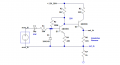
Here's my offering for an amp which allows for an initial resistance check. R6 simulates the sensor resistance. R7 provides some protection against unwanted direct grounding of the sensor lead. The 'hi' side of the sensor would need to be disconnected from its current location and connected instead to the circuit input.
Hi Les,
From what I read, 1.6k is about typical for reluctance sensors. Your experience confirms my suspicion about the resistance check.
It's all guesswork as to what the PCM input circuitry is like.
Here's my offering for an amp which allows for an initial resistance check. R6 simulates the sensor resistance. R7 provides some protection against unwanted direct grounding of the sensor lead. The 'hi' side of the sensor would need to be disconnected from its current location and connected instead to the circuit input. View attachment 145709
Here is a another wrinkle to add to the confusion. I looked at a very old post from the Cadillac forum, approx 2006 this was posted by another Cadillac owner had the same problem (sensor was way under 5VAC). He stated the following below in quotes, but did not post a diagram or schematic of what he did or how he installed it inline. Maybe you can make some sense out of the following comments from 2006, and how this op amp achieved the 5VAC or higher:
"Using a simple LM741 op amp I created an amplifier with +vcc and -vcc".
If those were the only components they would have been configured as an amp with a gain of 100. Both input and output would be DC coupled. The amp probably would not have passed a rigorous preliminary sensor check. It is unclear whether -Vcc is synonymous with ground or is a voltage below ground.
Hi Alec,
If the 741 circuit DID WORK then it suggects there is no sensor continuity check. As it was battery powered it gets round the problem of having to connect one side of the sensor to ground to get power fron the car's 12 volts. like you when I read post #27 I was thinking of a gain of 100 being too high. But if the resistance of the sensor was 1.6 K that would reduce the gain to 38 The sensor would also probably have some inductive reactance at it's working frequency which would further reduce the gain. If it was me building this amplifier my first step would to be measure the sensor resistance, Measure the resistance from ground to to both inputs to the PCM (With the car battery disconnected.) I would then re connect the battery and mesure the voltage between ground and both inputs of the PCM and also between the PCM inputs. I would do this with the ignition off and repeat it with the ignition on. I would then re connect the sensor and repeat these voltage tests. This should give some idea about the design of the sensor input circuit. A small isolated DC to DC converter could be used to power the amplifier to avoid the worry about connecting one side of the sensor input to ground to power the amplifier. I like ebp's explanation of the buildup of metal particles causing the reduction in the sensor output.
I totally agree with Les. Life would be simpler if we knew the PCM input characteristics. A forlorn hope, but do you have a schematic/wiring diagram showing the PCM input stage? Personally, I would be leery of connecting anything to the PCM inputs. A circuit error or failure could fry the PCM. Your call.
Ebp's explanation is very plausible. Other possibilities could be loss of field strength (if there is a permanent magnet associated with the sensor), or perhaps even shorted turns as a result of vibration wear of the enamel insulation.
Hi Alec,
I too would be very cautious of damaging the PCM. Electronic spares for cars seem to cost an unrealisticly high price. (The ABS sensor I replaced a few years ago cost me £65.00 and that was from a motor factors not a main dealer.) I was very tempted to rewind the original but decided against it as it was a brake part. My point was if I had decided to take the risk of destroying a very expensive part I would want as much information as possible to try to minimise the risk. The cause of the loss of amplitude of the signal could be any one of the possibilities that you mentioned.
I wonder if a transformer or autotransformer could fix this by stepping up the voltage?
Or, a brute force solution... CD or MP3 player playing a suitable sine wave tone through a car amplifier. '90s car audio gear can be dirt cheap at yard sales, if you don't have stuff lying around.
Hi Les,
From what I read, 1.6k is about typical for reluctance sensors. Your experience confirms my suspicion about the resistance check.
It's all guesswork as to what the PCM input circuitry is like.
Here's my offering for an amp which allows for an initial resistance check. R6 simulates the sensor resistance. R7 provides some protection against unwanted direct grounding of the sensor lead. The 'hi' side of the sensor would need to be disconnected from its current location and connected instead to the circuit input. View attachment 145709
Alec:
This circuit worked fairly well. Made some good progress. At medium and higher speed, the light stays off, so the circuit did boost the signal (Yay !!). But at lower speed, the light stays on, I'm guessing not enough output to amplify when moving a slower street speed. Is there any "tweak" or modification I can make to this circuit to increase the amplitude and lower speed? Maybe a resistor change ?? Thanks a bunch, this is giving me real hope.
I wonder if a transformer or autotransformer could fix this by stepping up the voltage?
Or, a brute force solution... CD or MP3 player playing a suitable sine wave tone through a car amplifier. '90s car audio gear can be dirt cheap at yard sales, if you don't have stuff lying around.
Bassbindevil: You make a good point, which I have not yet tried, since I was too focused on amplifying the AC signal. After building an opamp circuit, and a few others herein, they only worked when I really accelerated, which tells me that maybe it is a frequency issue. If this is the case, I'm wondering if just a simple sine wave generator circuit would work? Some of the Cadillac guys said that their "known good sensor put out 5.5 VAC and 500 Hz". It would be real easy to just make a sine wave generator, kinda the way you suggested. This one caught my attention: http://www.learningaboutelectronics.com/Articles/Sine-wave-generator-circuit-with-a-transistor.php
I said it in your other thread and I'll say it again here: It could be helpful to read the error code being thrown by the computer. Some data is always better than none. It may be a transmission error code and that means that a cheap code reader may not give much detail. You may need something that could actually get the code being reported by the transmission controller.
I said it in your other thread and I'll say it again here: It could be helpful to read the error code being thrown by the computer. Some data is always better than none. It may be a transmission error code and that means that a cheap code reader may not give much detail. You may need something that could actually get the code being reported by the transmission controller.
I've already done all of the background on it. It is a P056 code, ISS (Input Speed Sensor). A know problem in '90s Cadillac's. The only choice's are to either remove the transmission and engine to replace a $20 sensor ($2,000 in labor). Or bypass the sensor and feed in a "dummy signal" to the ECM, so to speak. It has been successfully done by other Cadillac owners, however, it was in a very old forum, and I can no longer reach any of them. Here is the quote from the last guy who successfully fed in a dummy load, and thus turned of the Check Engine light: "
From reading and researching, the minimum value needed by the ECM is 5.0 VAC and 530 Hz.Using a simple LM741 op amp I created an amplifier with +vcc and -vcc.
From reading and researching, the minimum value needed by the ECM is 5.0 VAC and 530 Hz....Or bypass the sensor and feed in a "dummy signal" to the ECM, so to speak.
Have your studies given solid verification that a dummy signal - not tied to the actual sensor frequency - would really work? It would be easy to test: Use your current circuit, which is close to working. Break the connection to the sensor and insert the headphone output of a smartphone running a signal generator app. There are several that are free and will do the job. You can choose the frequency and you could try 2kHz, say, and see if this keeps your dash light off.
The current circuit can almost certainly be tweaked to improve the fidelity of the waveform so that the frequency doesn't throw the error, but maybe that can go to the back burner until you confirm it's necessary. If the fixed frequency really works, that's an easy thing to do.
Have your studies given solid verification that a dummy signal - not tied to the actual sensor frequency - would really work? It would be easy to test: Use your current circuit, which is close to working. Break the connection to the sensor and insert the headphone output of a smartphone running a signal generator app. There are several that are free and will do the job. You can choose the frequency and you could try 2kHz, say, and see if this keeps your dash light off.
The current circuit can almost certainly be tweaked to improve the fidelity of the waveform so that the frequency doesn't throw the error, but maybe that can go to the back burner until you confirm it's necessary. If the fixed frequency really works, that's an easy thing to do.
"From reading and researching, the minimum value needed by the ECM is 5.0 VAC and 530 Hz.Using a simple LM741 op amp I created an amplifier with +vcc and -vcc.
1 UA741 op amp
1 circuit board
1 1k ohm resistor (Brown, Black, Red)
1 100k ohm resistor (Brown, black, Yellow)
2 battery holders
2 wire connectors "
There is no way that simple circuit can increase the frequency of the ISS signal, so how come you don't have a 530Hz signal already, if that's what he had?
There is no way that simple circuit can increase the frequency of the ISS signal, so how come you don't have a 530Hz signal already, if that's what he had?
I'm not sure, but maybe by using smaller voltage batteries, it reduced the gain? I have downloaded an O-scope app and signal generator. I am going to play with the amplitude and frequency and see what that does.

 Facebook
 Google
 GitHub
 Linkedin