Facebook
 Google
 GitHub
 Linkedin

What? No real negative money score in Jeopardy!That is a fair point, it’s just a bit different in my head because current is the movement of charge which can be positive or negative whereas money and height are positive only quantities that can be represented as negative just due to mathematics.
Conventional vs Electron flow
- Thread starter electricalengineer3
- Start date
- Status
- Not open for further replies.
Scroll to continue with content

Height can very easily be both positive and negative -- consider a map of some place like Death Valley. It has areas that are both above sea level and below sea level and so you see both positive and negative elevations on the map. Same with money -- look at most credit card statements and you will see charges shown as positive transactions and payments shown as negative transactions.That is a fair point, it’s just a bit different in my head because current is the movement of charge which can be positive or negative whereas money and height are positive only quantities that can be represented as negative just due to mathematics.
Agreed, but the negative with money really does indicate the direction of the flow of the money. A negative current doesn’t actually indicate that the flow of charge is the other way. It indicates that the net flow of positive charge is the other way, whereas the net flow of negative charge is in the same direction as the arrow.
And was my other statement correct in assuming that those who refer to electron flow as another convention are always referring to the positive current value going from - to +?
And was my other statement correct in assuming that those who refer to electron flow as another convention are always referring to the positive current value going from - to +?

With conventional current and a passive device, the terminal of which the current enters is made positive.Can someone post a simple example of solving a problem using the both of these? I get the difference between the two but I don't get how its the same if you solve either way. If someone could do some problems both ways I would much appreciate it.
With electron current and a passive device, the terminal of which the current enters is made negative.
Example:
With a vertically positioned resistor with conventional current and the current entering the top of the resistor the top becomes positive. With the same resistor if electron current, if the current enters the top then the top becomes negative.
Okay, yeah that makes sense to me now, assuming when you say electron current, you are referring to a positive current value when the arrow of said current points in the direction of electron movement?With conventional current and a passive device, the terminal of which the current enters is made positive.
With electron current and a passive device, the terminal of which the current enters is made negative.
Example:
With a vertically positioned resistor with conventional current and the current entering the top of the resistor the top becomes positive. With the same resistor if electron current, if the current enters the top then the top becomes negative.
Yes an arrow is often used to show current flow, and electron flow would go from the negative of the battery through the load and into the positive terminal of the battery.
So if we had a horizontally positioned resistor with the negative battery terminal connected to the left side of the resistor, the left side of the resistor would become negative as the current would flow from left to right. if you draw both a current arrow and a voltage arrow they both point in the same direction when the current arrow is in the direction of the electron current,a and the voltage arrow has tip that is positive and tail that is negative.
With conventional current flow, if the positive terminal of the battery was connected to the left side of the resistor the left side would become positive, although the current would still flow from left to right.
Interestingly if we draw the current and voltage arrows now the current arrow points left to right while the voltage arrow points right to left.
Electron current flow is mostly useful in physics where we have a phenomenon that depends on the direction of electron flow.
So if we had a horizontally positioned resistor with the negative battery terminal connected to the left side of the resistor, the left side of the resistor would become negative as the current would flow from left to right. if you draw both a current arrow and a voltage arrow they both point in the same direction when the current arrow is in the direction of the electron current,a and the voltage arrow has tip that is positive and tail that is negative.
With conventional current flow, if the positive terminal of the battery was connected to the left side of the resistor the left side would become positive, although the current would still flow from left to right.
Interestingly if we draw the current and voltage arrows now the current arrow points left to right while the voltage arrow points right to left.
Electron current flow is mostly useful in physics where we have a phenomenon that depends on the direction of electron flow.
Okay so conventional current is positive current going from + to - of a battery externally, electron current is positive current going from - to +, why don’t people who want to model the flow of electrons use a negative value because of their negative charge and then they would still be under conventional current?Yes an arrow is often used to show current flow, and electron flow would go from the negative of the battery through the load and into the positive terminal of the battery.
So if we had a horizontally positioned resistor with the negative battery terminal connected to the left side of the resistor, the left side of the resistor would become negative as the current would flow from left to right. if you draw both a current arrow and a voltage arrow they both point in the same direction when the current arrow is in the direction of the electron current,a and the voltage arrow has tip that is positive and tail that is negative.
With conventional current flow, if the positive terminal of the battery was connected to the left side of the resistor the left side would become positive, although the current would still flow from left to right.
Interestingly if we draw the current and voltage arrows now the current arrow points left to right while the voltage arrow points right to left.
Electron current flow is mostly useful in physics where we have a phenomenon that depends on the direction of electron flow.
I addressed that point in my first few responses in this thread.Okay so conventional current is positive current going from + to - of a battery externally, electron current is positive current going from - to +, why don’t people who want to model the flow of electrons use a negative value because of their negative charge and then they would still be under conventional current?
https://forum.allaboutcircuits.com/threads/conventional-vs-electron-flow.166883/post-1476600
https://forum.allaboutcircuits.com/threads/conventional-vs-electron-flow.166883/post-1476605
https://forum.allaboutcircuits.com/threads/conventional-vs-electron-flow.166883/post-1476616
Most of the people that use electron current learned to use it at a point where the level they were delving into the theory and the complexity of the circuits they were working with it was sufficient to be sloppy with the math and they learned to unconsciously apply the needed magical mystery minus signs associated with the incorrect way that electron current is pretty much invariably used. So it has become part of the way they think about it and many, many (most?) people have an extremely hard time of reprogramming how they think about things unless they are forced to.
Well in short, the direction of current is different then the polarity. Benjamin Franklin made it easy for us by popularizing conventional current flow, but later scientists found that electron current flow better explains some physical processes, and the electron happens to have a charge that is negative.Okay so conventional current is positive current going from + to - of a battery externally, electron current is positive current going from - to +, why don’t people who want to model the flow of electrons use a negative value because of their negative charge and then they would still be under conventional current?
If you have an electron flow as a current in a wire that flows from left to right the math will be similar to that if you shot electrons through a vacuum from left to right when it comes to interacting with other entities like fields. In both cases we imagine something moving from left to right and so the curernt arrow shows this direction of movement.
So the idea with conventional current is to make the calculations simpler, and the idea with electron flow is to keep it as close to reality as possible. There are shortcuts taken sometimes though like when the negative result is reported as a positive result in some physical laws, or at least an unsigned result. The current in a wire has no reference to the real world unless you want to stick to nature exactly. To a person doing a measurement a current of -3.5 amps may have no other reference to the real world so they may report the current as being simply "3.5 amps" and anyone dealing with that measurement doesnt care either. But if the direction is important then it has to be reported as "-3.5 amps" so that anyone else that uses that information for something else doesnt get results that differ in sign.
As a side note, you might notice that sometimes we might chose the direction of current arbitrarily and then later do a calculation that shows that the current is positive, but if we change something else in the circuit that current may turn out to be negative.
For a simple example in a given circuit that we have not analyzed yet we might assign a current in a resistor as going left to right (either convention of current flow) and then after we analyze the circuit we find out that the current is +3.5 amps, but then we change something in the circuit and that some current changes to -3.5 amps. So in one case we found the current to be the opposite to our assumed direction and in the other it was following what we had assumed.
It is a little harder to use electron current flow because you always have to carry the sign through the entire analysis.
We could probably talk about this a little more maybe bring in some applications that are often encountered in real life and see how they relate to the two conventions.
Gotcha, I just wanted to get peoples opinions on what they think when they hear electron flow. I think most would be thinking of a positive current moving in the direction of electrons, but it seems MrAI does not think of it in such a way. If you are treating electron flow correctly then basically it is just negative conventional current and doesn’t need to be treated differently at all. You can use positive and negative conventional current and flip between them as much as you want and still be correct, at least I believe so.I addressed that point in my first few responses in this thread.
https://forum.allaboutcircuits.com/threads/conventional-vs-electron-flow.166883/post-1476600
https://forum.allaboutcircuits.com/threads/conventional-vs-electron-flow.166883/post-1476605
https://forum.allaboutcircuits.com/threads/conventional-vs-electron-flow.166883/post-1476616
Most of the people that use electron current learned to use it at a point where the level they were delving into the theory and the complexity of the circuits they were working with it was sufficient to be sloppy with the math and they learned to unconsciously apply the needed magical mystery minus signs associated with the incorrect way that electron current is pretty much invariably used. So it has become part of the way they think about it and many, many (most?) people have an extremely hard time of reprogramming how they think about things unless they are forced to.
Okay, so you seem to think that when most people are referring to electron current, they just mean any negative current. Wouldn’t a negative current one way and a positive current the other be the exact same thing and thus they are not a different convention at all? I thought the “other convention” was what the navy was using where they gave a positive value to current leaving the - terminal of a battery which is obviously different from conventional current and must be treated differently.Well in short, the direction of current is different then the polarity. Benjamin Franklin made it easy for us by popularizing conventional current flow, but later scientists found that electron current flow better explains some physical processes, and the electron happens to have a charge that is negative.
If you have an electron flow as a current in a wire that flows from left to right the math will be similar to that if you shot electrons through a vacuum from left to right when it comes to interacting with other entities like fields. In both cases we imagine something moving from left to right and so the curernt arrow shows this direction of movement.
So the idea with conventional current is to make the calculations simpler, and the idea with electron flow is to keep it as close to reality as possible. There are shortcuts taken sometimes though like when the negative result is reported as a positive result in some physical laws, or at least an unsigned result. The current in a wire has no reference to the real world unless you want to stick to nature exactly. To a person doing a measurement a current of -3.5 amps may have no other reference to the real world so they may report the current as being simply "3.5 amps" and anyone dealing with that measurement doesnt care either. But if the direction is important then it has to be reported as "-3.5 amps" so that anyone else that uses that information for something else doesnt get results that differ in sign.
As a side note, you might notice that sometimes we might chose the direction of current arbitrarily and then later do a calculation that shows that the current is positive, but if we change something else in the circuit that current may turn out to be negative.
For a simple example in a given circuit that we have not analyzed yet we might assign a current in a resistor as going left to right (either convention of current flow) and then after we analyze the circuit we find out that the current is +3.5 amps, but then we change something in the circuit and that some current changes to -3.5 amps. So in one case we found the current to be the opposite to our assumed direction and in the other it was following what we had assumed.
It is a little harder to use electron current flow because you always have to carry the sign through the entire analysis.
We could probably talk about this a little more maybe bring in some applications that are often encountered in real life and see how they relate to the two conventions.
No not really. The electron 'flow' is the DIRECTION of the particles assumed to be participating in the flow. It is then usually thought of as negative. The most important point is that the terminal that it enters is to be negative with a passive element. So it is the way the analysis proceeds.Okay, so you seem to think that when most people are referring to electron current, they just mean any negative current. Wouldn’t a negative current one way and a positive current the other be the exact same thing and thus they are not a different convention at all? I thought the “other convention” was what the navy was using where they gave a positive value to current leaving the - terminal of a battery which is obviously different from conventional current and must be treated differently.
Before the analysis you can assume some direction but the reality is the lump sum of electrons flow in a certain direction and there is no changing that.
After the analysis though sometimes we get a current that is in the opposite direction than the arrow so we have to understand that the sign changes from the assumed sign.
We might have to look at some examples.
It is true though that a positive charge moving in the negative direction is the same as a negative charge moving in the positive direction.
A positive charge moving in the positive direction would be the same as a negative charge moving in the negative direction.
My understanding is that a negative current in the direction of electrons is a negative conventional current, and a positive current in the direction of the electrons would be a positive electron current. These would be two different conventions. If you solve a problem with a current arrow pointing left to right and get a positive value for that arrow and then resolve the problem with your current arrow pointing right to left and get a negative value you wouldn’t say the two currents are under a different convention? What would be different is if I called the left to right current positive and you called the right to left current positive in the same wire, that would be different conventions. I think someone included a picture illustrating this early on.No not really. The electron 'flow' is the DIRECTION of the particles assumed to be participating in the flow. It is then usually thought of as negative. The most important point is that the terminal that it enters is to be negative with a passive element. So it is the way the analysis proceeds.
Before the analysis you can assume some direction but the reality is the lump sum of electrons flow in a certain direction and there is no changing that.
After the analysis though sometimes we get a current that is in the opposite direction than the arrow so we have to understand that the sign changes from the assumed sign.
We might have to look at some examples.
It is true though that a positive charge moving in the negative direction is the same as a negative charge moving in the positive direction.
A positive charge moving in the positive direction would be the same as a negative charge moving in the negative direction.
I get that the electrons move in a certain way regardless but I don’t see how choosing to call a current positive one way or negative the other way would fall under different conventions. My understanding was it is a different convention is when the positive current is assigned to different charge’s movement.
Conventional current is compatible with (and required by) general Passive sign convention used in just about every computer model of electrical systems.
https://en.wikipedia.org/wiki/Passive_sign_convention
https://en.wikipedia.org/wiki/Passive_sign_convention
In electrical engineering, the passive sign convention (PSC) is a sign convention or arbitrary standard rule adopted universally by the electrical engineering community for defining the sign of electric power in an electric circuit.[1] The convention defines electric power flowing out of the circuit into an electrical component as positive, and power flowing into the circuit out of a component as negative.[1] So a passive component which consumes power, such as an appliance or light bulb, will have positive power dissipation, while an active component, a source of power such as an electric generator or battery, will have negative power dissipation.[2] This is the standard definition of power in electric circuits; it is used for example in computer circuit simulation programs such as SPICE.
To comply with the convention, the direction of the voltage and current variables used to calculate power and resistance in the component must have a certain relationship: the current variable must be defined so positive current enters the positive voltage terminal of the device.[3] These directions may be different from the directions of the actual current flow and voltage.
Correct, and conventional current (from what I know and understand) is perfectly compatible with the passive sign convention. Let’s say you draw an arbitrary arrow because you have no idea which way the positive current flows, you draw the arrow pointing into a resistor and label the side of the resistor the current is entering wiyh a +. You solve the circuit and get a negative value for current, and thus by ohms law you will get a negative voltage with the reference polarity you assigned under PSC. This solution is mathematically and literally equivalent to if you had pointed your current arrow in the other direction, putting the + on the other side of the resistor and solving for a positive voltage with that reference polarity, this leads me to conclude thag conventional current vs. electron flow convention is not a matter of positive vs. negative current but a matter of which way you are saying positive current flows (in direction of either positive or negatives). This would be in my opinion a true different convention requiring a different sign convention, no?Conventional current is compatible with (and required by) general Passive sign convention used in just about every computer model of electrical systems.
https://en.wikipedia.org/wiki/Passive_sign_convention
mrai seems to think otherwise but that I am still not completely sure about
A negative charge flowing in the positive direction is the same as a positive charge flowing in the negative direction.My understanding is that a negative current in the direction of electrons is a negative conventional current, and a positive current in the direction of the electrons would be a positive electron current. These would be two different conventions. If you solve a problem with a current arrow pointing left to right and get a positive value for that arrow and then resolve the problem with your current arrow pointing right to left and get a negative value you wouldn’t say the two currents are under a different convention? What would be different is if I called the left to right current positive and you called the right to left current positive in the same wire, that would be different conventions. I think someone included a picture illustrating this early on.
I get that the electrons move in a certain way regardless but I don’t see how choosing to call a current positive one way or negative the other way would fall under different conventions. My understanding was it is a different convention is when the positive current is assigned to different charge’s movement.
So if you have an electron flowing left to right and you call it a positive current, then that would be the same as a positive charge flowing from right to left.
So whatever you want to glean from that is up to you.
In a electromagnetic system whatever you do has to jive with the physical laws in magnetics, in particular the direction of the force, unless you dont care about that for a purely electrical system.
Hello again,
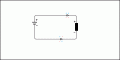
Here is a diagram that might help.
The signs of the currents shown are as follows:
The symbol on the left indicates the current polarity,
the symbol on the right indicates the direction where positive is left to right in the top and bottom wires.
This means that + - means positive current flowing in the negative direction.
Now if we follow that then we see that no matter what we choose the resistor polarity comes out according to the statement "a positive current entering a terminal makes that terminal positive".
Now you can switch roles, but you'll also have to change that statement and you will always have to remember that a positive current flowing in the positive directoin makes the terminal negative, which seems less intuitive.
Here is a diagram that might help.
The signs of the currents shown are as follows:
The symbol on the left indicates the current polarity,
the symbol on the right indicates the direction where positive is left to right in the top and bottom wires.
This means that + - means positive current flowing in the negative direction.
Now if we follow that then we see that no matter what we choose the resistor polarity comes out according to the statement "a positive current entering a terminal makes that terminal positive".
Now you can switch roles, but you'll also have to change that statement and you will always have to remember that a positive current flowing in the positive directoin makes the terminal negative, which seems less intuitive.
Last edited:
I don’t see the diagram.Hello again,
Here is a diagram that might help.
The signs of the currents shown are as follows:
The symbol on the left indicates the current polarity,
the symbol on the right indicates the direction where positive is left to right in the top and bottom wires.
This means that + - means positive current flowing in the negative direction.
Now if we follow that then we see that no matter what we choose the resistor polarity comes out according to the statement "a positive current entering a terminal makes that terminal positive".
Now you can switch roles, but you'll also have to change that statement and you will always have to remember that a positive current flowing in the positive directoin makes the terminal negative, which seems less intuitive.
Yeah geeze i was talking to someone on the phone in text at the same time as i was making that post so i forgot to upload the picI don’t see the diagram.

It is there now, and thanks.
Okay, here it is I see it now so overall it seems like each arrow you have labeled is what actually is a different convention. If you use the top arrow than the current always enters the positive as you said if you use the bottom arrow the current always enters the -. I will draw a similar diagram later on today to show what I mean if you’re not understanding what I meanHello again,
Here is a diagram that might help.
The signs of the currents shown are as follows:
The symbol on the left indicates the current polarity,
the symbol on the right indicates the direction where positive is left to right in the top and bottom wires.
This means that + - means positive current flowing in the negative direction.
Now if we follow that then we see that no matter what we choose the resistor polarity comes out according to the statement "a positive current entering a terminal makes that terminal positive".
Now you can switch roles, but you'll also have to change that statement and you will always have to remember that a positive current flowing in the positive directoin makes the terminal negative, which seems less intuitive.
View attachment 209423
- Status
- Not open for further replies.