Conventional vs Electron flow

Status
Not open for further replies.

Thread Starter

electricalengineer3

Joined Feb 6, 2020
172
Isn't that what I've been saying since, oh, https://forum.allaboutcircuits.com/threads/conventional-vs-electron-flow.166883/post-1476600

You are not going to change the fact that people who want to use "electron flow" are almost all going to do it improperly. The best you can do is recognize this and make the necessary corrections/translations yourself when interacting with them.
The only thing we never touched on that I wish I had brought up, is yes if you have a conventional current arrow pointing in the direction of electrons it would have a negative value. You could also represent it as a positive value pointing the other way and both of these are conventional current. The only thing that I have seen in the past couple months that’s weird about this is everyone only seems to talk about positive conventional current. Like people just simply say “current goes the opposite direction of electrons, by convention” when in reality it seems that POSITIVE conventional current goes opposite electrons. We use the negative sign to indicate “direction” but currents can be positive or negative so why do we talk about them in such a way?
 

WBahn

Joined Mar 31, 2012
32,823
The only thing we never touched on that I wish I had brought up, is yes if you have a conventional current arrow pointing in the direction of electrons it would have a negative value. You could also represent it as a positive value pointing the other way and both of these are conventional current. The only thing that I have seen in the past couple months that’s weird about this is everyone only seems to talk about positive conventional current. Like people just simply say “current goes the opposite direction of electrons, by convention” when in reality it seems that POSITIVE conventional current goes opposite electrons. We use the negative sign to indicate “direction” but currents can be positive or negative so why do we talk about them in such a way?
Not sure I quite understand your point. People saying that, "current goes the opposite direction of elections, by convention," makes it sound like they got together and decided that it would be a good idea to define current in such a way that it goes in the opposite direction of electrons. That's not what the convention is. The convention is that current denotes the net flow of charge without respect to the polarity of the charge carrier.

Whether a given current is positive or negative depends on the interplay between three things: The reference direction of the current (i.e., which way the arrow is pointing), the sign of the charge carriers, the direction in which the charge carriers are moving. A negative current means that if the head and the tail of the arrow were collectors of charge that the tail of the arrow would be becoming more positively charge (or less negatively charged) than the head. The mechanism by which that is happening is irrelevant (for all but an extremely small number of situations, such as where the Hall effect is at play).
 

crutschow

Joined Mar 14, 2008
38,503
As WBahn noted, the current "convention" is that it flows from positive to negative, irrespective of the charge carrier polarity.
The carrier polarity is only of concern when discussing the operation of devices such as vacuum tubes, and solid-state components.
 

Thread Starter

electricalengineer3

Joined Feb 6, 2020
172
Not sure I quite understand your point. People saying that, "current goes the opposite direction of elections, by convention," makes it sound like they got together and decided that it would be a good idea to define current in such a way that it goes in the opposite direction of electrons. That's not what the convention is. The convention is that current denotes the net flow of charge without respect to the polarity of the charge carrier.

Whether a given current is positive or negative depends on the interplay between three things: The reference direction of the current (i.e., which way the arrow is pointing), the sign of the charge carriers, the direction in which the charge carriers are moving. A negative current means that if the head and the tail of the arrow were collectors of charge that the tail of the arrow would be becoming more positively charge (or less negatively charged) than the head. The mechanism by which that is happening is irrelevant (for all but an extremely small number of situations, such as where the Hall effect is at play).
Agreed, so why when we solve using randomly assigned reference arrows, and get a negative value, why do 99% of people say that means that current goes the other way? I mean if you solve for a negative value than that mean that negative current goes in the direction of your arrow, and positive current goes in the other direction, but the way we speak about it is as if positive current is what we always mean when saying current
 

Thread Starter

electricalengineer3

Joined Feb 6, 2020
172
As WBahn noted, the current "convention" is that it flows from positive to negative, irrespective of the charge carrier polarity.
The carrier polarity is only of concern when discussing the operation of devices such as vacuum tubes, and solid-state components.
Well doesn’t the convention also say that negative current flows from - to +, by deduction
 

WBahn

Joined Mar 31, 2012
32,823
Agreed, so why when we solve using randomly assigned reference arrows, and get a negative value, why do 99% of people say that means that current goes the other way? I mean if you solve for a negative value than that mean that negative current goes in the direction of your arrow, and positive current goes in the other direction, but the way we speak about it is as if positive current is what we always mean when saying current
Because when we speak about signed quantities we pretty much always speak in terms of a positive quantity being in the "direction" of the reference.

It's the same in many other fields -- when we talk about a "negative cash flow" we could be talking about assets flowing out of a business or debits flowing into a business, but we almost always talk about it is if it were the former unless the distinction matters.
 

crutschow

Joined Mar 14, 2008
38,503
Agreed, so why when we solve using randomly assigned reference arrows, and get a negative value, why do 99% of people say that means that current goes the other way?
Because 99% of the people prefer to think of current as always going in the same direction (plus to minus) to avoid confusion, but if you prefer do something else, you are perfectly free to do that.
Well doesn’t the convention also say that negative current flows from - to +, by deduction
Yes.
 

WBahn

Joined Mar 31, 2012
32,823
Well doesn’t the convention also say that negative current flows from - to +, by deduction
No. The convention doesn't say anything at all about positive to negative or negative to positive. It merely says that the term "current" will refer to the flow of "charge" (as opposed to charge carriers).

I am free to put the reference direction in either direction -- I can flip a coin to make the decision if I want. All a "negative current" means is that the flow of charge is in the direction opposite of the arrow I chose to draw.
 

Thread Starter

electricalengineer3

Joined Feb 6, 2020
172
Because when we speak about signed quantities we pretty much always speak in terms of a positive quantity being in the "direction" of the reference.

It's the same in many other fields -- when we talk about a "negative cash flow" we could be talking about assets flowing out of a business or debits flowing into a business, but we almost always talk about it is if it were the former unless the distinction matters.
Okay so when we say that by convention current moves opposite to electrons, it is implied that we mean positive current. I was just confused because I knew that conventional current could be negative, and therefore would be in the direction of electrons.

More specifically, the convention doesn’t specify to use positive or negative current, it specifies which direction positive current points (in direction of negative charge or positives) and once we have decided on pointing positive current in the direction of positive charges(conventional current), it is common to always refer to current as being positive and using the negative as a sign of direction. Not to say that the negative is any less valid or a different convention, simply for conversational purposes or arrows without a value, you should know they refer to positive conventional flow.
 

Thread Starter

electricalengineer3

Joined Feb 6, 2020
172
No. The convention doesn't say anything at all about positive to negative or negative to positive. It merely says that the term "current" will refer to the flow of "charge" (as opposed to charge carriers).

I am free to put the reference direction in either direction -- I can flip a coin to make the decision if I want. All a "negative current" means is that the flow of charge is in the direction opposite of the arrow I chose to draw.
I agree, except wouldn’t a negative current mean that the net flow of positive charge is in the direction opposite of the arrow, and the net flow of negative charge is in the same directuon of the arrow?
 

Thread Starter

electricalengineer3

Joined Feb 6, 2020
172
Because 99% of the people prefer to think of current as always going in the same direction (plus to minus) to avoid confusion, but if you prefer do something else, you are perfectly free to do that.
Yes.
Okay so there’s the convention you use (positive current being in the direction of positive charge: conventional, positive current being in the direction of electrons: electron flow) and there’s the tendency in either convention to treat the - sign as meaning current the other way, not to say that the - current is any less valid, just as a way to simplify our thoughts and conversations?
 

WBahn

Joined Mar 31, 2012
32,823
Okay so when we say that by convention current moves opposite to electrons, it is implied that we mean positive current. I was just confused because I knew that conventional current could be negative, and therefore would be in the direction of electrons.

More specifically, the convention doesn’t specify to use positive or negative current, it specifies which direction positive current points (in direction of negative charge or positives) and once we have decided on pointing positive current in the direction of positive charges(conventional current), it is common to always refer to current as being positive and using the negative as a sign of direction. Not to say that the negative is any less valid or a different convention, simply for conversational purposes or arrows without a value, you should know they refer to positive conventional flow.
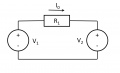
Consider the following circuit:

CurrentDir.PNG
I have arbitrarily chosen the direction of Io to be from left to right. I have no idea whether that is "correct" or not. I could have chosen it to be right to left and that choice would have been equally valid. Assuming that V1 is not exactly equal to V2, one choice will result in Io being positive and the other choice will result in Io being negative.

Because it is a resistor, we can say that current flows through the resistor from the more positive terminal to the less positive terminal; but this is because this is the behavior dictated by the constitutive equation for a resistor (better known as Ohm's Law). Had this been a device with a different constitutive equation, such as an inductor or a capacitor, then it is NOT always the case that current flows from the more positive terminal to the less positive terminal.

The ONLY thing that a negative current tells you is that net charge flows in the opposite direction of the arbitrarily chosen reference direction for that current.
 

WBahn

Joined Mar 31, 2012
32,823
I agree, except wouldn’t a negative current mean that the net flow of positive charge is in the direction opposite of the arrow, and the net flow of negative charge is in the same directuon of the arrow?
Yes. The important thing is that now you are tying the flow of charge to the direction of the reference arrow and putting all consideration of electrons and such out of the way because that doesn't matter -- we are talking about the flow of charge irrespective of the nature of the charge carriers.
 

Thread Starter

electricalengineer3

Joined Feb 6, 2020
172
Consider the following circuit:

View attachment 209118
I have arbitrarily chosen the direction of Io to be from left to right. I have no idea whether that is "correct" or not. I could have chosen it to be right to left and that choice would have been equally valid. Assuming that V1 is not exactly equal to V2, one choice will result in Io being positive and the other choice will result in Io being negative.

Because it is a resistor, we can say that current flows through the resistor from the more positive terminal to the less positive terminal; but this is because this is the behavior dictated by the constitutive equation for a resistor (better known as Ohm's Law). Had this been a device with a different constitutive equation, such as an inductor or a capacitor, then it is NOT always the case that current flows from the more positive terminal to the less positive terminal.

The ONLY thing that a negative current tells you is that net charge flows in the opposite direction of the arbitrarily chosen reference direction for that current.
Correct, allow me to just point one thing out to emphasize the source of my most recent confusion.

This statement: “Because it is a resistor, we can say that current flows through the resistor from the more positive terminal to the less positive terminal“

This statement is only true if everyone knows that when you say current, that you mean positive current. If this isn’t inherently known, then someone could say wouldn’t negative current flow from the more negative to the less negative terminal and they would be correct. This person would not be using a different convention, rather talking about it in a “different way”, right?
 

Thread Starter

electricalengineer3

Joined Feb 6, 2020
172
Yes. The important thing is that now you are tying the flow of charge to the direction of the reference arrow and putting all consideration of electrons and such out of the way because that doesn't matter -- we are talking about the flow of charge irrespective of the nature of the charge carriers.
Correct, you were a big help in getting me to that point and I really appreciate that, it allowed me to dig into what I actually didn’t understand.

I was simply confused because we have conventional current which is positive in the direction that positive charge would move and negative in the direction that negative charge would move. Hence, if staying under this convention and you wanted to track the flow of electrons you would do so with a negative value because they are negatively charged.
then, there is the entirely different definition people call “electron flow” which gives a positive value to current in the direction of electrons.

the correct way of modeling electron flow is not contradictory to our convention for current, because we can have a current being positive one way or a current being negative the other.

However, the alternate definition for current must be treated much differently especially when solving problems involving the usage of sign conventions.

Then, other layer to this is although the mathematical sign of the current does tell you something about which charges are potentially flowing which directions, we do not treat the sign as such in day to day conversation. We make positive current our default for the word current, and use the negative sign to tell us what this current is doing.

Is this a fair summary?
 

WBahn

Joined Mar 31, 2012
32,823
Correct, allow me to just point one thing out to emphasize the source of my most recent confusion.

This statement: “Because it is a resistor, we can say that current flows through the resistor from the more positive terminal to the less positive terminal“

This statement is only true if everyone knows that when you say current, that you mean positive current. If this isn’t inherently known, then someone could say wouldn’t negative current flow from the more negative to the less negative terminal and they would be correct. This person would not be using a different convention, rather talking about it in a “different way”, right?
When we talk about any polarized quantity, we are talking about the case for positive values. That is a convention that is pretty much universal. When I say that h is the height above the ground, I do not need to specify that I am talking about positive heights -- that is universally understood. If I say that h is the depth below the surface, I don't need to say that I am talking about positive depths. If I say that P is the amount of money I owe you, I don't have to say that I am talking about positive money. It is the same with current.
 

WBahn

Joined Mar 31, 2012
32,823
Correct, you were a big help in getting me to that point and I really appreciate that, it allowed me to dig into what I actually didn’t understand.

I was simply confused because we have conventional current which is positive in the direction that positive charge would move and negative in the direction that negative charge would move. Hence, if staying under this convention and you wanted to track the flow of electrons you would do so with a negative value because they are negatively charged.
then, there is the entirely different definition people call “electron flow” which gives a positive value to current in the direction of electrons.
Again, consider the diagram I posted. If V1 = 10 V and V2 = 20 V and R1 was 1 kΩ, them I1 would be -10 mA. That negative sign has NOTHING to do with whether we are tracking positive ions or negatively charged electrons or positrons. It merely tells us that the value of the total charge that has moved past a point in that branch is becoming more negative at the rate of 0.01 coulombs per second. That is ALL it tells us. The change could be due to positive charges moving in the direction opposite the arrow or negative charges moving in the direction of the arrow or some combination of the two such that there is an imbalance resulting in -10 mC/s of charge moving in the direction of the arrow.
 

Thread Starter

electricalengineer3

Joined Feb 6, 2020
172
Again, consider the diagram I posted. If V1 = 10 V and V2 = 20 V and R1 was 1 kΩ, them I1 would be -10 mA. That negative sign has NOTHING to do with whether we are tracking positive ions or negatively charged electrons or positrons. It merely tells us that the value of the total charge that has moved past a point in that branch is becoming more negative at the rate of 0.01 coulombs per second. That is ALL it tells us. The change could be due to positive charges moving in the direction opposite the arrow or negative charges moving in the direction of the arrow or some combination of the two such that there is an imbalance resulting in -10 mC/s of charge moving in the direction of the arrow.
Correct, the sign of the current doesn’t tell us for sure what charge is moving, but it does tell us for each sign of charge, which direction it would be moving if it were to be moving in that circuit. Basically, I just wanted to confirm that when people say we have to use electron flow carefully they are referring to the electron flow convention where electron movement is given a positive current value. Because under conventional current, we know that the current can be either positive or negative and those are just fine. You don’t have to consistently use positive or negative current in any situations as they are interchangeable.
 

Thread Starter

electricalengineer3

Joined Feb 6, 2020
172
When we talk about any polarized quantity, we are talking about the case for positive values. That is a convention that is pretty much universal. When I say that h is the height above the ground, I do not need to specify that I am talking about positive heights -- that is universally understood. If I say that h is the depth below the surface, I don't need to say that I am talking about positive depths. If I say that P is the amount of money I owe you, I don't have to say that I am talking about positive money. It is the same with current.
That is a fair point, it’s just a bit different in my head because current is the movement of charge which can be positive or negative whereas money and height are positive only quantities that can be represented as negative just due to mathematics.
 
Status
Not open for further replies.
Top