Conventional vs Electron flow

Status
Not open for further replies.

Thread Starter

electricalengineer3

Joined Feb 6, 2020
172
Okay so negative charge moving one way is the same as positive charge moving the other and they can both be assigned a positive value with their respective opposing directions and it won’t matter?
I take it with a grain of salt and some common sense. You will continue to see it both ways depending on the document you are reading so get familiar with it. Once I became used to it, it became a non-issue.
yep, I’m trying to make it that way for myself.
 

MrChips

Joined Oct 2, 2009
34,807
Okay so negative charge moving one way is the same as positive charge moving the other and they can both be assigned a positive value with their respective opposing directions and it won’t matter?

also, sorry for bringing this up again but why are we keen on ignoring the terminals?
Because the sign of the terminal does not tell you the direction of the current.
I already told you the answer you gave to the exercise on post #90 is incorrect.

Do the KVL and KCL analysis.
There are three unknown currents flowing in R1, R2, and R3.
Since there are three unknowns you need three equations.
Show your equations.
Solve for the currents in R1, R2, and R3.
 

Thread Starter

electricalengineer3

Joined Feb 6, 2020
172
Because the sign of the terminal does not tell you the direction of the current.
I already told you the answer you gave to the exercise on post #90 is incorrect.

Do the KVL and KCL analysis.
There are three unknown currents flowing in R1, R2, and R3.
Since there are three unknowns you need three equations.
Show your equations.
Solve for the currents in R1, R2, and R3.
Correct it doesn’t in circuits with multiple sources but don’t we have to have some assumption as a starting point?

i1=i2+i3 or i2=i1-i3
-10+i1 +10i2=0 (because i1 and i3 oppose each other)
-10i2+i3 +5=0
Using these equations I get current through r1 as 20/7 going left to right current through r2 going top to bottom at 5/7 and current through r3 as 15/7. This is similar to what I got for the last set of equations I just didn’t calculate i2 last time. If these equations are incorrect could you please tell me why?
 

MrChips

Joined Oct 2, 2009
34,807
Correct it doesn’t in circuits with multiple sources but don’t we have to have some assumption as a starting point?

i1=i2+i3 or i2=i1-i3
-10+i1 +10i2=0 (because i1 and i3 oppose each other)
-10i2+i3 +5=0
Using these equations I get current through r1 as 20/7 going left to right current through r2 going top to bottom at 5/7 and current through r3 as 15/7. This is similar to what I got for the last set of equations I just didn’t calculate i2 last time. If these equations are incorrect could you please tell me why?
In order to understand your equations we have to see how you drew your currents in the circuit.
Show your drawing with the currents I1, I2, and I3 drawn with arrows showing direction of flow.
 

Thread Starter

electricalengineer3

Joined Feb 6, 2020
172
In order to understand your equations we have to see how you drew your currents in the circuit.
Show your drawing with the currents I1, I2, and I3 drawn with arrows showing direction of flow.
I1 coming out of the left source positive, which splits into i2 going top to bottom in the middle branch and i3 going left to right across r3 and down into the positive of the 5V
 

MrChips

Joined Oct 2, 2009
34,807
Ok. Then show how you arrive at your KVL and KCL equations.

KVL - Total algebraic sum of all potential differences in a loop is zero.
KCL - Total algebraic sum of all currents at a node is zero.
 

Thread Starter

electricalengineer3

Joined Feb 6, 2020
172
Ok. Then show how you arrive at your KVL and KCL equations.

Do you understand KVL? Total algebraic sum of all potential differences in a loop is zero.
Do you understand KCL? Total algebraic sum of all currents at a node is zero.
Yes so starting at bottom left corner for left loop you hit the minus side of the battery first and that’s -10+i1R1+i2R2=0
Loop 2 starting below R2
Since I have already defined I 2 going top to bottom then it’s gonna be -i2R2+i3R3+5V=0
Kcl equation is just i1=i2+i3
I’m honestly not seeing what’s wrong with these
 

MrChips

Joined Oct 2, 2009
34,807
Did you switch R2 and R3?
Let's be consistent and stick with my original diagram.
Show your equations now to see if we are on the same page.
 

Thread Starter

electricalengineer3

Joined Feb 6, 2020
172
Did you switch R2 and R3?
Let's be consistent and stick with my original diagram.
Show your equations now to see if we are on the same page.
Certainly did. -10+i1R1+i2R3=0
-i2R3+i3R2+5=0
I1 defines out the plus of the 10 volt i2 and i3 both leaving the top center node so i2 going top to bottom and i3 going left to right
 

WBahn

Joined Mar 31, 2012
32,823
Correct it doesn’t in circuits with multiple sources but don’t we have to have some assumption as a starting point?
Nope. You can flip a coin.

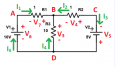
Consider the following assignments for the voltages and currents in each component in the circuit:

Arbitrary.png

Note that I avoided using V1 and V2 since these are the symbolic voltages of the two given supplies.

These were literally made by flipping a coin for each current and each voltage polarity. Absolutely no attempt was made to pick the "right" directions. We therefore have ten unknowns (two for each component -- a voltage and a current) that we have to solve for. So we need ten linearly independent equations.

In terms of these symbolic voltages, we can apply KVL around any closed loop in the circuit. For each loop we sum the voltage gains (or drops) going around the loop. We can flip a coin to determine if we sum the gains or the drops and we can flip a coin to determine if we go clockwise or counterclockwise around the loop.

Left loop: (+V6) + (+V7) + (-V3) = 0 [Sum of voltage gains going clockwise starting at A]
Right loop: (-V3) + (-V4) + (-V5) = 0 [Sum of voltage drops going clockwise starting at B]
Perimeter: (-V6) + (-V5) + (-V4) + (-V7) = 0 [Sum of voltage gains going counterclockwise starting at A]

We can use any two of these, since the third is a linear combination of the other two. For instance, if you add the equations for the Left and Perimeter loops, you get the equation for the Right loop.

In terms of these symbolic currents, we can apply KCL at every node in the circuit. For each node we sum the currents into (or out of) the node and set it equal to zero. We can flip a coin to determine if we sum the currents into or out of the node.

Node A: (+I5) + (-I1) = 0 [Sum of currents into the node]
Node B: (+I1) + (+I2) + (+I4) = 0 [Sum of currents into the node]
Node C: (-I2) + (-I3) = 0 [Sum of currents into the node]
Node D: (+I5) + (+I4) + (-I3) = 0 [Sum of currents out of the node]

We can use any three of these; the fourth is a linear combination of the others. For instance, if we sum the equations for Nodes A, B, and C, we get the equation for Node D.

For all of these equations, the choice of conventional current or electron current is completely immaterial (as long as we are consistent and use the same definition for all of the currents in the circuit).

So our KVL and KCL equations give us five of the ten equations we need. The other five come from the constitutive equation for each component, which relates the voltage across that component to the current through that component.

V6 = V1
V7 = (-I1)·R1
V3 = (-I4)·R3
V4 = (+I2)·R2
V5 = -V2

This is where the choice of current convention can come into play. The above equations are for conventional current and they would also apply to electron flow IF the electron-flow crowd were internally consistent. But they aren't, and so they need to apply a minus sign to the three middle equations (the Ohm's Law equations).

With these ten equations we can now solve for every voltage and current in the circuit.

Not surprisingly, if this is the way we solved circuits in practice, we would almost never get correct results because there are just too many opportunities to make silly mistakes. So we develop analysis techniques the embed most of the constraints into the technique itself. For example, Node Voltage Analysis is merely a systematic application of KCL in such a way that KVL is guaranteed to be satisfied and the constitutive equations are taken into account. Similarly, Mesh Current Analysis is merely a systematic application of KVL in such a way that KCL is guaranteed to be satisfied and, again, the constitutive equations are taken into account.
 

MrChips

Joined Oct 2, 2009
34,807
Did all currents I1, I2, and I3 have positive values?
This means that the directions you originally chose matched the actual directions.
Is the direction of I2 what one would expect judging by the sign on the V2 battery terminal?
 

Thread Starter

electricalengineer3

Joined Feb 6, 2020
172
Did all currents I1, I2, and I3 have positive values?
This means that the directions you originally chose matched the actual directions.
Is the direction of I2 what one would expect judging by the sign on the V2 battery terminal?
Yes they did. And no it is not what you would expect but without some convention I don’t know what the values physically means. Sure I found out that i2 is positive and there is positive current flowing in the way I said but what does that actually mean.
 
Status
Not open for further replies.
Top