Conventional vs Electron flow

Status
Not open for further replies.

Thread Starter

electricalengineer3

Joined Feb 6, 2020
172
A long time ago when I think dinosaurs roamed the earth, well maybe not quite that long ago but anyway I learned it and was taught electron flow, before solid state diodes were popular I was taught that for example on a diode vacuum tube like an old 5U4G that when the filaments were hot electrons "cooked" off or were emitted from the filament which served as a cathode and flowed to the plate which served as an anode. Thus in the case of a solid state diode I was taught electrons flowed into the arrow. A little later I learned about hole flow? So do electrons really flow or do the holes the electrons occupied actually flow? Does it really matter and if it does it likely only matters to a select few. Those with obsessive compulsive disorder need not apply.

During The Second World War (WW-II) there was a saying following the US taking The Philippine Islands back. The saying went "By the grace of God & the help of the Marines McArthur has returned to the Philippines. I figure by the grace of God and current flow I survived a 45 year career working in electronics. I can honestly say over an entire career and endless formula that never once did it matter which way the electrons flowed. There was never any call for it. When I walked away upon retirement I told my juniors that my entire career was an "E" Ticket ride and that "electronic stuffs are been very, very gud to me" and let it go at that.

Forum discussions on this subject never seem to go well and my simple observation is toss in a few OCD types and things go South real quick. Since I don't have a dog in the race I just grab a snack and watch. Become familiar with the theory behind If you assume current flow, its direction is from the positive end to the negative end and If you assume electron flow, it's direction is from the negative end to the positive end and move along.

Ron
Fair enough totally get what you’re saying. I’m just trying to understand it more than anything. I just don’t see how positive electrons flowing out of the negative could make even the slightest bit of sense. To me it seems like electron flow should be the exact same as conventional current because it’s a flow of negative charge.
 

MrChips

Joined Oct 2, 2009
34,807
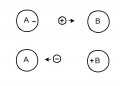
If I move a positive charge from A to B, B will attain a positive charge leaving behind A with a negative charge.
If I move a negative charge from B to A, A will gain a negative charge leaving behind B with a positive charge.

Charge Flow.jpg
The two situations are identical.
 

Reloadron

Joined Jan 15, 2015
7,888
Fair enough totally get what you’re saying. I’m just trying to understand it more than anything. I just don’t see how positive electrons flowing out of the negative could make even the slightest bit of sense. To me it seems like electron flow should be the exact same as conventional current because it’s a flow of negative charge.
About all I can tell you is the trick, if we want to call it a trick, is to try and understand it both ways and move on. When you begin to dwell on it there are problems as well as headaches.

Ron
 

WBahn

Joined Mar 31, 2012
32,823
Yeah I mean when we look at the actual definition of current (flow of charge with respect to time), electron flow should be noted as a negative change in charge going out of the negative terminal of a battery. This is mathematically equivalent to positive charge coming out of the positive. This leads me to conclude that electron flow is no different then what we already use. Obviously this is not the case. But what do you mean the magical mystery minus signs? I don't see how negatives could come into play if they are just assuming negative charge moving is positive.
Consider the following scenario: A 1 F capacitor is connected to a 10 V battery via a switch (say through a 1 Ω resistor to keep the current levels well defined). Initially the capacitor is uncharged. The switch is closed and left closed for a long time. The now-charged capacitor is then removed from the circuit. What is the charge on the plate that was originally connected to the negative terminal of the battery.

The electron-flow crowd will insist that an initial current of +10 A is flowing from the negative terminal of the battery toward the capacitor.

They will have no objection to the notion that one ampere is one coloumb per second.

They will all claim that there is 10 coulombs per second of charge flowing out of the negative terminal toward the capacitor.

They will have no objection to equations such as Q = I·T, saying that the total charge that flows (in a constant-current situation) is the product of the current that is flowing multiplied by the amount of time that it flows.

They will say that the charge on the bottom plate is -10 C, even though it resulted from a current flow toward the plate that was, at all times since the switch was closed, non-negative.

How do they arrive at this?

I've had this conversation with numerous electron-current folks over the years and they pretty much all employ a magical mystery minus sign at one of two points in their approach. They either claim outright that this +10 A of current transfers a negative charge since electrons are negatively charged, or they will claim that the charge on the bottom plate is negative because it was connected to the negative side of the battery. In either case they are effectively using Q=-I·T to account for the implicit use of a positively-charged electron in a world where voltages are determined by negatively-charged electrons.
 

WBahn

Joined Mar 31, 2012
32,823
A long time ago when I think dinosaurs roamed the earth, well maybe not quite that long ago but anyway I learned it and was taught electron flow, before solid state diodes were popular I was taught that for example on a diode vacuum tube like an old 5U4G that when the filaments were hot electrons "cooked" off or were emitted from the filament which served as a cathode and flowed to the plate which served as an anode. Thus in the case of a solid state diode I was taught electrons flowed into the arrow. A little later I learned about hole flow? So do electrons really flow or do the holes the electrons occupied actually flow? Does it really matter and if it does it likely only matters to a select few. Those with obsessive compulsive disorder need not apply.

During The Second World War (WW-II) there was a saying following the US taking The Philippine Islands back. The saying went "By the grace of God & the help of the Marines McArthur has returned to the Philippines. I figure by the grace of God and current flow I survived a 45 year career working in electronics. I can honestly say over an entire career and endless formula that never once did it matter which way the electrons flowed. There was never any call for it. When I walked away upon retirement I told my juniors that my entire career was an "E" Ticket ride and that "electronic stuffs are been very, very gud to me" and let it go at that.

Forum discussions on this subject never seem to go well and my simple observation is toss in a few OCD types and things go South real quick. Since I don't have a dog in the race I just grab a snack and watch. Become familiar with the theory behind If you assume current flow, its direction is from the positive end to the negative end and If you assume electron flow, it's direction is from the negative end to the positive end and move along.

Ron
For MOST situations, the distinction doesn't matter (as long as you put in the magical mystery minus signs to make things work out). Even with vacuum tube circuits the distinction is largely immaterial and you can analyze them with purely conventional current just fine. When you design and build them the nature of the charge carrier is certainly important since it determines what needs to get heated or what polarity is needed to get something to hit something else (electrons to hit the phosphors on a screen, for instance.

But there ARE situations in which a positive charge moving in one direction and a negative charge moving in the other direction give fundamentally different results. The classic example is the Hall effect.
 

Thread Starter

electricalengineer3

Joined Feb 6, 2020
172
For MOST situations, the distinction doesn't matter (as long as you put in the magical mystery minus signs to make things work out). Even with vacuum tube circuits the distinction is largely immaterial and you can analyze them with purely conventional current just fine. When you design and build them the nature of the charge carrier is certainly important since it determines what needs to get heated or what polarity is needed to get something to hit something else (electrons to hit the phosphors on a screen, for instance.

But there ARE situations in which a positive charge moving in one direction and a negative charge moving in the other direction give fundamentally different results. The classic example is the Hall effect.
What's weird to me is using conventional current direction, if you assume negative charge leaving from the negative then that gives you a positive current and if you use positive charge leaving from the positive you also get positive current.
 

MaxHeadRoom

Joined Jul 18, 2013
30,654
My initial foray into electronics started with valve theory, as that was the go-to electronic device of the time, so I had a very good schooling in the boiling off of electrodes in a thermionic valve (tube) with the resultant flow of electrons from K to A..
Also applied to the later implementation of mercury pool Ignitron and also the Thyratron and Dekatron tubes.
So with the implementation of semiconductors, using the conventional flow methods took a little getting used to.
But I am fine with it now! :cool:
Max.
 

MrChips

Joined Oct 2, 2009
34,807
What's weird to me is using conventional current direction, if you assume negative charge leaving from the negative then that gives you a positive current and if you use positive charge leaving from the positive you also get positive current.
The direction of flow is multiplied by the sign of the charge.
Two negative values when multiplied give a positive result.
 

Thread Starter

electricalengineer3

Joined Feb 6, 2020
172
The direction of flow is multiplied by the sign of the charge.
Two negative values when multiplied give a positive result.
So with conventional current flow, there is positive current coming out of both terminals of the battery? Can you provide your rationale for thinking through this
 

MrChips

Joined Oct 2, 2009
34,807
So with conventional current flow, there is positive current coming out of both terminals of the battery? Can you provide your rationale for thinking through this
Where did I make that statement?
I implied that a negative charge flowing in one direction can be perceived as a positive charged flowing in the reverse direction.
 

MrChips

Joined Oct 2, 2009
34,807
Are you still adhering to the flawed notion that electrons always leave the -ve terminal of a battery?
Electrons can flow in either direction. The direction is not determined only by the sign assigned to the battery terminal.
When you are charging a battery you reverse the flow of electrons, i.e. electrons flow into the -ve terminal and out of the +ve terminal.
 

nsaspook

Joined Aug 27, 2009
16,321
So with conventional current flow, there is positive current coming out of both terminals of the battery? Can you provide your rationale for thinking through this
What? That's a nonsense straw-man.

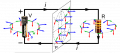
Think energy. The energy used in an electric circuit isn't "contained" in the electrons and electrons aren't used up when energy is consumed in a circuit.
With AC current flow the current direction/voltage polarity reverses many times a second but if you do the math with the fields that actually carry the energy with a purely resistive load impedance the power equations are always positive pointing away from the source on both sides. The is exactly the same with a DC circuit.
wL6Py.png

On both battery terminals the Poynting vector (Poynting vector is a cross product of the two fields) BLUE still points from source to load even though the current is switching directions.
https://en.wikisource.org/wiki/On_the_Transfer_of_Energy_in_the_Electromagnetic_Field
A current in a conductor is rather to be regarded as consisting essentially of a convergence of electric and magnetic energy from the medium upon the conductor and its transformation there into other forms. The current through a seat of so-called electromotive force consists essentially of a divergence of energy from the conductor into the medium. The magnetic lines of force are related to the circuit in the same way throughout, while the lines of electric force are in opposite directions in the two parts of the circuit,—with the so-called current in the conductor, against it in the seat of electromotive force. It follows that the total E.M.I. round the circuit with a steady current is zero, or the work done in carrying a unit of positive electricity round the circuit with the current is zero. For work is required to move it against the E.M.I. in the seat of energy, this work sending energy out into the medium, while an equal amount of energy comes in in the rest of the circuit where it is moving with the E.M.I. This mode of regarding the relations of the various parts of the circuit is, I am aware, very different from that usually given, but it seems to me to give us a better account of the known facts.
 

Thread Starter

electricalengineer3

Joined Feb 6, 2020
172
Where did I make that statement?
I implied that a negative charge flowing in one direction can be perceived as a positive charged flowing in the reverse direction.
Well this is what I am looking at it from. Current direction defined as flowing out of the positive. Dq/dt for positive charges is positive times positive direction give you positive. Dq/dt for a negative charge is negative times negative direction gives you a positive. So overall, it seems that there is a positive value coming out of both terminals.
 

Thread Starter

electricalengineer3

Joined Feb 6, 2020
172
What? That's a nonsense straw-man.

Think energy. The energy used in an electric circuit isn't "contained" in the electrons and electrons aren't used up when energy is consumed in a circuit.
With AC current flow the current direction/voltage polarity reverses many times a second but if you do the math with the fields that actually carry the energy with a purely resistive load impedance the power equations are always positive pointing away from the source on both sides. The is exactly the same with a DC circuit.
View attachment 198851

On both battery terminals the Poynting vector (Poynting vector is a cross product of the two fields) BLUE still points from source to load even though the current is switching directions.
https://en.wikisource.org/wiki/On_the_Transfer_of_Energy_in_the_Electromagnetic_Field
It wasn't a straw man. It was me not understanding what he was trying to convey. I don't understand this so I am trying to ask if what I am taking his words to mean is the correct way of interpreting them. I am definitely not trying to argue with anyone
 

WBahn

Joined Mar 31, 2012
32,823
What's weird to me is using conventional current direction, if you assume negative charge leaving from the negative then that gives you a positive current and if you use positive charge leaving from the positive you also get positive current.
That shouldn't be weird at all -- it's the way it should be. In either case the flow of charge is such that the positive terminal is becoming less positive (or the negative terminal is becoming less negative) relative to the other terminal (this, of course, is balanced out by current flows within the power source).
 

WBahn

Joined Mar 31, 2012
32,823
Well this is what I am looking at it from. Current direction defined as flowing out of the positive. Dq/dt for positive charges is positive times positive direction give you positive. Dq/dt for a negative charge is negative times negative direction gives you a positive. So overall, it seems that there is a positive value coming out of both terminals.
But when you say that the direction is negative, that means it is in the opposite direction, so going TOWARD the negative terminal.
 

Thread Starter

electricalengineer3

Joined Feb 6, 2020
172
That shouldn't be weird at all -- it's the way it should be. In either case the flow of charge is such that the positive terminal is becoming less positive (or the negative terminal is becoming less negative) relative to the other terminal (this, of course, is balanced out by current flows within the power source).
So is electron flow just using conventional current in the opposite direction and it’s still technically positive that way
 

nsaspook

Joined Aug 27, 2009
16,321
It wasn't a straw man. It was me not understanding what he was trying to convey. I don't understand this so I am trying to ask if what I am taking his words to mean is the correct way of interpreting them. I am definitely not trying to argue with anyone
OK, but you still seem to be stuck on the basic misconception of the flow of charge to energy. You just seem reluctant to accept some very good answers and move on to better things.
 

Thread Starter

electricalengineer3

Joined Feb 6, 2020
172
OK, but you still seem to be stuck on the basic misconception of the flow of charge to energy. You just seem reluctant to accept some very good answers and move on to better things.
I’m sorry for making that impression, this is just overwhelming to me trying to figure this out especially when I’ve heard a bunch of stuff from other sources. I know at the end of the day it’s really not a big deal I’m just really trying to make sense of it. In your opinion, what is the key thing I should be taking away
 

WBahn

Joined Mar 31, 2012
32,823
So is electron flow just using conventional current in the opposite direction and it’s still technically positive that way
If you are being careful to be mathematically rigorous and stay in conformance with the definitions of charge, voltage, energy, power, and all of the other quantities, then yes.

If you are a typical electron-flow aficionado, then no because you will be sloppy with your definitions (mostly because you don't give them any thought) and will get in the habit of throwing about magical mystery minus signs in order to get things to work out the way you want them to.
 
Status
Not open for further replies.
Top