Read the specs. You’ll have to do a bit of math for the rack and pinion.
What is your requirement? The specs will be meaningless unless you know what you need. Ask yourself do I really need that much speed or what’s the minimum requirement.
Your image shows crochet/knitting needles, was that to just illustrate or is that what your working with, doing? I at one time was into weaving and did a lot of reading on the different typs of loom. There are two types that may give you some ideas. Maybe look into them there is a lot on the web about them and how they work.
1 Dobby loom. https://en.wikipedia.org/wiki/Dobby_loom The old time ones were and still are controlled by a pattern lag to move the individual warp threads so a pattern could be made in the cloth, The lag had different length pins or pegs to move the heddles(the things that raise the warp threads). The modern computer controlled ones use solenoids to do the same thing.
2.Jacquard loom. https://en.wikipedia.org/wiki/Jacquard_machine This is another way to make repeating patterns in cloth. It is real similar to the dobby, but used *punch cards* on a chain that moved the heddles as needed to make the design.
Then there are circular looms. https://en.wikipedia.org/wiki/Loom#Circular_looms Not real sure how they work but have seen them in operation weaving socks and such tube like things. They some how can even add words into a weaving but don't know how they do it.
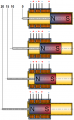
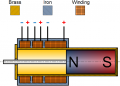
Please define speed. What about a programmable "thing" that will push/pull from 0 to 2cm in 100 steps in 0.14 seconds? (Found one at 0.07 seconds) Many solenoids only push and no pull, so they add a spring.
So these *pens* aren't really doing any work? If speed is important their will need to be power to get to the "down" position. What ever your building/doing(you still haven't said what this is) is going to be huge to have 1500 solenoids capable of doing any type of lifting/work. Why not just state the actuall use of what your trying to do? Making people guess is just getting a lot of guesses for answers. Not a good way to solve a problem.
Please define speed. What about a programmable "thing" that will push/pull from 0 to 2cm in 100 steps in 0.14 seconds? (Found one at 0.07 seconds) Many solenoids only push and no pull, so they add a spring.
So these *pens* aren't really doing any work? If speed is important their will need to be power to get to the "down" position. What ever your building/doing(you still haven't said what this is) is going to be huge to have 1500 solenoids capable of doing any type of lifting/work. Why not just state the actuall use of what your trying to do? Making people guess is just getting a lot of guesses for answers. Not a good way to solve a problem.
Hey, I can say it's okay... it's a knitting machine, so the image I posted at the beginning with needles is really what the project is about... normally knitting machines use carriage to activate the needles but I think activating it individually will make it faster... answering your question, to go back down I plan to use a spring
You’ll also need to identify/calculate the solenoid release time, which is typically slower than the actuation time. Total response time equals (actuation + release) times.
For faster actuation time, use the highest voltage possible. Suggest 2 x operating voltage and switch back to operating voltage to hold the solenoid in position. For faster release time, you’ll need additional components, such as a zener diode in series with the diode reverse biased across the solenoid terminals.
You would most likely have to build it yourself. A while ago, Danko helped me design a solenoid winding machine. Specifically with controlling wire tension. Let me know if you're interested.
See that wasn't so hard. Then I'm assuming it's a V-bed type of machine? A flat knitter? Your in luck then because there is a ton of patents out there to look at and get ideas from. or if just for your self, copy. This type machine has been around in one form or another since ~1860's or maybe before.
But don't quite understand why you would need 3 needle heights, but then I don't knit.
You’ll also need to identify/calculate the solenoid release time, which is typically slower than the actuation time. Total response time equals (actuation + release) times.
For faster actuation time, use the highest voltage possible. Suggest 2 x operating voltage and switch back to operating voltage to hold the solenoid in position. For faster release time, you’ll need additional components, such as a zener diode in series with the diode reverse biased across the solenoid terminals.
See that wasn't so hard. Then I'm assuming it's a V-bed type of machine? A flat knitter? Your in luck then because there is a ton of patents out there to look at and get ideas from. or if just for your self, copy. This type machine has been around in one form or another since ~1860's or maybe before.
But don't quite understand why you would need 3 needle heights, but then I don't knit.
Yes, it is a V bed machine, and yes, this machine is around for a long long time and since 1995 the electronic machines can make a whole garment. The need for 3 movements is related to knitting that im not going to go over, but I uploaded a simulation of what needles do here
The most moderns machines currently use a mechanism that moves back and fourth to active the needles (35a in the image)
I want to make this needles independent to increase the speed, this change will also require more changes related to the yarn carriage that is not illustrated in this pic.
have a second look at the video clip, does the needle on the left need to move to three positions, or would only two do ?
to my quick look, it looks like in or out on the left needle is all you need.
have a second look at the video clip, does the needle on the left need to move to three positions, or would only two do ?
to my quick look, it looks like in or out on the left needle is all you need.
You would most likely have to build it yourself. A while ago, Danko helped me design a solenoid winding machine. Specifically with controlling wire tension. Let me know if you're interested.
Again not a knitter. Don't all of the needles on a side move in unison? If so that could make things easier, by using a reciprocating cam. Kind of a heart shaped one, with the low position being where the lobes meet. And the two lobes having a different lift height. Moving one direction(say CW) to make the medium move or CCW to make the high move.
Unless this is going to make a very course knit, space is going to get used up fast with solenoids. Have you seen how this company is doing it? https://www.kniterate.com/
Again not a knitter. Don't all of the needles on a side move in unison? If so that could make things easier, by using a reciprocating cam. Kind of a heart shaped one, with the low position being where the lobes meet. And the two lobes having a different lift height. Moving one direction(say CW) to make the medium move or CCW to make the high move.
Unless this is going to make a very course knit, space is going to get used up fast with solenoids. Have you seen how this company is doing it? https://www.kniterate.com/
yes, they use what i said before, a carriage that activate the needles as it moves back and forth, I want to be able to activate needles individually and the reason is the speed, primarily... normally you activate needles in an order but I developed a new way of knitting that does not necessarily need this order

 Facebook
 Google
 GitHub
 Linkedin