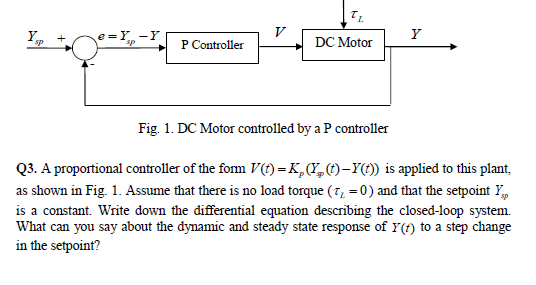
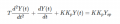
Well to start you could solve the DE and then you will have the time domain response from which you can tell what the dynamics are. You can also transform to the Laplace domain and then take the limit as 's' goes toward zero, which will give you the steady state response absolutely if all the poles are in LHP, and also just transform into the time domain which will give you the time domain response. You could also take the limit as time goes toward infinity but that's usually harder to do (but not impossible).
If there are poles on the jw axis you may be able to show that the steady state response is a limited value sine type wave.
Or you could start with a qualitative description of how the system responds to a step change in the set point. Then describe it more precisely using the parameters of the system

 Facebook
 Google
 GitHub
 Linkedin