Control of the DC-DC Boost Converter

Thread Starter

Said76

Joined Jul 11, 2018
11
Hello, I'm new to converters. I'm currently working on the PSO control of the MOSFET for a DC-DC boost converter, and I'd like to first master the conventional (classical) control for this type of converter. So, we want an output voltage that will be our reference voltage for controlling the MOSFET, is that right? And we compare it to the actual (measured) output voltage? So we'll have an error, and this error will be fed into a regulator? (I'm starting with a PID regulator for the classical control). So, the output of this regulator is a signal? So how is this signal fed into the MOSFET to make it work? Thank you.
 

ronsimpson

Joined Oct 7, 2019
4,658
reference voltage
Yes, you need a reference. To make a measurement you need a reference of known value. We often use 1.25V or 2.5V but it probably does not matter.
compare it to the actual (measured) output voltage
The error amplifier looks at the two voltages and tells us "too high" or too low or just right. There is a time delay in the amplifier. If the difference is very small the amplifier responds slowly, but if the error is large the amp responds fast. Much like your foot on the gas pedal of a car.
So we'll have an error, and this error will be fed into a regulator?
I don't know what you are doing. In a boost power supply, the MOSFET is on/off/on/off. In most switching power supplies the duty cycle determines how much power or current or voltage gets moved from input to output. (there are many different kinds of power supplies)
Example: The Pulse Width Regulator is an oscillator. Say it is running at 50% on and 50% off. There is an output voltage. The error amp looks at the output voltage and tells the oscillator to increase or decrease or stay the same duty cycle.

Do you need a picture?
 

Thread Starter

Said76

Joined Jul 11, 2018
11
Oui, il vous faut une référence. Pour effectuer une mesure, il vous faut une référence de valeur connue. On utilise souvent 1,25 V ou 2,5 V, mais cela n'a probablement pas d'importance.

L'amplificateur d'erreur compare les deux tensions et indique si elles sont trop élevées, trop basses ou correctes. Il existe un délai de réponse de l'amplificateur. Si la différence est très faible, l'amplificateur réagit lentement ; si l'erreur est importante, il réagit rapidement, un peu comme lorsqu'on appuie sur l'accélérateur d'une voiture.

Je ne comprends pas ce que vous faites. Dans une alimentation boost, le MOSFET est commuté (marche/arrêt/marche/arrêt). Dans la plupart des alimentations à découpage, le rapport cyclique détermine la quantité de puissance, de courant ou de tension transférée de l'entrée à la sortie. (Il existe de nombreux types d'alimentations.)
Exemple : Le régulateur de largeur d’impulsion est un oscillateur. Supposons qu’il fonctionne à 50 % de rapport cyclique et 50 % d’arrêt. Il présente une tension de sortie. L’amplificateur d’erreur analyse cette tension et commande à l’oscillateur d’augmenter, de diminuer ou de maintenir le même rapport cyclique.

Vous avez besoin d'une photo ?
[/CITATION]

Thank you for your response; yes, a diagram would be appreciated if possible.
 

ronsimpson

Joined Oct 7, 2019
4,658
Link1

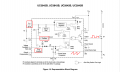
I drew red boxes around some items.
Vref id 5.0 volts. It is divided down to 2.5V and toes to the error amplifier. Pin-1 is looking at the output voltage, or some division of the output voltage. Example, if the output voltage is 100V it needs to be divided by two resistors to get to 2.5V. The error amp is looking at two different 2.5Vs.
The oscillator starts the next cycle. Like a heartbeat.
1762116903475.png
 
Top