Control a DC motor

Thread Starter

ArakelTheDragon

Joined Nov 18, 2016
1,366
Hi!

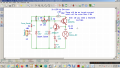
What do you think about this circuit for controlling a 12V DC motor. The motor is normally current controlled, this will not work for a voltage controlled motor.
1691740746476.png
 

AlbertHall

Joined Jun 4, 2014
12,625
The 40Ω resistor is short circuited.
With the pot at either end of its travel one or other of the zeners will be connected directly across the 18V supply and will be destroyed.
 

LowQCab

Joined Nov 6, 2012
5,101
I think You need to start over from the beginning.

Start by stating what the application is,
then why You want to control the speed of the Motor, and what the Motor is powering.

State exactly how You would like the Motor to behave,
under every circumstance that it will be required to operate under.

Do You need precise speed-control ?
Do You need Ramp-Up and Ramp-Down speed-control ?
Do You need Motor-Braking ?
( It appears that You don't need Reversing capability )
What is the "Locked-Rotor-Current" ? ( actually measured with a Meter ) or DC-Ohms of the Motor.

There is no such difference as a Current-Controlled-Motor, vs, a Voltage-Controlled-Motor.
The Speed-Controlling-Circuitry may be Voltage, or Current based, or both.
.
.
.
 

MaxHeadRoom

Joined Jul 18, 2013
30,658
If it IS a series field motor, speed control is very hard to accomplish.
If precise RPM is required a shunt field or PM field motor is preferred.
 

Thread Starter

ArakelTheDragon

Joined Nov 18, 2016
1,366
There is no precise control required. Its just a motor for a pump or door. All I need it to do is start, work smoothly on a constant speed and then turn off fast. No rump of the speed needed. No motor braking needed. No reversing needed. Normally I control them with a pot and nothing else.
 

MaxHeadRoom

Joined Jul 18, 2013
30,658
All I need it to do is start, work smoothly on a constant speed and then turn off fast. No rump of the speed needed.
As I already mentioned, a series motor RPM varies quite drastically with change of load, off load they essentially operate at a run-away speed. RPM control is usually done with some form of optical RPM (slot) sensor.
 
Top