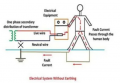
Continous Fault Current passing through Earth ground

MisterBill2

Joined Jan 23, 2018
27,587
If I had your shower I would not use it until a licensed electrician corrected the problem. You are toying with death (no kidding!).
THIS WAS NOT IN A SHOWER!!!!!! I was outside, using power tools on a wooden fence. For unknown reasons the GFI protecting the outlet I was using kept tripping. AND I never felt any slight sock at all. BUT it had to be the current passing from the tool into my hands, because both of the tools were double insulated, no greeenwire ground pin. How is any master electrician going to diagnose that???
 

Thread Starter

Secan

Joined Sep 20, 2024
205
There are design flaws in most GFCI Receptacles. 8 years ago I was analyzing a circuit of a GFCI receptable with a forum dedicated to electricians and electrical, electronic engineers. I have a Waterpik dental spray motor that can trip them at will. Something that can never happen to a Siemens GFCF breaker that is very superior. I tried to send the Waterpik motor and GFCI receptable to the United States so an electronic engineer I was corresponding can check it out himself, but halfway the motor got damage in the shipping, and that was the last time I communicated with them because the engineer was very old and had bypass surgery before that.

Do you agree GFCI receptacles have design flaw such that motors can trip them? Note this is not because of some leakage current because the Waterpik motor is isolated and the ground not connected because we never use ground.
 

crutschow

Joined Mar 14, 2008
38,529
My experience with tripping a GFCI device protecting an outlet that I was using is that while the current was certainly passing thru my hands and body to the ground, I never felt it or had any hint that I was being shocked.
Not my experience.
I accidentally touched the hot lead on a plug that was partially plugged in, and It was a good jolt before the GFCI tripped, that I don't care to experience again. :eek:
 

MisterBill2

Joined Jan 23, 2018
27,587
Certainly there is such a thing as being to safe! Think about the outside GFCI outlet used for the heating cable to keep the exposed water pipes from freezing. A bit of rain and the GFI trips and then the pipes freeze and burst. The fact is that electrical heater tapes seem to have a small amount of leakage.
 

crutschow

Joined Mar 14, 2008
38,529
I had an interesting repeating occurrence of tripping a GFCI using an electric charcoal starter, which had a Calrod type of heating element.
It normally didn't trip, but if I let the rod in the coals too long, and it got hot enough from the coals, it would trip the breaker.
Apparently the leakage to the outer grounded sheath increased at high temperatures, eventually reaching the tripping point of the GFCI.
 

Futurist

Joined Apr 8, 2025
769
View attachment 353429

In my location (Asia). Our power company only supplies us with 2 live wires producing 220 Volts, without giving us any neutral wire. Our electrical system is same as in the United States except no neutral is given to us and we don't use grounding, so just imagine you use your USA 2 live wires to produce 220 Volts for all appliances even 8W lamp. Our 8W lamp is rated 220V and all appliances. We never use 110V.. This lack of grounding is simply lack of awareness and not many got electrocuted enough for government to make a push. So we don't use grounding protection in appliances. I know the risk of not having ground in metal enclosure. So we avoid metal enclosure and use plastic enclosure. In my case. I use Siemens GFCI breakers in all breakers in the main panel in my house so in the event of any leakage of currrent (like raining and the ceiling gets wet, the Siemens GFCI breaker trips). I imagine that when live wire touches metal enclosure, the GFCI breaker will trip.

My question is this.

Since I don't have any ground wire or ground electrode planted to the soil (earthing). I connected my antistatic wrist band with a rod planted to the concrete beside my bedroom. But since the concrete and soil can have plenty of fault current due to the breaker not tripping say there is live wire touching the concrete anywhere like in my neighbors, street, etc. Can the wrist band become electrified? Let's say it has 1 Megaohm inside the wrist band. If the ground connecting it has 220 volts potential, does this formula 220V/1Megaohm = 0.000022 Amp work? It means even if my wrist band is connected to the soil with 220V potential, it is safe with only 0.000022A flowing?

Also consider the case the electronics components I'm working has another potential in its own ground plane. So there is voltage difference between the earth and the circuit which can attract current. But still it is just 220V/1Megaohm = 0.00022 Amp current?

Did I miss something? In the US, you connect the wrist band to the metal enclosure or ground which is connected to the ground rod and the neutral and ground bonded at the service entrance tripping breakers. But in my case, there is missing neutral and ground and I improvise by connecting the wrist band to the concrete outside my window via nails. And so I want to make sure I don't miss something in the analysis of continuous fault current passing through the soil and concrete. Fault current exist all over the city continuously due to no breakers tripping when live wire touches the concrete, etc.

Thank you.
Note, you'll also not get an electric shock when its wired like this, not a suggestion just information.

1754422192055.png
 
Last edited:

Thread Starter

Secan

Joined Sep 20, 2024
205
when I was discussing with the electricians forums 8 years ago. They said in the United States, no one makes use of full house GFCI breakers because appliances were connected to ground and some current leakage can make the GFCI make many false trips. So my full house GFCI breakers was kind of an experiment they approved. I am the only one not only in my country using full house GFCI breakers but in the United States as well. Now after 8 years of experiment. The Siemens GFCI breakers never make any false tripping even once because my house is totally isolated with no leakage to ground because we don't connect appliances to ground.

My country electricians are mostly from poor sectors who earns only 10 dollars a day. They didn't finish any school even high school. Now imagine even in the United States, many electricians are still being taught about grounding by Mike Holt school like bonding ground and neutral at the service panel. In my country, if neutral and ground would be given by the power companies, the electrician can easily make mistake of using hot wire as neutral and not connecting the ground. To avoid this problem, we are only given the 2 hot wires of the US AC system. Originally the power company was also poor, so they purchased used transformers form the United States hence we followed the USA AC system and removed the neutral and ground to avoid confusion.

Now. If I'd put the entire house at same potential by connecting appliances ground to the floor like some of you suggested. This would make the GFCI breakers make more false trip, isn't it?

Not only this. I'd like to know what would happen if for example I didn't have any GFCI breakers, and the full house potential was accidentally connected to the hot wire and the breakers won't trip because neutral and ground is not bonded at the house panel (something totally foreign concept to all electricians in my country). What would happen? Would I be like a bird walking on top of the live wire in the street electric poles. But what would happen if Im standing on my parking with full house 220V potential and I touch the neighbor's house with another potential? Would I get a shock?
 

Thread Starter

Secan

Joined Sep 20, 2024
205
If you measure the voltage between incoming supply and your local earth and get somewhere between 60V and 180V on each wire then what you have is an IT earthing system, which is not allowed for power distribution in most countries.
Do you have two-pin or three-pin mains connectors? If 3-pin, then how is the earth pin wired?

For shock prevention, equipotential bonding is at least as important than earthing, especially if the earth connection is high resistance. Do you have metal water pipes? Any metal window frames? If so connect these together and to your concrete and that is your "earth". It isn't necessarily earth, but it means that all the surfaces you can touch will be at the same potential. All the resistance between these surfaces and the real earth will be in parallel and will decrease the resistance to the real earth.
Connect the earth pin of your appliances to this and you will then be much safer, as if there is a fault, the case of the faulty appliance will be at the same potential as the rest of your environment.
If you can get a reasonable resistance to the actual "earth" then a residual current device (aka ground fault interruptor) will operate.
Pls see the following youtube video where I measured 100V between any of the hot wires to ground which showed we have IT earthing system. Why is it not allowed?


What do you get when you measured such in the United States? And why didn't my Siemens GFCI Breakers trip.. didn't the current get to 5mA?
 
Last edited:

MrAl

Joined Jun 17, 2014
13,711
View attachment 353429

In my location (Asia). Our power company only supplies us with 2 live wires producing 220 Volts, without giving us any neutral wire. Our electrical system is same as in the United States except no neutral is given to us and we don't use grounding, so just imagine you use your USA 2 live wires to produce 220 Volts for all appliances even 8W lamp. Our 8W lamp is rated 220V and all appliances. We never use 110V.. This lack of grounding is simply lack of awareness and not many got electrocuted enough for government to make a push. So we don't use grounding protection in appliances. I know the risk of not having ground in metal enclosure. So we avoid metal enclosure and use plastic enclosure. In my case. I use Siemens GFCI breakers in all breakers in the main panel in my house so in the event of any leakage of currrent (like raining and the ceiling gets wet, the Siemens GFCI breaker trips). I imagine that when live wire touches metal enclosure, the GFCI breaker will trip.

My question is this.

Since I don't have any ground wire or ground electrode planted to the soil (earthing). I connected my antistatic wrist band with a rod planted to the concrete beside my bedroom. But since the concrete and soil can have plenty of fault current due to the breaker not tripping say there is live wire touching the concrete anywhere like in my neighbors, street, etc. Can the wrist band become electrified? Let's say it has 1 Megaohm inside the wrist band. If the ground connecting it has 220 volts potential, does this formula 220V/1Megaohm = 0.000022 Amp work? It means even if my wrist band is connected to the soil with 220V potential, it is safe with only 0.000022A flowing?

Also consider the case the electronics components I'm working has another potential in its own ground plane. So there is voltage difference between the earth and the circuit which can attract current. But still it is just 220V/1Megaohm = 0.00022 Amp current?

Did I miss something? In the US, you connect the wrist band to the metal enclosure or ground which is connected to the ground rod and the neutral and ground bonded at the service entrance tripping breakers. But in my case, there is missing neutral and ground and I improvise by connecting the wrist band to the concrete outside my window via nails. And so I want to make sure I don't miss something in the analysis of continuous fault current passing through the soil and concrete. Fault current exist all over the city continuously due to no breakers tripping when live wire touches the concrete, etc.

Thank you.
Hi there,

When dealing with shock hazard you should really have a local expert check out your situation so that anything you don't know about might be revealed, and a solution recommended. If you make any mistake or anyone misunderstands your situation, it could be very dangerous.

I am still wondering about a few things myself.
For one, how do they wire your appliances over there. Do they connect one wire of the 220v feed to the metal case of your appliances?
They used to do that over here too and it was dangerous and people did get killed from that. When I was younger and in a rock band, we did an outdoor concert one time and there was no stage we had to stand on the grass. We had to be careful to make sure the plug from the amplifiers were plugged in the right way into the outlets so that the cases of the amplifiers were not live. If the case is live, then the ground wires of the microphones becomes live, and if your lips touch the metal of the microphone grill (also metal back then) you would get a shock or worse. They don't do it that way anymore though they use a separate ground wire.

Another point is that you can test for leakage with a decent meter too. You can connect the meter to the case of something and the other lead to the place you think is grounded. You might get a high voltage reading, but then you connect maybe a 100k or 10k resistor across the meter leads to see if the voltage drops a lot. If the voltage drops a lot with a 100k resistor, then the voltage measured is not really a direct connection, but if it does not drop at all or very little, then it is a direct connection and that would be very dangerous. Still, an experience electrician would be the best option and explain the situation clearly.
 

Thread Starter

Secan

Joined Sep 20, 2024
205
Hi there,

When dealing with shock hazard you should really have a local expert check out your situation so that anything you don't know about might be revealed, and a solution recommended. If you make any mistake or anyone misunderstands your situation, it could be very dangerous.

I am still wondering about a few things myself.
For one, how do they wire your appliances over there. Do they connect one wire of the 220v feed to the metal case of your appliances?
They used to do that over here too and it was dangerous and people did get killed from that. When I was younger and in a rock band, we did an outdoor concert one time and there was no stage we had to stand on the grass. We had to be careful to make sure the plug from the amplifiers were plugged in the right way into the outlets so that the cases of the amplifiers were not live. If the case is live, then the ground wires of the microphones becomes live, and if your lips touch the metal of the microphone grill (also metal back then) you would get a shock or worse. They don't do it that way anymore though they use a separate ground wire.

Another point is that you can test for leakage with a decent meter too. You can connect the meter to the case of something and the other lead to the place you think is grounded. You might get a high voltage reading, but then you connect maybe a 100k or 10k resistor across the meter leads to see if the voltage drops a lot. If the voltage drops a lot with a 100k resistor, then the voltage measured is not really a direct connection, but if it does not drop at all or very little, then it is a direct connection and that would be very dangerous. Still, an experience electrician would be the best option and explain the situation clearly.
In the entire Philippines. All metal cases of appliances are not connected to ground or any wire. For example. In my room is a dehumidifier and fire alarm panel, and PC metal casing in front of me. All are metal case but the outlets are only 2 pin. The ground in the device is not used.

dehu and fire alarm.jpg


The reason our AC system is so simple... that is, use the United States 2 hot wires (110V to neutral each forming 220V) and avoid using neutral in the service panel (or any EGC) is because most of our wires in houses are corroded. So if we follow the United States using Equipment Grounding Conductor (EGC) and bonding them with neutral at the service panel and use 110V like in the U.S. What will happen if in millions of houses, the neutral is like broken, so the current from the hot wire would go into all the appliance cases and we would have mass casualty.

Without neutral in the main service panel. We can't connect EGC at the main panel because they can easily be connected to any of the 2 hot wires. And without neutral and grounding. We don't connect appliances ground to the water pipes because we change to PVC pipes.

I don't know anyone who got electrocuted. It's so rare in our society. To be safe I replaced all breakers in main panel into GFCI breakers.

My concern now is since there are fault current running in the ground. What would happen if I connect antistatic wrist band and connect it to the concrete with a nail. Would the fault current reach me? The antistatic wrist band has a tiny 1 Megaohm resistor. Is it enough protection? No one wants to answer this after I asked for 3 weeks already. Maybe you can answer this.

Btw.. our electrical code is copied word by word from the United States except using 110v part. So even if you read the codes. No one follows them. No electricians follow them. Most of our electricians are so poor they never own any home. They live near the river with tents or wooden hut and they need to feed family with only 8 dollars a day salary if they have a job connecting the 220V hot wires. This is reality.
 

Thread Starter

Secan

Joined Sep 20, 2024
205
Let me share the illustration from the manual:

antistatickit.jpg

This illustration is provided you have grounding in your outlet. In my case. I don't have grounding. So can I connect it to the concrete floor with a nail?

Isn't it if you have proper EGC (Equipment Grounding Conductor) to the neutral in the main panel., All fault current pass though the EGC and neutral direct to transformers. If all the appliances in your place never use EGC, and there is fault, would the earth be energized and have potential? I just don't like the potential to develope in me say producing 50V as the input of the EEG is only 5V. Can anyone understand me?

In your country that uses proper EGC to neutral. Do ground fault develope in your earth? If not, then does mine do since we don't use EGC and there may be some live wires that connects to earth that doesn't trip the breaker? Please someone explain all these. Thank you.
 

MrAl

Joined Jun 17, 2014
13,711
In the entire Philippines. All metal cases of appliances are not connected to ground or any wire. For example. In my room is a dehumidifier and fire alarm panel, and PC metal casing in front of me. All are metal case but the outlets are only 2 pin. The ground in the device is not used.

View attachment 353790


The reason our AC system is so simple... that is, use the United States 2 hot wires (110V to neutral each forming 220V) and avoid using neutral in the service panel (or any EGC) is because most of our wires in houses are corroded. So if we follow the United States using Equipment Grounding Conductor (EGC) and bonding them with neutral at the service panel and use 110V like in the U.S. What will happen if in millions of houses, the neutral is like broken, so the current from the hot wire would go into all the appliance cases and we would have mass casualty.

Without neutral in the main service panel. We can't connect EGC at the main panel because they can easily be connected to any of the 2 hot wires. And without neutral and grounding. We don't connect appliances ground to the water pipes because we change to PVC pipes.

I don't know anyone who got electrocuted. It's so rare in our society. To be safe I replaced all breakers in main panel into GFCI breakers.

My concern now is since there are fault current running in the ground. What would happen if I connect antistatic wrist band and connect it to the concrete with a nail. Would the fault current reach me? The antistatic wrist band has a tiny 1 Megaohm resistor. Is it enough protection? No one wants to answer this after I asked for 3 weeks already. Maybe you can answer this.

Btw.. our electrical code is copied word by word from the United States except using 110v part. So even if you read the codes. No one follows them. No electricians follow them. Most of our electricians are so poor they never own any home. They live near the river with tents or wooden hut and they need to feed family with only 8 dollars a day salary if they have a job connecting the 220V hot wires. This is reality.
Hello again,

First, some problems take longer to solve than others. It could take that 3 weeks or longer, just try to be patient, what else can we do anyway.
But given some more time we may be able to come up with something.

Just off the top of my head, since CURRENT is your concern and it's a GROUND current, why can't you use a GFI with your wrist thing? Maybe there is a way to wire up the GFI outlet to detect that current as a fault current if it happens to get dangerous. If it can be connected to break the circuit, that might be enough.
The other thing is that 220/1000000 equals 220ua, which I do not think is lethal. I think 30ma is the max, but I would rather go lower than that. If the current COULD be as high as 220ua as a max, then there may be no reason for concern. You may feel a shock, but then you will know it and stop doing whatever you are doing. I can't be 100 percent sure of this though, but what you could do is look up the specs of a good quality GFI outlet and see what the max current spec for that is. They cant mass produce GFI outlets if they kill people, I don't think :)

As a last resort, if it's only you, you might be able to connect a cord to your belt or something that pulls a switch open that breaks the circuit. If you fall, it breaks the circuit. Switch would be high on the wall or ceiling.
Alternately, a laser beam that breaks if you fall, thus tripping the circuit.
Of course there is always a circuit that senses current like maybe 100ua, then trips the circuit so everything shuts off. I would TEST that SEVERAL times to make dang sure it worked every time.
 
Top