Contact Sense using an opamp or similar

Thread Starter

anishkgt

Joined Mar 21, 2017
549
Hi All,

Would it possible to use an op-amp to sense when two terminals touch each other ?

My idea to use it for my spot welder where the contact sense idea would be used to sense if the electrodes makes a firm contact with the spot to be welded. I've just starting learning about op-amps and this seemed like a good start to learn about them with a practical approach.

Thanks in advance.
 

Reloadron

Joined Jan 15, 2015
7,893
Yes, an operational amplifier would work. That said there are better options, for example a comparator. There is quite a bit to resistance spot welding. Prior to the electrodes closing there is an open circuit voltage. When the tongs close or clamp the open circuit voltage rapidly drops to about 0 volts. That change can be easily detected in several ways with one simple method being a comparator. That said yes, an operational amplifier could also be configured to work. This is oversimplifying a complex process with plenty of variables.

Ron
 

Thread Starter

anishkgt

Joined Mar 21, 2017
549
Thank you Ron.

I am using this idea as practical example to learn about op-amps. I had used voltage buffer and it helped me understand it better when I had implemented it in my project.

Could you pls provide me a sample circuit. I have the LT1078 and a LMV321LT in the poroject, can i use one of these ?

Thanks in advance.
 

Thread Starter

anishkgt

Joined Mar 21, 2017
549
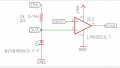
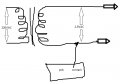
contact is just one of the secondary terminal which would be connected to them all the time. my Idea is as follows, I had been following this link for the sample circuit of a comparator. Shouldn't the other pin also be connected the other electrode as well, otherwise there wouldn't be anything to compare for comparator and DIODE at the output to ignore any negative voltage as the output of the opamp goes to a arduino.
CS_Idea.png
 

Alec_t

Joined Sep 17, 2013
15,125
Very high voltages will be present between the spot welder electrodes when welding current is interrupted. You will need to protect your circuit from those.
 

Dodgydave

Joined Jun 22, 2012
11,395
Your problem is you need to monitor the Probe AC voltage 2.3v, as soon as they are joined together for welding, the voltage will drop or dissappear.. I would use an opto-couper and feed that into your op amp or put a led on.
 

Reloadron

Joined Jan 15, 2015
7,893
But that voltage is only induced when the weld button is pressed and i need to omit the weld button. Just making sure am on the same page as you are.
You never mentioned a weld button or AC resistance verse DC resistance weld. You need to better present exactly what you have in mind including the steps through your weld process. That includes each step and what happens at each step through the process.

Ron
 

Thread Starter

anishkgt

Joined Mar 21, 2017
549
My Bad thought it was clear after that message.

So here is how it works,
My circuit detects the zero cross on the AC sine wave and triggers two Thyristors in a back-to-back configuration which switches on a MOT(Microwave Oven Transformer) at the peak of the sine, which is the typical way to switch on inductive loads to avoid inrush currents. I also have two taps on the secondary to measure the voltage during a weld to calculate the Weld current. All these are initiated at the press of a button which am hoping to automate when the electrodes touch a conductive material like here, an nickel strip

Just not sure how to do this with an opamp or is there a better way to accomplish this task.
 

LesJones

Joined Jan 8, 2017
4,509
I do not think that is a good way to do it for a few reasons. First you are trying to test for contact being made with no current or voltage on the secondary. You can't apply DC across the contacts as the transformer secondary will short circuit it. Secondly I think that the required pressure sould be applied to the electrodes before the power is applied. I think a better way would be to have a suitable spring that was compessed when applying pressure to the electrodes. A micro switch could be triggered when this spring was compessed enough. Another couple of points. It seems to be reccomended to apply a short pre puse of current before the main welding pulse. I am not convinced that a transformer with the secondary heavily loaded represents a very inductive load. I would be interested in others opinion on this. I have recently been building a similar spot welder for battery tabs. I started trying to use a pulse generator design I found on the web but could not get the code to compile. I found it quicker to write my own code than to find out why I could not compile the code from the web. I use a foot switch to trigger the weld current.

Les.
 

Thread Starter

anishkgt

Joined Mar 21, 2017
549
my first design was simple and it works like a charm and it does incorporate a dual pulse. my Second has few more enhancements to it. but wanted to incorporate a way to detect the contact automatically.
 

LesJones

Joined Jan 8, 2017
4,509
One way that might work would be to have the primary energused via a resistor. (An incandescent light bulb would be suitable.) also have a current sence resistor in series and monitor the volage across it. When the elecrodes contacted each other the primary current would increase but not enough to weldas it would be limiited bu the light bulb. This would cause the voltage across the sense resitor to increase an this could be used to trigger the timer. I would suggestbadding a small delay between sensing the increase in current and triggering the timer. The back to back SCRs would short out the light bulb and sense resistor to give the full welding current. Is this the URL of the website that your design is based on ? http://www.avdweb.nl/arduino/hardware-interfacing/spot-welder-controller.html#h8-software I
If so did you have any problem compiling the software ?
http://www.avdweb.nl/arduino/hardware-interfacing/spot-welder-controller.html#h8-software
Les.
 

Thread Starter

anishkgt

Joined Mar 21, 2017
549
Hey Les,

Did not get what you meant, do you have a schematic or a rough drawing ?

Secondly I am not using Alberts code. I wish to learn and do things so i just skipped his code completely and wrote my own. Mine is a bit more complex as i use a servo as well and an LCD screen to set the dual weld time independently and precisely adjust the servo travel.
 

Thread Starter

anishkgt

Joined Mar 21, 2017
549
I read these SSR's have a leakage current/voltage when they are in their open state as in not conducting. Would that be an advantage here ?
 

LesJones

Joined Jan 8, 2017
4,509
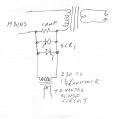
I have changed the idea slightly. The bulb or high power resistor will also act as the sense resistor. There will be the primary of a small transformer (Say 240 to 12 volts at a few mA) connected in parallel with the resistor. This will isolate the sense circuit from the mains. The 12 volt winding will be connected to small bridge rectifier and smoothing capacitor and this will be used to trigger the timer. This is the circuit I was thinking of.
101217.jpg


I suggest first finding a suitable rated bulb so it only glows dimly when the weld transformer secondary is open and glows more brightly when the output is short circuited. I have no idea what the primary current of the unloaded transformer would be so I would start with a 50 or 100 watt bulb. Like you I wrote my own timer code but mine is very simple. It uses a PIC16F628 with a 10 position BCD switch to set the weld time in increments of 50 mS (From 50 to 500 mS) The pre pulse time and pause time is fixed. I did plan to use Alberts code as there seemed no point in re inventing the wheel but I could not get it to compile. (I am very poor at "C" programming so I quickly wrote the code in assembler.)

Les.
 

LesJones

Joined Jan 8, 2017
4,509
When the electrodes are not shorted there is no secondary current so the primary current is only the magnetizing current which should be quite low. As the primary current is quite low there will not be very much voltage drop across the lamp (Or resistor if you use one instead of a lamp.). As the small transformer primary is in parallel with the lamp the voltage across that will be low so the voltage across it's secondary will be low. When the electrodes are shorted together the current through the welding transformer will increase so the voltage across the small transformer primary will also increase. This will cause the voltage across the small transformer secondary to increase. All you need to do is detect when the voltage from the small transformer secondary exceeds a set value and use that signal to trigger the timer.

Les.
 
Top