Constant current through IR LEDs

Thread Starter

sab201

Joined Nov 18, 2023
297
Good Day,

I am thinking of building a pulsed current Infra Red LED device. So need to know if this will be possible.

I am having a buck converter and a circuit to pass constant and pulsed dc current. I want to pass this current through IR LEDs.

The rating of LED is,
Forward Current100mA
Forward voltage1.2V - 1.4V
LED Size5 mm
LED TypeInfrared LED or IR transmitter

Since one LED can take a maximum of 0.1 Ampere, can I connect 50 LEDs in series and pass a 5 Ampere constant and or pulsed dc current from a constant current buck converter source through the LEDs which are in series.

Will it work out or will it damage the LEDs.

Thanks.
 

bertus

Joined Apr 5, 2008
22,882
Hello,

In series, the voltage will add up.
In parallel, the current will add up.
It is not a good plan to put many leds parallel.
The led with the lowest voltage drop will get most current and will burn.
The remaining leds will all get a higher current.
Then the led with the next lowest voltage drop will burn.
It is like an electronic fire cracker.

Bertus
 

panic mode

Joined Oct 10, 2011
4,864
you can put the leds in shorter strings so that you can use lower voltage.

for example common power supply is 24V, and you want to have some 3V overhard for linearization, then 24-3=21V and 20V/1.4V = 15 LEDs.
so you can have three strings of 15 LEDs, and one string of remaining 5 LEDs. each string will need own current limit. since forward voltage of LEDs is not very consistent, choosing series resistor will need to be done carefully for each string. the other option is to replace that resistor by LM317 and a 12 Ohm resistor. the only issue is the last string with only 5 LEDs will cause the last LM317 to dissipate more power.
it is better to rearrange things so that strings are the same (or almost the same).and suppose you are ok with 49 instead of 50 LEDs, then you have 7x sam circuit.
LEDs would have voltage drop under 10V and you can use 22 Ohm resistor per branch. combined current is 7*0.1A = 0.7A. this can be powered continuously or pulsed. to get more current through them, you need cooling, reducing resistor values and carefully timed pulsing.
 

xox

Joined Sep 8, 2017
936
Good Day,

I am thinking of building a pulsed current Infra Red LED device. So need to know if this will be possible.

I am having a buck converter and a circuit to pass constant and pulsed dc current. I want to pass this current through IR LEDs.

The rating of LED is,
Forward Current100mA
Forward voltage1.2V - 1.4V
LED Size5 mm
LED TypeInfrared LED or IR transmitter

Since one LED can take a maximum of 0.1 Ampere, can I connect 50 LEDs in series and pass a 5 Ampere constant and or pulsed dc current from a constant current buck converter source through the LEDs which are in series.

Will it work out or will it damage the LEDs.

Thanks.
This may or may not be a viable option for you but if you can stand to have a dedicated transistor for each an every LED, a Wilson mirror with a single resistor to set the desired current could be used.

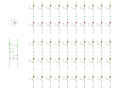
cm.png

The primary advantages of going that route are [1] a low voltage requirement (in the example given I went with 5V, but the actual value could be selected at your convenience, provided that it is higher than the forward voltage of the LED) [2] the power supply doesn't necessarily have to be well-regulated and [3] adding or removing LED/transistor pairs can generally be done without any further modifications to the circuit (the Wilson mirror basically ensures that the current through each LED is essentially constant regardless).
 

AnalogKid

Joined Aug 1, 2013
12,043
In the real world, I doubt that either (let lone both) the base-emitter voltage (Vbe) or the DC current gain (hfe) will be matched closely enough across 50 devices for that circuit to work. "Work" is defined here as almost identical brightness across 50 LEDs.

The classic current mirror circuit works perfectly in simulation, pretty well in integrated circuits, and rarely when built with discrete devices.

ak
 
Last edited:

sparky 1

Joined Nov 3, 2018
1,218
V=I*R is a starting point but then we move along to constant current we need to adapt and it can be confusing.

In constant current: I=I_set is a controlled variable.
The other variables are: dependent variables
A string of leds needs a higher voltage than a single or parallel led.

In constant current the focus is on how the loop controls current not voltage.
Look at how a Constant Current circuit works.

Sense resistor converts current → voltage
Comparator/op‑amp/transistor compares Vsense to Vref
Error amplifier adjusts output voltage
Loop converges when Vsense = Vref → I = I_set

The current loop is blind to LED count.

But that is not the required supply voltage. An example an LED has Vf (voltage forward) of 3.0 Vdc
Vstring=3.0+3.0+3.0=9.0 V
 
Last edited:

xox

Joined Sep 8, 2017
936
In the real world, I doubt that either (let lone both)the base-emitter voltage (Vbe) or the DC current gain (hfe) will be matched closely enough across 50 devices for that circuit to work. "Work" is defined here as almost identical brightness across 50 LEDs.

The classic current mirror circuit works perfectly in simulation, pretty well in integrated circuits, and rarely when built with discrete devices.

ak
Interesting take. Would such mismatches really amount to that much difference in current draw? I figured maybe a few millliamps give or take, although surely not so noticible as far as brightness levels are concerned. I guess a real-world circuit is the only way to know for certain, but coming from a seasoned pro such as yourself, I am inclined to concede that you are most likely correct.
 

xox

Joined Sep 8, 2017
936

No doubt, the Wilson mirror is a great solution in many cases. Although it probably would be best to implement it with a quad-transistor chip (considering that they will all be more closely matched). Of course in this case the question is more specifically whether or not individual LED/transistor pairs will be matched closely enough to all the others in order to ensure that brightness levels are practically equal, to which I can only say "maybe".
 

crutschow

Joined Mar 14, 2008
38,316
I see no significant advantage here for the Wilson mirror over a standard 2-transistor mirror, as it's the matching of the many transistors feeding each LED that will cause the variation between LEDs.

A small emitter resistor for each LED transistor will help minimize any Vbe differences between transistors.
The best value may need to be experimentally determined.
 

Thread Starter

sab201

Joined Nov 18, 2023
297
Hi all, thanks very much for all the replies.

I have seen constant current buck converters driving LED strips and adjusting the current through the pot increases or decreases the brightness of the LED strip as a whole.

So that is the principle I wanted to apply here. Could anyone tell what principle the LED strips are using.

I will read all the replies and try to apply them.
 

WBahn

Joined Mar 31, 2012
32,702
This may or may not be a viable option for you but if you can stand to have a dedicated transistor for each an every LED, a Wilson mirror with a single resistor to set the desired current could be used.

View attachment 361022

The primary advantages of going that route are [1] a low voltage requirement (in the example given I went with 5V, but the actual value could be selected at your convenience, provided that it is higher than the forward voltage of the LED) [2] the power supply doesn't necessarily have to be well-regulated and [3] adding or removing LED/transistor pairs can generally be done without any further modifications to the circuit (the Wilson mirror basically ensures that the current through each LED is essentially constant regardless).
That's not a Wilson mirror circuit -- or, rather, it's not being properly used. At that circuit is doing is generating a reference voltage that is then distributed to a bunch of transistors. But those transistors are not protected from having their current vary with Vce, so the output impedance of each mirror is just that of a plain-old basic current mirror.

All the top transistor is doing is providing the current buffering to feed all of those bases.

In addition, current mirrors like this are highly sensitive to transistor matching, which works well in well-laid out integrated circuits. It seldom works will with discrete transistors. To do that, you need something like ballast resistors in the emitters.
 

WBahn

Joined Mar 31, 2012
32,702
Hi all, thanks very much for all the replies.

I have seen constant current buck converters driving LED strips and adjusting the current through the pot increases or decreases the brightness of the LED strip as a whole.

So that is the principle I wanted to apply here. Could anyone tell what principle the LED strips are using.

I will read all the replies and try to apply them.
What is the actual underlying problem you are trying to solve? You may not need constant current. Having the same current in all the LEDs may be sufficient. Or, it may do nothing but compound the problem if the underlying need is for the brightness to be uniform across all of the LEDs.

The first, most important, and hardest part of solving most problems is clearly stating and understanding what the actual problem is that needs to be solved.
 

sghioto

Joined Dec 31, 2017
8,633
So that is the principle I wanted to apply here. Could anyone tell what principle the LED strips are using.

I will read all the replies and try to apply them.
The single color 12V LED strips are broken up into segments, normally 3 LEDs in series with a current limiting resistor. All segments are in parallel across the 12 volt supply.
 

Thread Starter

sab201

Joined Nov 18, 2023
297
The first, most important, and hardest part of solving most problems is clearly stating and understanding what the actual problem is that needs to be solved.
I think of building an Infrared device for healing purposes, I have read that pulsed infrared has healing properties so I want to try it out and see its effects. It is for experimental and learning purposes only.

I already have a pulsed constant current setup using buck converter that powers an electromagnet. I want the same current flowing through the electromagnet to flow through the IR LEDs. When the IR LEDs are connected in series with the Electromagnet, the same constant current will flow through both which is sourced from a buck converter.

The Current is 1 to 4 Amperes adjustable at 4 to 7 volts dc from the output of the buck converter.
 

Alec_t

Joined Sep 17, 2013
15,101
If your power supply (buck converter) driving the LEDs has a 4-7V output voltage, that rather rules out long strings of LEDs in series. Allowing some headroom for current control, 7V could only drive 4S strings.
 

Thread Starter

sab201

Joined Nov 18, 2023
297
If your power supply (buck converter) driving the LEDs has a 4-7V output voltage, that rather rules out long strings of LEDs in series. Allowing some headroom for current control, 7V could only drive 4S strings.
My requirement is initially to run IR LEDs in series with the electromagnet with the same current being powered by a constant current buck converter source. The number of LEDs need not be 50, it can be any number from 10 to 50. Once this is possible I will try to experiment more with other possibilities by increasing the number of LEDs.
 

BobTPH

Joined Jun 5, 2013
11,463
Simple math.
Vsupply = N x Vled

Use Vled = 1.8 to 2 V for worse case scenario.

Hence 10 LEDs will need at least 18-20 V supply.
He mentions that he wats the same current through the electromagnet, and that is 1-4A. This is not possible with the LEDs in series.

To make that happen, (4A) you would need to put 40 in parallel with a resistor for each.
 
Top