Connecting Circuits

Tonyr1084

Joined Sep 24, 2015
9,744
There are a LOT of things the TS has not clearly stated. However, I gathered that he wants the motor to run in one direction when "Holding" one push button - and only for the duration the button is held. Then he wants to be able to run the motor in the other direction, again, when "Holding" the other push button - and only for the duration the button is held.

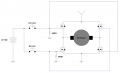
On that assumption, what comes to mind are those small PB switches that you can fit 50 of them in a shirt pocket; small. Using an H Bridge with MOSFETs will do. The size and rating of the FET's will depend on the amperage of the motor. Not drawn on the diagram is a snubber circuit.
1599930992939.png
 

MisterBill2

Joined Jan 23, 2018
27,514
There are a LOT of things the TS has not clearly stated. However, I gathered that he wants the motor to run in one direction when "Holding" one push button - and only for the duration the button is held. Then he wants to be able to run the motor in the other direction, again, when "Holding" the other push button - and only for the duration the button is held.

On that assumption, what comes to mind are those small PB switches that you can fit 50 of them in a shirt pocket; small. Using an H Bridge with MOSFETs will do. The size and rating of the FET's will depend on the amperage of the motor. Not drawn on the diagram is a snubber circuit.

View attachment 217016
The TS explains exactly how it will work back in post #13.
 

Tonyr1084

Joined Sep 24, 2015
9,744
Let say, on pressing one of the buttons, it is running in Clockwise direction and then I stop it by releasing the push button which I pressed for running it and after a minute or two, by pressing another push button it should run in another direction that is Anti-Clockwise.
It's what I assumed; motor runs as long as a button is pressed. Letting go of the button means letting the motor stop on its own. No dynamic braking required. Reversal entails pushing and holding the other button. Like a hoist on the front of an off-road vehicle. One button extends the cable, the other retracts it. It's up to the user to decide when to release the button.

@MisterBill2 and I bumped heads on this one. We both are saying the same thing.

[edit] pressing both forward and reverse buttons at the same time will result in catastrophic failure of the FET's. There's a down side to everything. The only way I can imagine protecting the circuit from that kind of failure is to have one of the two switches wired as SPDT push button rigs where the NC pin is connected to the other switch input. If you need I can draw it that way.
 
Last edited:

MisterBill2

Joined Jan 23, 2018
27,514
It's what I assumed; motor runs as long as a button is pressed. Letting go of the button means letting the motor stop on its own. No dynamic braking required. Reversal entails pushing and holding the other button. Like a hoist on the front of an off-road vehicle. One button extends the cable, the other retracts it. It's up to the user to decide when to release the button.

@MisterBill2 and I bumped heads on this one. We both are saying the same thing.

[edit] pressing both forward and reverse buttons at the same time will result in catastrophic failure of the FET's. There's a down side to everything. The only way I can imagine protecting the circuit from that kind of failure is to have one of the two switches wired as SPDT push button rigs where the NC pin is connected to the other switch input. If you need I can draw it that way.
The disaster mentioned is why I suggested SPDT buttons. And the reason I added the diodes and resistor is to reduce the unintended hard dynamic braking when the button is released with the circuit that I first suggested. The higher current PB switches were available from Digikey, I think that they were CH brand and rated ten amps. They are a snap action type and so should be quite reliable.
 

MaxHeadRoom

Joined Jul 18, 2013
30,659
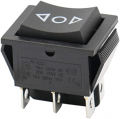
It can also be done with a single switch unit, they come in many shapes and sizes, from the industrial Left-right momentary with return to centre off, there is also the cheaper single switch rocker that does it, used in RV's etc and rated 30a peak.
With this type of switch there is a automatic interlock that prevents simultaneous left and right push.
You guys are making it way too complicated.
Max.
 
Last edited:

MisterBill2

Joined Jan 23, 2018
27,514
It can also be done with a single switch unit, they come in many shapes and sizes, from the industrial Left-right momentary with return to centre off, there is also the cheaper single switch rocker that does it.
With this type of switch there is a automatic interlock that prevents simultaneous left and right push.
You guys are making it way too complicated.
Max.
Certainly it could. BUT the TS did ask for two push buttons, hence my suggestion using two push buttons and no heat sinks and no bias resistors . Nor does it use relays, solid state or otherwise.
 
Last edited:

MaxHeadRoom

Joined Jul 18, 2013
30,659
:rolleyes: :rolleyes: This is essentially two descrete push buttons in one!!
He didn't say they couldn't be integrated!
Also No solid-state or relays!
Max.
 
Last edited:

Thread Starter

Incredible-Bots

Joined Sep 12, 2020
6
@Tonyr1084

Yes, You are absolutely right. But when both push buttons are not pressed then motor should not run in any direction that is, it is OFF condition.
And I don't want to press both push buttons simultaneously but if accidentally they are pressed then there must be something that can save any type of short circuit or damage to the motor and wiring.
Using MOSFET is a nice idea, But can you briefly elaborate how this can be done ?

The specifications of motor are :
RPM - 60
TORQUE - 7.5 Kg-Cm
Operating Voltage - 12
No load current - 800mA
Load Current - upto 9 A (max)

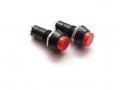
Screenshot_20200913-092632_Amazon.jpgAbove is the image of Push Button that I'm deciding to use.
 

MisterBill2

Joined Jan 23, 2018
27,514
OK,
With those pushbuttona the TS will need to use two of those SPDT automotive style black cube relays, connecting them in the same arrangement as I have described previously.The relays would have the diodes feeding terminals 87A on each relay, while the supply negative will connect to terminals 87 on each. The motor will connect between the two "30" terminals, and the buttons will operate the coil, one on each of the relays.
I need somebody to draw the circuit since the TS does not seem to understand any of my detailed written descriptions.
 

MaxHeadRoom

Joined Jul 18, 2013
30,659
Here is the RV version, quite a few sources.
With these, no danger of pushing two at once!!
IOW automatic interlock.
I don't see why you need Mosfets or relays?
Power supply-switch-motor.
Max.

1600004833794.png
 

MisterBill2

Joined Jan 23, 2018
27,514
Certainly any of those switches, in a spring-return to off configuration, would work quite well. But given the responses from the TS it will be interesting to see what we get back from this suggestion.
 

Thread Starter

Incredible-Bots

Joined Sep 12, 2020
6
OK,
With those pushbuttona the TS will need to use two of those SPDT automotive style black cube relays, connecting them in the same arrangement as I have described previously.The relays would have the diodes feeding terminals 87A on each relay, while the supply negative will connect to terminals 87 on each. The motor will connect between the two "30" terminals, and the buttons will operate the coil, one on each of the relays.
I need somebody to draw the circuit since the TS does not seem to understand any of my detailed written descriptions.

Instead of using two SPDT relays, can we use a single DPDT relay.?
 

MisterBill2

Joined Jan 23, 2018
27,514
Instead of using two SPDT relays, can we use a single DPDT relay.?
NO!!!! A single relay will not provide an off condition, as had been mentioned before. each relay would be operated by one button to drive the motor in one direction, with the motor not driven when no buttons are pressed.
There is a scheme that could use one relay to provide directional control from one button, and run the motor with the other button, but it would be more challenging to use. One button would select direction by operating the relay, the other would switch motor power on.

The ONLY reason that I suggested using relays is that the TS posted pictures of pushbuttons that are not able to handle the current of the motor, nor do they have a normally closed contact. Consider that if the stalled current of the motor is 8 amps then the averaged starting current will be several amps for at least a second. The low-current button switch will not last very long under those conditions. And one more thing is that with the proposed relay implementation, if both buttons are pressed, nothing will happen.
Have we seen any information about the specifications of the button switches the TS has selected? They look like low power rated devices.
 

Tonyr1084

Joined Sep 24, 2015
9,744
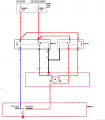
Wife used to own a Hyundai Sonata. Sunroof stopped working properly and needed some attention. Here's a bastardized copy of their control circuit. A lot of it has been removed for clarity, but in the end it's what @MisterBill2 has been saying all along. Only difference is the momentary toggle at the bottom of the drawing. Black is ground, Red is (reverse) and blue is (forward). As for switches, you can use the two switches you want as long as they will carry the current needed for the relays. If both buttons are pressed simultaneously (by accident or deliberate) you achieve dynamic braking instantaneously. I've removed all superfluous markings such as limit switches. Notice they used two SPDT relays. Ground markers are representative of the negative leg of the circuitry. Those double arrows represent the plug and harness assemblies in the automobile and can be ignored.

2007-10-30_220558_sun.png
 

MisterBill2

Joined Jan 23, 2018
27,514
The post #36 is exactly the circuit I was describing. The only difference is the pin numbers on the relays, which do not match those on the black cube relays. Also, the drawing shows a 3 position center off switch in stead of two push buttons. The circuit is not my creation, it has been around for many years, and it works very well.
 

Tonyr1084

Joined Sep 24, 2015
9,744
Replace the "Center Off" push button with two individual push buttons and you have your circuit.

The circuit is a Hyundai circuit. But yes, it's been around a long time. Easier to post than to draw new.
 

MaxHeadRoom

Joined Jul 18, 2013
30,659
The ONLY reason that I suggested using relays is that the TS posted pictures of pushbuttons that are not able to handle the current of the motor, nor do they have a normally closed contact. Consider that if the stalled current of the motor is 8 amps then the averaged starting current will be several amps for at least a second. The low-current button switch will not last very long under those conditions. And one more thing is that with the proposed relay implementation, if both buttons are pressed, nothing will happen.
The RV version I showed also @MrChips requires no relays, no interlocks, and will carry 20A or 35A peak!
(Electrical Interlock:: Prevention of energizing circuit should both P.B. be simultaneously operated)
Max.
 
Top