I have read in many reliable sites that high inrush currents are avoided if you switch at zero crossing. But this App Note states the opposite. Am I misinterpreting something?
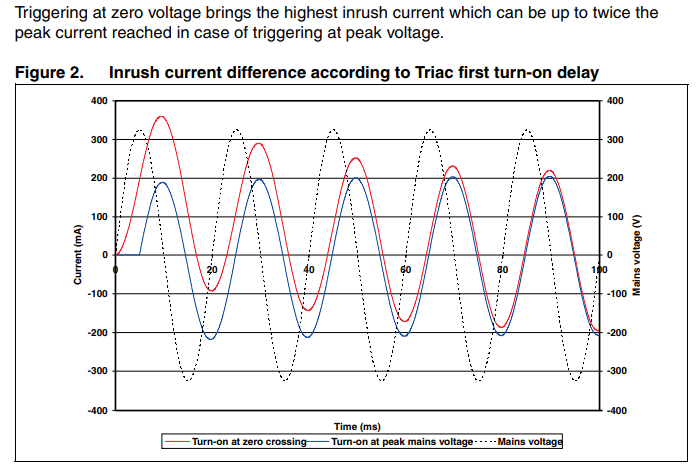
It depends on the type of load, such as resistive or inductive. But triggering a TRIAC at zero crossing minimizes EMI noise.I have read in many reliable sites that high inrush currents are avoided if you switch at zero crossing. But this App Note states the opposite. Am I misinterpreting something?
![]()
Hey! Thanks for posting that. I too am learning something new out of this thread.Thank you! I'm clear now. That's why I just read that zero crossing switches are not recommended for large inductive loads as also stated in this App Note. After all, I just mixed the loads, that's why my confusion.
Yeah, I'm using one of those at the input of the bridge rectifier for limiting the inrush into a bulk capacitor at startup. It works well.Hey! Thanks for posting that. I too am learning something new out of this thread.
As I side note, I strongly suggest you take a look at inrush current suppressors. Those devices present a certain amount of resistance at startup, but then almost go down to zero when the load stabilizes.
Here's an example of what I'm saying.
| Thread starter | Similar threads | Forum | Replies | Date |
|---|---|---|---|---|
|
|
DMM count confusion | Test & Measurement | 6 | |
| F | PCB layout for oscillator - separated GND plane confusion | PCB Layout , EDA & Simulations | 49 | |
| I | BLDC Driver circuit confusion | General Electronics Chat | 5 | |
| C | Fuse Layout confusion | Power Electronics | 4 | |
| M | Differential pair - current flow confusion | Analog & Mixed-Signal Design | 8 |