Facebook
 Google
 GitHub
 Linkedin
The attached file is response of MOS differential pair to input CM variation. In this case, we assume that the circuit is a perfect symmetry.
Then \(I_{D1}=I_{D2}=\dfrac {I_{ss}} {2}\), and hence \(V_{GS1}=V_{GS2}= const\). If \(V_{CM}\) varies, the voltage across current source will vary accordingly.
Now, I want to ask about how current source can change it voltage like this?
Can I consider it as a resistor that have constant current throught it?
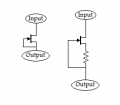
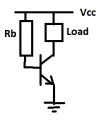
What is the actual internal circuit of current source?
Then \(I_{D1}=I_{D2}=\dfrac {I_{ss}} {2}\), and hence \(V_{GS1}=V_{GS2}= const\). If \(V_{CM}\) varies, the voltage across current source will vary accordingly.
Now, I want to ask about how current source can change it voltage like this?
Can I consider it as a resistor that have constant current throught it?
What is the actual internal circuit of current source?
Attachments
-
 10.5 KB Views: 34